

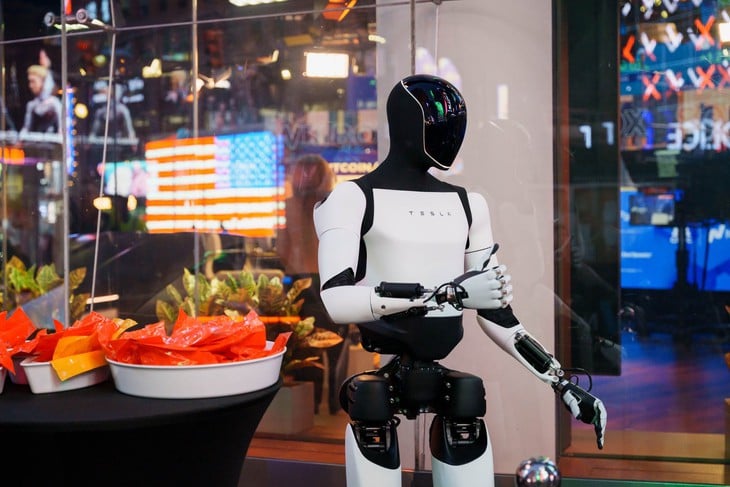
Tesla's Optimus robot - Photo: Tesla
First unveiled at AI Day 2021, Optimus is a humanoid robot that Tesla aims to use to perform dangerous, repetitive, or tedious tasks.
The first version simply walked, but by Gen 2, the robot had been significantly upgraded with refined grasping abilities and flexible movement. Every step Optimus took was filmed and shared by Tesla, allowing the tech community and the public to closely follow each demonstration.
Tesla unveils a smooth-running robot.
Optimus robot runs like a real person - Video : Tesla
In December 2025, Tesla posted a video showing Optimus jogging in a laboratory. The robot coordinated its limbs smoothly and maintained good balance. Tesla estimated Optimus reached a speed of approximately 13.7 km per hour, placing it among the fastest humanoid robots currently available. The video quickly went viral, attracting significant attention from the tech community.
The demonstration version showed that Optimus not only walked but also smoothly coordinated actions such as waving its arms, lifting its legs, and changing direction. This was the first time Tesla showcased a humanoid robot running with a nearly natural gait, far surpassing previous prototypes.
Some argue that Optimus's gait and speed closely resemble natural human movement, demonstrating Tesla's advancements in AI and mechanics.
The technology behind these amazing robots.
Optimus the robot dances gracefully and flexibly - Video: Tesla
Optimus's highly flexible movements are thanks to its multi-jointed hands, allowing the robot to perform complex maneuvers, grasp objects, and fine-tune its movements. Tesla employs motion capture technology, having real people wear sensor suits and perform actions like walking and picking up objects, recording the data for the robot to learn from.
The AI system, combined with sensors, helps Optimus balance itself, position its limbs, and adjust its posture, allowing it to move without direct control.
Tesla has also released videos showing Optimus performing more complex movements such as turning, rhythmic stepping, and even dancing. These moments appeared on Tesla's official channels and were publicly shared by Elon Musk, demonstrating their experimentation with various forms of movement to improve the robot's mobility.
The future of robots in everyday life
Elon Musk has expressed his expectation that Optimus will begin serving in enterprise environments starting in 2026, but has not yet provided a specific commercial roadmap. Based on the capabilities observed in the demo videos, Optimus could potentially aim to assist humans in their daily lives and work in the future.
If these goals are realized, humanoid robotics technology could bring about significant changes in how humans work and live, and alter the division of labor between humans and robots in the context of rapidly increasing automation.
The appearance of Optimus has also led to much discussion about its social impact, job opportunities, and the extent to which humans can adapt to the new technology. Robots could be applied in factories, services, cleaning, or assisting the elderly and disabled, depending on the capabilities of future versions.
Besides its potential to boost the technology industry, the integration of robots into daily life also places clear demands on safety standards, personnel training, and equipment management in real-world environments.
Source: https://tuoitre.vn/tesla-gay-sot-voi-man-khoe-robot-biet-chay-nhu-nguoi-that-20251211172114846.htm


![[Photo] Prime Minister Pham Minh Chinh holds a phone call with the CEO of Russia's Rosatom Corporation.](/_next/image?url=https%3A%2F%2Fvphoto.vietnam.vn%2Fthumb%2F1200x675%2Fvietnam%2Fresource%2FIMAGE%2F2025%2F12%2F11%2F1765464552365_dsc-5295-jpg.webp&w=3840&q=75)


![[Photo] Closing Ceremony of the 10th Session of the 15th National Assembly](/_next/image?url=https%3A%2F%2Fvphoto.vietnam.vn%2Fthumb%2F1200x675%2Fvietnam%2Fresource%2FIMAGE%2F2025%2F12%2F11%2F1765448959967_image-1437-jpg.webp&w=3840&q=75)












































































Comment (0)