

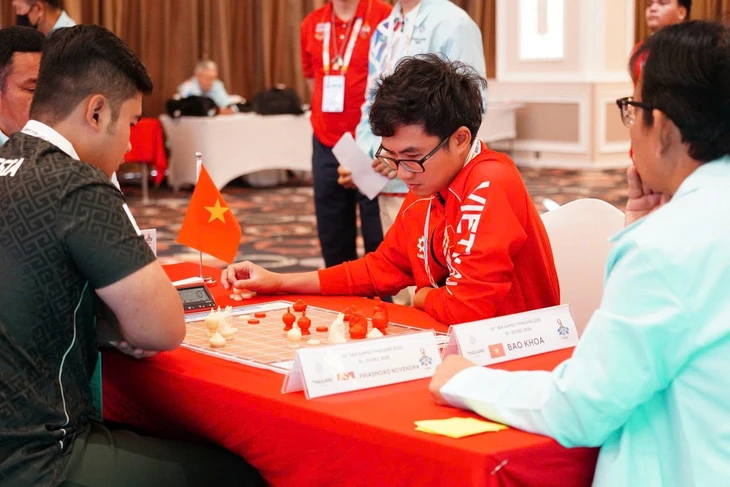
The Vietnamese chess team (in red jerseys) is competing in the Makruk chess event at the 33rd SEA Games - Photo: Vietnam Chess Federation
In the first three matches of the mixed Makruk standard chess qualifying round, the Vietnamese team had an impressive performance, easily defeating their two opponents, Malaysia and Indonesia.
Notably, the Vietnamese players drew against host Thailand – the team that won the gold medal at the 32nd SEA Games. Currently, Vietnam is temporarily leading with 5 points (equal to Thailand but with a better goal difference).
In today's competition, if the Vietnamese chess team achieves good results against the Philippines and Singapore, they have a real chance of winning their first gold medal in the Makruk chess category at the 33rd SEA Games.
This impressive achievement has led fans to ask many interesting questions, such as: What is Makruk chess and how does it differ from regular chess? Why is it that a game only popular in Thailand and Cambodia, and not as well-known in Vietnam as chess, can still be played so well by our players?
What is Makruk flag?
In the world of board games, while Western chess dominates globally, Thailand boasts its own version called Makruk (or Thai Chess).
This game is not just a form of entertainment but also a cultural heritage, attracting players with its apparent simplicity yet possessing incredible strategic depth.

The Makruk chess game has many unique shapes - Photo: Vietnam Chess Federation
Makruk originates from the ancient Indian game of Chaturanga. Like most other Asian chess variations, it has evolved into a unique identity. While using the familiar 8x8 board, Makruk is by no means a simple copy of chess.
The Queen is the weakest piece.
Right from the arrangement of the pieces, there's a slight difference in Makruk chess. Instead of the pawns being placed above the King, Queen, Rook, Bishop, and Knight, the pawns in Makruk are placed one row away from the King, Queen, Rook, and Bishop.
The biggest difference lies in the power of the key pieces. In Makruk, the Queen can only move and capture one square diagonally, in contrast to the Queen's ability to move freely in any direction in chess. Similarly, the Bishop is also limited to moving one square diagonally or one square straight forward.
This limitation completely alters the tactical landscape. In chess, the Queen can quickly make a difference. In Makruk, the strategic roles of the Rook and Knight become far more important in the early and middle stages of the game.
"Makruk requires patience. No single strong opening move can decide the game immediately. Players must focus on building their position and gradually pressuring their opponent," shared a professional Makruk player.
Characteristics of the Makruk flag
Another feature that makes Makruk tense is the move counting rule. If a player only has their King and no Pawns left to promote, they have a maximum of 64 moves to checkmate their opponent. If unsuccessful, the game ends in a draw.
This rule forces players to be able to finish the game effectively, preventing endlessly long games or repeated draws.
For centuries, Makruk has been a popular form of entertainment at sidewalk cafes, markets, and traditional festivals in Thailand.
Recently, the game has taken a major step forward with the inclusion of its related version, Ouk Chatrang (Snail Chess), as an official game at the SEA Games. This has helped Makruk and its variations gain attention from the international chess community.
At 9:00 AM on December 12th, matches 4 and 5 of the mixed Makruk standard chess qualifying round will continue between the Vietnamese team and the teams from the Philippines and Singapore.
Source: https://tuoitre.vn/viet-nam-sang-cua-gianh-huy-chuong-vang-mon-co-moi-tai-sea-games-33-2025121008592129.htm


![[Photo] Prime Minister Pham Minh Chinh holds a phone call with the CEO of Russia's Rosatom Corporation.](/_next/image?url=https%3A%2F%2Fvphoto.vietnam.vn%2Fthumb%2F1200x675%2Fvietnam%2Fresource%2FIMAGE%2F2025%2F12%2F11%2F1765464552365_dsc-5295-jpg.webp&w=3840&q=75)

























































Comment (0)