

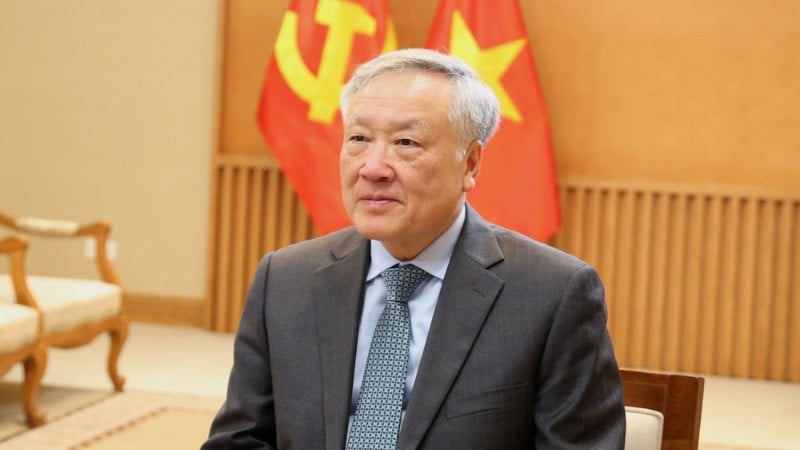
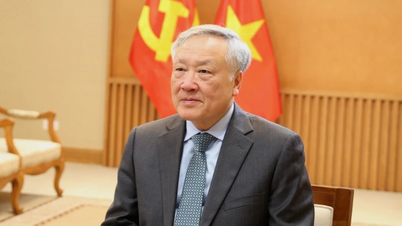
Comrade Nguyen Hoa Binh , Member of the Political Bureau, Standing Deputy Secretary of the Party Committee, Standing Deputy Prime Minister of the Government. (Photo: VGP/Nguyen Hoang)
The Government's Electronic Information Portal had a frank exchange with Comrade Nguyen Hoa Binh, Member of the Politburo , Standing Deputy Secretary of the Party Committee, and Standing Deputy Prime Minister. Through the lens of an insider, the dry numbers suddenly become alive, containing within them a strategic mindset, the courage to look directly at the truth, and above all, a heart for the people and the nation.
Mr. Deputy Prime Minister , looking back at the term that is about to end, public opinion assesses that one of the most outstanding achievements of the 13th Party Congress term was the successful implementation of the organizational streamlining revolution throughout the entire political system. Could you summarize the outstanding results after nearly a year of operation under the new organizational model?
Deputy Prime Minister Nguyen Hoa Binh: As journalists and public opinion have assessed, implementing Resolution 18 of the Central Committee has truly led to a revolution in organization. People call this the "reorganization of the country." I believe that term is very figurative and accurate. This is not just a mechanical integration of administrative units, but a true revolution with many unprecedented goals, marking a new historical period and laying a solid foundation for a prosperous era of national development.
I have had the opportunity to speak with many international leaders and experts, and they all acknowledge that not every country can carry out this revolution, and in fact, not many countries have succeeded. After nearly a year of operation, despite the initial difficulties of the "uneven furrows," we can affirm the following 10 major achievements :
Firstly, it has created a broad space for economic development. The reorganization of administrative units has maximized the strengths of each economic region. We have created large-scale cities, such as Ho Chi Minh City – a megacity with an economic scale comparable to many major cities worldwide, capable of competing on an international level. Many localities that previously faced difficulties due to fragmented terrain, such as the Central Highlands, now have coastal areas after reorganization, creating a connection between the marine and mountainous economies. The first and most important result is the harmonious combination of the advantages of the economic regions: the plains have mountains, the marine economy has forests, thus optimizing and maximizing the strengths and development space of the country.
Secondly, we must drastically cut down on unreasonable intermediaries. We have resolutely eliminated the layers of intermediaries that have existed for many years. In reality, many departments, bureaus, sub-bureaus, general departments, and even district-level agencies are essentially intermediaries – places where the capacity for policy-making is insufficient, and direct service to the people is inadequate. Therefore, reduction is essential. In fact, we have recently reduced 46% of provincial-level administrative units (29 provinces), 100% of district-level administrative units (696 units), 66.9% of commune-level administrative units (6,714 units), all 30/30 general departments, and more than 1,000 departments and bureaus, and over 4,400 sub-bureaus at the same level, making the system operate more smoothly.
We have resolutely eliminated the intermediate layers that have existed for many years. In reality, many departments, bureaus, sub-bureaus, general departments, and even district-level agencies are essentially intermediary points – where the capacity for policy-making is insufficient, and direct service to the people is not effective.
Thirdly, the political system is organized scientifically, streamlined, effective, and efficient. This revolution is not only taking place within the Government but encompasses the entire political system, from the Party, the National Assembly, the armed forces to the Fatherland Front. Agencies and units with similar functions and tasks have been merged to streamline operations and improve efficiency. For example, the Foreign Affairs Committee and the Ministry of Foreign Affairs, or the Mass Mobilization Committee and the Propaganda Department – where the functions of propaganda, mobilization, and gathering the people overlap, we have reorganized them scientifically to avoid duplication and maximize resources.
Fourth, drastically reducing the workforce while improving its quality is a goal we have strived for over many terms, but progress has been slow. Now, we have achieved breakthrough results. Through this restructuring, the entire system, from the central to local levels, has reduced approximately 145,000 personnel. This creates a valuable opportunity to refine the workforce; address appropriate policies; and encourage those with limited health, capabilities, or advanced age to retire. This also represents a meaningful generational transition, as the older generation is willing to step aside to make room and opportunities for development for young, talented, formally trained cadres to contribute and shoulder the responsibility of national development in the new era.
Fifth, we have saved significant budgetary resources to invest in social welfare. For many years, we wanted to reform the salary system but were hampered by the cumbersome bureaucracy and large workforce. Implementing Resolution 18 has streamlined the system, estimated to save approximately 39,000 billion VND in recurrent expenditures annually. These resources have been mobilized for social welfare, providing better care for the people. Immediately after downsizing the workforce, the Politburo decided to use these resources, combined with other state budget resources such as increased revenue and expenditure savings, to waive tuition fees, build schools in border areas, and improve healthcare capacity. Total spending on social welfare during the past term has reached over 1 trillion VND, demonstrating the superiority of this policy.
For many years, we have wanted to reform the salary system, but we were hampered by the cumbersome bureaucracy and large workforce. Implementing Resolution 18 has streamlined the system, estimated to save approximately 39,000 billion VND in recurrent expenditures annually. This resource has been mobilized for social welfare, providing better care for the people. Immediately after downsizing the workforce, the Politburo decided to use this resource, combined with other resources from the state budget such as increased revenue and expenditure savings, to waive tuition fees, build schools in border areas, and improve healthcare capacity.
Sixth, building a government closer to the people and serving them better is also a noble goal of the organizational revolution. For the first time, at the grassroots level (communes and wards), we have organized administrative centers with modern equipment and high-tech applications. Previously, the district level was far away, and the commune level had limited capacity. Now, we have brought professional staff to the communes, setting higher demands on local governance and public service. As a result, the service capacity of the grassroots government has been significantly improved, better meeting the needs of the people.
Seventh, creating the necessary impetus to promote digital transformation. Reorganizing the administrative apparatus is a powerful boost for digital transformation. To better serve the people and build an administrative system independent of geographical boundaries, operating 24/7, the only way is to digitize. This is a condition that "forces" all levels of government, from central to local, to decisively implement digital transformation to improve the efficiency of serving the people and adapt to the new governance model.
Eighth, strengthen national unity. In the new administrative unit, we combine lowland and highland areas, coastal and delta regions. This arrangement creates conditions for economically strong regions to share resources and support more disadvantaged regions. The responsibility of the Party organization and local government is to narrow the development gap, thereby consolidating and strengthening national unity even more firmly.
Ninth, strengthening national defense and security capabilities. Deploying regular police officers to communes helps to accurately assess the situation, resolve conflicts at the grassroots level, and protect the peaceful lives of the people. Simultaneously, reorganizing the military forces according to new administrative units also contributes to increasing national defense potential, enhancing defensive capabilities, and firmly protecting national sovereignty.
Tenth, enhance national competitiveness. Overall, as each commune and province strengthens with a larger, more open economy and mutual support, it will create a combined strength for the entire economy. The synergy of strength from localities after restructuring is the foundation for enhancing the nation's position and competitiveness in the international arena.
Of course, "every beginning is difficult," and the early days of operation inevitably involved some setbacks and shortcomings. But looking at the overall trend of improvement and the increasing satisfaction index of the people, we have reason to believe in the future. This is the motivation to continue striving, overcoming challenges, and making the system operate more smoothly and efficiently for the goal of serving the people and developing the country.

On June 30, 2025, Deputy Prime Minister Nguyen Hoa Binh visited and worked with Duc Trong commune (Lam Dong province) on the organization and operation of the Public Administrative Service Center.
The "reorganization of the country" revolution was a very difficult task. However, this time it was carried out from the central government to the local level in a short period of time. To solve this difficult, sensitive, and unprecedented problem in such a short time, how did we overcome our own limitations? And what lessons can be learned?
Deputy Prime Minister Nguyen Hoa Binh: This is a good question, touching on our most pressing concerns. This success did not come naturally; it was achieved through hard work, dedication, and even the sacrifice of personal interests. From this vivid and arduous experience, 10 major lessons have been learned, which will be useful not only for implementing this policy but also many others.
Firstly, we must have strategic thinking and a forward-looking vision. To carry out a revolution of this magnitude requires superior vision and thinking; we must have the courage to discard the old, long-standing models. In reality, old models, while once effective, have revealed shortcomings in the new era. Therefore, a comprehensive, groundbreaking, and long-term governing mindset is necessary for our success.
Secondly, the interests of the country and the people must be placed above all else. When formulating major policies, this is the supreme principle. This lesson, though not new, is extremely meaningful in this context. Everyone has feelings for their homeland, everyone wants their homeland to become a central urban area, and everyone wants to retain the names of their communes, districts, and provinces. But if we do not prioritize the greater good, if we do not see the common good of the country, we cannot succeed. We must make serving the people the central focus and the benchmark for success in order to organize a government apparatus that is truly close to and serves the people, as we have today.
Put the interests of the country and the people first. When formulating major policies, this is the supreme principle. This lesson, though not new, is extremely meaningful in this context. Everyone has feelings for their homeland, everyone wants their homeland to become a central urban area, and everyone wants to keep the names of their commune, district, and province. But if we don't put the bigger picture first, if we don't see the common good of the country, we cannot succeed. We must make serving the people the central focus and the benchmark for success in order to organize a government apparatus that is truly close to and serves the people, as we have today.
Thirdly, we must adhere closely to reality, frankly confront our limitations, and bravely overcome them. Our organizational structure has existed for 70-80 years and has been effective in the past. However, entering a new phase, many shortcomings have become apparent. For example, there are tasks with 2-3 agencies sharing the same functions and responsibilities; many organizational structures are essentially intermediaries, creating additional layers of bureaucracy. Numerous general departments, departments, divisions, and offices make the system cumbersome. Therefore, the lesson is that we must boldly identify and confront these challenges and limitations, and courageously eliminate them in order to succeed. If we continue to be hesitant, evasive, and focused on narrow self-interest, it will be very difficult to overcome the weaknesses that have persisted for many years.
Fourth, there must be very high political determination and decisive action. To carry out a revolution that not every country can achieve, high determination must begin with the highest power organs: the Central Committee, the Politburo, the National Assembly, the Government... Action must be truly decisive; hesitation, deliberation, and calculation will lead to missed opportunities. During the peak period, the Politburo and the Government met weekly to review work and urge implementation. This approach was a new one: working from the top down, the Central Committee setting an example for those below to follow, and the entire political system getting involved. This has overcome the long-standing limitation of "correct policies but weak implementation."
Fifth, we must promote the strength of national unity and create widespread consensus. In the face of difficult and sensitive tasks, the greatest lesson is to maintain unity within the Party, the political system, and the people. We must share responsibility. In reality, this policy has received overwhelming support from the people since its inception. It can be said that the revolution has affirmed the people's trust in the Party; the people have great confidence and wholeheartedly support it.
Sixth, absolutely adhere to the Party's leadership and discipline. Once a correct policy is established, it must be strictly implemented, speaking and acting in accordance with the Resolution and the law. Leaders often say, "One command, all respond." If each place acts independently, not moving in the same direction, failure will follow. Therefore, adhering to Party discipline in ensuring progress and completing tasks on time is a hard-won lesson.
Once a sound policy is established, it must be strictly implemented, with words and actions in accordance with the Resolution and the law. Leaders often say, "One command, all respond." If each place acts independently, not moving in the same direction, it will fail.
Seventh, do a good job in political ideology and communication. This revolution affects people, every official, civil servant, and citizen. The merger changes village and commune names, makes commutes longer, and directly impacts people's lives. Therefore, ideological work must come first to create understanding and sharing from within the Party to the people. Cadres and Party members must understand that working is a duty, and retiring to streamline the system is also a duty. Good ideological work is essential to creating consensus. In carrying out this task, the press and media have played a very important role.
Eighth, there must be a policy of "attracting and retaining talented individuals." Streamlining the administrative apparatus, despite the large number of personnel, requires that while the size of the apparatus decreases, the capacity and quality of the workforce must increase. Therefore, alongside downsizing the workforce, there must be a policy to attract and select talented individuals with a spirit of dedication. Ultimately, people remain the decisive factor in the effectiveness of the government apparatus. As the ancients taught, "Talented individuals are the lifeblood of the nation," to have talented individuals, we must revitalize education and have policies to value and retain truly talented people.
Ninth, perfecting institutions and laws must precede and pave the way. The Party's policies must be immediately institutionalized through legislation. The National Assembly has amended the Constitution, the Laws on the Organization of the National Assembly, the Government, and local governments... The Government has drafted a series of decrees. This legal system creates a solid legal framework for the revolution to take place within the framework of a rule of law state. Institutional progress also helps in allocating resources for implementation. Although the initial operation under the new system may not be perfect immediately, we accept that reality and continuously improve it to better suit practical realities.
Tenth, invest resources appropriately and strategically. Large-scale projects like this require significant resources, but it's crucial to know where to invest. The lesson is to prioritize, investing scientifically and systematically in clearly defined areas. One of those priorities is investing in digital infrastructure to build a digital society and a digital government. Thanks to this targeted investment, we have achieved impressive results: the majority of people's administrative procedures have been handled digitally. This is a major step forward in building an e-government and better serving the people.

On June 30, 2025, Deputy Prime Minister Nguyen Hoa Binh visited and worked with Duc Trong commune (Lam Dong province) on the organization and operation of the Public Administrative Service Center.
The 13th National Congress of the Communist Party of Vietnam faced numerous difficulties and challenges, yet we overcame them and achieved unprecedented successes. These results were made possible thanks to the decisive and wise leadership and guidance of the Party. As a member of the Politburo, could the Standing Deputy Prime Minister please explain how the Party's leading role was demonstrated in creating consensus and spreading that spirit of determination throughout the entire political system and society to achieve this success?
Deputy Prime Minister Nguyen Hoa Binh: I completely agree and deeply share this assessment. As someone directly involved in the decision-making of the Central Committee and the Politburo during this turbulent term, I deeply understand the truth that: All victories of the Vietnamese revolution, from the glorious victories in history to the breakthrough achievements of today, originate from the wise and skillful leadership of the Party.
The Party's "leading role" during this historical period is clearly demonstrated in three core aspects:
Firstly, regarding thinking and direction: The Party has demonstrated a superior strategic vision, reflecting the stature of the times. To prepare the country for a "new era"—an era of national progress—the Party has not merely addressed immediate issues. The Party has made significant shifts in its thinking, approaching the advanced levels of governance in the world. The recent decision to implement a revolution in the organizational structure is the clearest evidence of this. It is the culmination of innovative thinking, daring to confront the truth, and courageously eliminating outdated and backward practices to build a prosperous future. Without the Party's foresight and unwavering political resolve, we could hardly have formulated such historically significant and groundbreaking policies.
The Party has demonstrated a superior strategic vision, befitting the times. To prepare the country for a "new era"—an era of national resurgence—the Party has not merely addressed immediate problems. It has made significant shifts in its thinking, approaching the advanced levels of governance seen worldwide. The recent decision to implement a revolution in the organizational structure is the clearest evidence of this.
Secondly, regarding the implementation methods and new elements: This is a special highlight of this term. The Party's pivotal role is not only in issuing wise resolutions, but also in decisive action, "matching words with deeds." We have witnessed a fundamental change in approach: the Central Committee sets the example, and all levels follow; ensuring thoroughness at every step. The widespread social impact and consensus achieved recently stem from the decisiveness and exemplary leadership of the Central Committee, the Politburo, and the Secretariat. In particular, we cannot fail to mention the role of General Secretary To Lam – the "chief architect" who has strongly inspired, guided, and maintained the flame of determination for the entire system.
Thirdly, it requires unwavering resolve. Faced with difficulties and challenges , the current context demands that the Party's leading role be affirmed more strongly than ever before. We are not only under pressure to achieve high double-digit growth to realize the aspiration of a "wealthy people, a strong nation," leading the country to prosperous and powerful development, and ensuring the people's well-being and happiness; but we also constantly and continuously confront unexpected situations in a volatile and unpredictable world. These include extreme natural disasters, unprecedented epidemics, and rapid and unpredictable global political changes.
All these factors directly impact, daily and hourly, every aspect of the country's political and social life, creating an urgent need for the Party's leadership to be truly steadfast. The Party's calmness, wisdom, and decisiveness are the foundation of unwavering confidence, helping to unite the people and transform challenges into opportunities. The Party is truly the capable helmsman, the decisive core of all victories, guiding the country through obstacles and challenges to confidently move forward and soar into a new era.
Thank you very much, Mr. Deputy Prime Minister, for this meaningful conversation!
Nguyen Hoang (compiled)
baochinhphu.vn
Source: https://nhandan.vn/sap-xep-lai-giang-son-cuoc-cach-mang-tu-y-dang-den-long-dan-va-khat-vong-ve-ky-nguyen-vuon-minh-post929716.html



![[Photo] Prime Minister Pham Minh Chinh holds a phone call with the CEO of Russia's Rosatom Corporation.](/_next/image?url=https%3A%2F%2Fvphoto.vietnam.vn%2Fthumb%2F1200x675%2Fvietnam%2Fresource%2FIMAGE%2F2025%2F12%2F11%2F1765464552365_dsc-5295-jpg.webp&w=3840&q=75)

![[Photo] Closing Ceremony of the 10th Session of the 15th National Assembly](/_next/image?url=https%3A%2F%2Fvphoto.vietnam.vn%2Fthumb%2F1200x675%2Fvietnam%2Fresource%2FIMAGE%2F2025%2F12%2F11%2F1765448959967_image-1437-jpg.webp&w=3840&q=75)





























































Comment (0)