


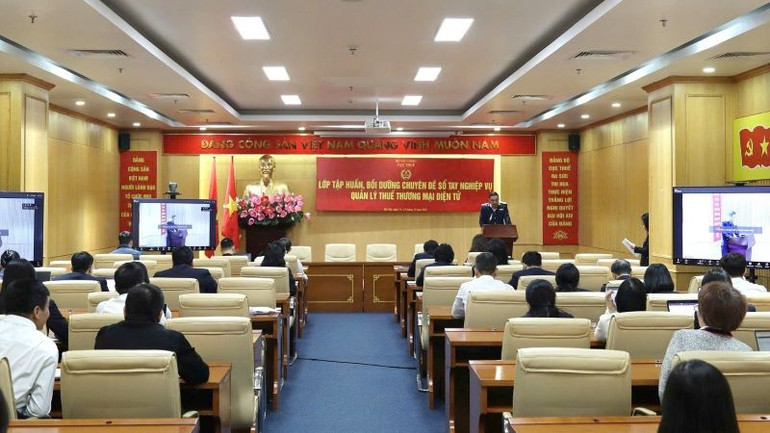
In his opening remarks at the conference, Mr. Cap Quy Phuc, Head of the E-commerce Tax Department, stated that in recent years, e-commerce has developed strongly, becoming one of the fastest-growing sectors of the digital economy . This places an urgent demand on the tax sector to innovate management methods, improve operational procedures, apply technology, and enhance the capacity of its staff.
"I suggest that officials and civil servants at all levels of the tax agency should demonstrate a sense of responsibility, focus on listening, and proactively exchange and share practical difficulties and obstacles so that the instructors and organizers can work together to resolve them, thereby improving the quality of the training session."
(Head of the E-commerce Tax Department - Mr. Cap Quy Phuc)
Furthermore, the Head of the E-commerce Tax Department stated that in the field of e-commerce, unifying methods, standardizing processes, and supporting officials to perform their duties more effectively is absolutely essential. Accordingly, the Tax Department has circulated the E-commerce Tax Management Handbook. This document provides detailed guidance for taxpayers on declaring and paying taxes for domestic and foreign e-commerce platforms that deduct and pay taxes on behalf of households and individuals; and for households and individuals engaged in e-commerce who declare and pay taxes.
The "Handbook on Tax Management for E-commerce" includes detailed instructions on topics such as: (i) Organization of tax deduction and payment; (ii) Subjects of deduction, types of taxes to be deducted, determination of deductible revenue, tax rates, timing of deduction, methods of declaring deductions (documents, initial declaration, supplementary declaration); (iii) Methods of submitting tax declaration documents, submission location and deadline; issuance of deduction certificates…
Based on the training content, civil servants will be fully equipped with knowledge on how to manage e-commerce taxes, understand the tax declaration and payment obligations of taxpayers operating in the e-commerce sector, and thereby provide the best guidance and support to taxpayers; thereby contributing to improving the efficiency of tax management for e-commerce activities, meeting the requirements of reform, digital transformation, and budget revenue collection in the new situation.
4 volumes of the Handbook on Tax Management for E-commerce
(1) Handbook for organizing domestic e-commerce platforms, digital platforms and other organizations with digital economic activities to carry out deduction and payment on behalf of households and individuals;
(2) Handbook for organizing and managing e-commerce platforms and digital platforms abroad to carry out deductions and payments on behalf of others;
(3) Handbook for households and individuals residing and doing business on e-commerce platforms and digital platforms without payment functions to declare and pay taxes
(4) Handbook for non-resident households and individuals doing business on e-commerce platforms and digital platforms without payment functions for tax declaration and payment.
Source: https://nhandan.vn/tap-huan-chuyen-de-so-tay-nghiep-vu-quan-ly-thue-thuong-mai-dien-tu-post929730.html


![[Photo] Prime Minister Pham Minh Chinh holds a phone call with the CEO of Russia's Rosatom Corporation.](/_next/image?url=https%3A%2F%2Fvphoto.vietnam.vn%2Fthumb%2F1200x675%2Fvietnam%2Fresource%2FIMAGE%2F2025%2F12%2F11%2F1765464552365_dsc-5295-jpg.webp&w=3840&q=75)







































































Comment (0)