

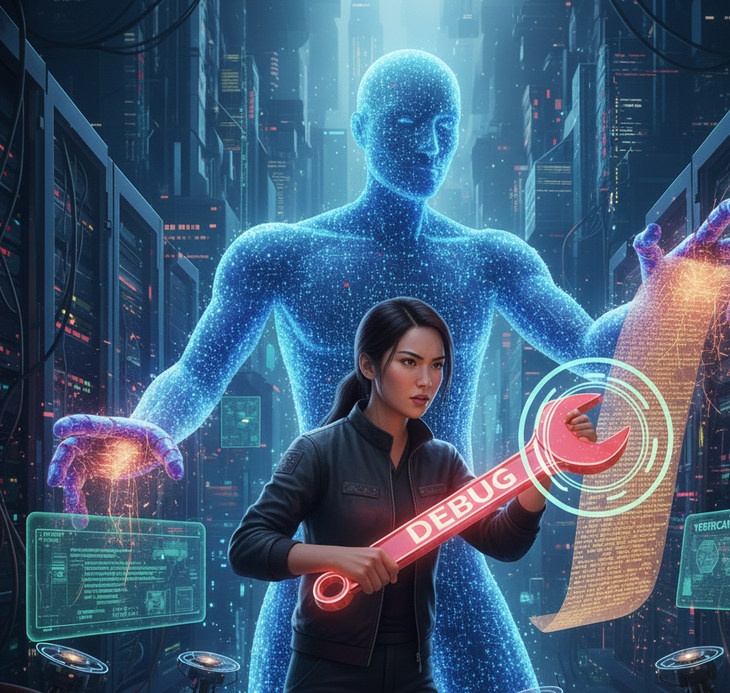
AI transforms ideas into source code quickly, but it's not yet refined.
The latest research from CodeRabbit (a popular source code review tool) indicates that AI-generated code has a 1.7 times higher error rate than code created by humans. We are facing a paradox: the faster and more convenient something is, the greater the risk.
The paradox of convenience: AI source code is riddled with errors.
According to data from CodeRabbit, an average AI-generated code change request contains 10.83 errors, compared to only 6.45 for humans. Notably, these errors are not just minor; AI tends to generate serious logical errors 1.4 times more often than human programmers.
The core reason lies in the fact that AI is essentially a "predictive machine." It's good at guessing what the next letter will be based on massive amounts of data from the internet, but it's completely clueless about the real-world context of a complex system.
AI can write polished, syntactically correct code (with 1.76 times fewer spelling errors than humans), but when put into operation, that code can become a "saboteur" due to conflicts with other components in the system.
The Achilles' heel is security.
What worries experts most is the security vulnerability. AI frequently repeats classic mistakes such as handling passwords insecurely, exposing sensitive information, or facilitating SQL injection attacks.
It's like a construction worker with superhuman speed who forgot to install the door lock. Reports indicate that AI security vulnerabilities are 1.57 times more likely to fail than humans. Microsoft's need to patch a record 1,100 vulnerabilities in 2025 is a wake-up call.
As the amount of source code increases dramatically thanks to AI, the pressure on security engineers also increases exponentially. The cost of patching vulnerabilities after a product has launched is always many times higher than getting it right from the start.
From "coder" to "moderator"
While the 1.7 times error rate might seem alarming, it doesn't mean we should turn our backs on AI. The bright spot is that AI is 1.32 times better at writing test scripts than humans.
The role of modern programmers is shifting dramatically. They are no longer diligent "typers," but are gradually becoming architects and evaluators. The most important skill in 2025 is not memorizing programming languages, but critical thinking to detect seemingly naive but dangerous flaws in AI.
We need to establish rigorous "checkpoints," combining human intuition with the automation of error-checking tools. Ultimately, AI is only truly effective when it's in the hands of programmers who know how to question and dare to reject erroneous results.
The future of programming doesn't lie in who writes code faster, but in who manages the supporting tools better.
Source: https://tuoitre.vn/code-do-ai-viet-nhanh-hon-nhung-loi-nhieu-gap-1-7-lan-con-nguoi-20251222173455961.htm

































































































Comment (0)