

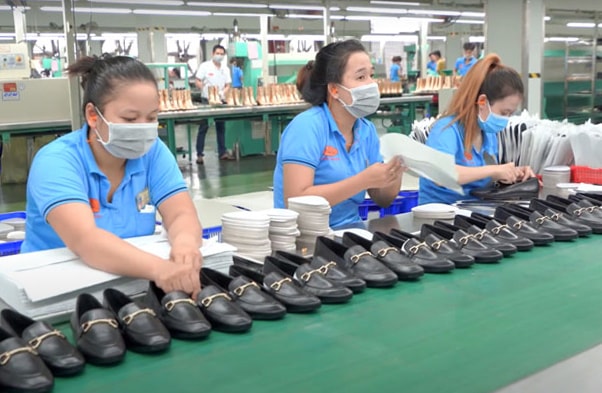
Exports are showing positive growth.
2025 is considered a "trial by fire" for the Vietnamese footwear business community. Despite the fact that purchasing power in key markets such as the United States and the European Union (EU) has not fully recovered, coupled with pressure from green standards and traceability requirements, the industry has maintained stable growth thanks to its flexible adaptability and full utilization of free trade agreements (FTAs).
According to preliminary statistics from the Customs Department, the total export turnover of the entire leather and footwear industry in 2025 is expected to reach nearly 29 billion USD, an increase of more than 2.5 billion USD compared to 2024. Of this, footwear exports will continue to play a leading role with a turnover of 24.2 billion USD (up 5.8%); handbags, suitcases, and umbrellas will bring in over 4.61 billion USD (up 8.5%).
Notably, imports of machinery and equipment increased by 38%, indicating that businesses are actively reinvesting in technology to prepare for a new production cycle. The industry's trade balance recorded an impressive surplus of $2.48 billion in the last month of the year alone.
Last year, the foreign-invested sector contributed $22.82 billion, accounting for 80% of total export turnover, a 17% increase compared to 2024. However, a positive development is the strong breakthrough of the domestic footwear industry, with a growth rate of up to 29%, reaching $5.84 billion. This figure shows that domestic businesses are gradually moving away from purely processing activities to conquer new market segments.
Regarding export markets, the United States continues to be the largest partner for the footwear industry with a turnover of over $11 billion, followed by the EU with nearly $6.88 billion. Within the EU region alone, the Netherlands and Belgium continue to play the most important role as logistics gateways for Vietnam...
The domestic market is also receiving more attention from businesses. With a current size of approximately $1 billion and a forecast of over $1.5 billion by 2033, the average growth rate is 4.86% per year. Each year, domestic consumption reaches about 155 million pairs of shoes and sandals. Currently, domestic products only account for nearly 40% of the domestic market share, posing challenges regarding distribution channels and brand recognition that Vietnamese businesses need to address soon.
Addressing shortcomings regarding imported raw materials and components.
Despite achieving positive growth figures, the leather and footwear industry still faces an inherent bottleneck: dependence on imported raw materials. According to the Vietnam Leather, Footwear and Handbag Association (Lefaso), the rate of imported raw materials remains at 70-75%. Although the average localization rate has improved to 55%, with items such as sports shoes reaching 70-80% domestic sourcing and canvas shoes almost 100% domestic sourcing, this remains very limited in the high-end segments.
Over the years, footwear businesses have strived to develop supporting industries, but these efforts remain fragmented and lacking in interconnectedness. Currently, China is still the largest supplier of raw materials and components (accounting for approximately 35%), followed by Thailand and Italy. Over-reliance on foreign suppliers makes the footwear industry vulnerable to logistics disruptions or global supply chain breakdowns.
Faced with this challenge, the Chairman of the Board of Directors of TBS Group, and also the Chairman of Lefaso, Nguyen Duc Thuan, emphasized that the strategic solution is to establish a fashion raw materials trading center. This will be the "nucleus" connecting domestic raw material manufacturers with exporters, creating a centralized market to reduce transaction costs and enhance proactiveness.
According to Lefaso's General Secretary Phan Thi Thanh Xuan, the construction of the raw materials trading center is not just an infrastructure project, but a step towards green localization. Accordingly, the center will help diversify the supply of raw materials, promote innovation in design and business models, and optimize the production supply chain. This is a necessary "passport" for Vietnamese businesses to maintain their market share in demanding markets such as the US and the EU.
However, to realize this goal, the footwear industry needs strong support from ministries, departments, and state management agencies. Economic experts suggest that preferential tax and credit policies are needed for businesses investing in high-tech production of premium materials. Simultaneously, administrative procedure reforms tailored to the specifics of the supply chain will help businesses reduce cost burdens and focus on research and development.
By 2026, Vietnam's footwear industry will no longer simply focus on export figures. The inevitable path is to transform from a low-cost outsourcing model to a high-value-added production model, integrating design and controlling raw materials. As the domestic supply chain is strengthened and becomes an ecosystem, Vietnam will not only assert its position as the world's factory but also as a link in the global fashion value chain.
Source: https://hanoimoi.vn/nganh-da-giay-go-nut-that-tu-chu-nguyen-phu-lieu-732057.html

![[Photo] First session of the 14th Congress of the Vietnam Trade Union](https://vphoto.vietnam.vn/thumb/1200x675/vietnam/resource/IMAGE/2026/06/03/1780465947883_ndo_br_img-3852-jpg.webp)



























































![[Video] Sunset at Lap An Lagoon – Where the sun sets over the fishing nets](https://vphoto.vietnam.vn/thumb/1200x675/vietnam/resource/IMAGE/2026/05/31/1780192137701_beach-landscape-sea-water-nature-grass-745871-pxhere-com.jpeg)








































Comment (0)