

 |
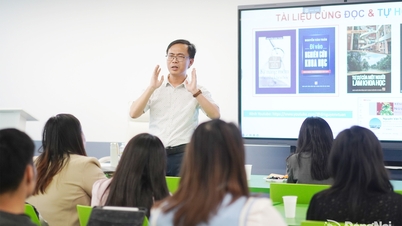
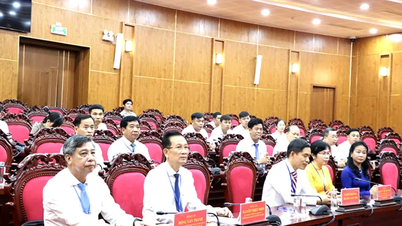
| A view of the seminar "The Future of the Publishing Industry - Opportunities and Challenges." Photo: Thuy Trang |
The speaker at the panel discussion was Ms. Claudia Kaiser, Vice President of the Frankfurt Book Fair. The Frankfurt Book Fair is the world's largest trade book fair, held annually in October at the Messe Frankfurt Exhibition Centre, shaping global publishing trends and attracting thousands of publishers from over 100 countries.
A shift in approach to younger readers.
Regarding the difficulties and challenges facing the publishing industry, speakers and participants in the seminar noted that people today use smartphones and social media too much, leading to less reading of books. This trend is more pronounced in Asia than in Europe and America.
According to Claudia Kaiser, reading is extremely important and should be introduced into schools as soon as possible. Developing a reading culture requires a long-term approach, not just a few short-term campaigns. Claudia Kaiser also stated that today's youth prefer shorter content, so a solution could be to create comic books with fewer words, similar to what Japan is doing, which would make them easier to read. Another example is in Europe, particularly in Germany, where many young adult novels are receiving significant investment in design, visuals, and reading experiences to encourage young people to return to reading. Not only content but also the presentation of books is increasingly important in creating reading interest for the new generation. As a result, young readers are lining up to get autographs from authors.
 |
| Young readers are buying books at Ho Chi Minh City Book Street. |
Concerned about the increasing number of e-books read today, some participants in the seminar questioned: Will e-books replace paper books in the future? If so, what will the future of reading culture be like? Regarding this issue, Ms. Claudia Kaiser stated: Around the 1990s, when e-books first appeared, she and many others "bet" on whether e-books would "take over" paper books. But nothing has happened, and people are still reading paper books. "I understand people's unfounded fears. In the 1990s, we also had similar fears, but they didn't come true. Rarely does any country have e-book sales accounting for 50%. As I mentioned, in Germany there's a trend of young adult novels. The books are beautifully printed. E-books can never match the quality of printed books. For books that require human emotion, e-books are unlikely to replace paper books," Ms. Claudia Kaiser affirmed.
Opportunities and challenges for the global publishing industry.
One topic that received much attention from delegates at the seminar was AI. Currently, AI is developing very rapidly and is gradually participating in many stages of the publishing industry such as: writing books, translating books, summarizing content, and producing automated voiceovers. This presents both opportunities and challenges for the global publishing industry. Accordingly, some issues raised at the seminar included: Is information from AI accurate and reliable? Will the involvement of AI in so many stages of the publishing industry affect jobs in this industry?...
The future of the publishing industry presents many challenges and opportunities. The key is for those working in the publishing industry to share, learn from each other, meet and connect more often to discuss and find common solutions in the current context.
In fact, AI could cause some traditional jobs in the publishing industry to gradually disappear or completely change in the future. For example, translators might not be needed for simple books in the future. Authors might also be affected by the emergence of best-selling books produced by AI. Furthermore, while AI can edit simple books, the role of editors becomes more important for books involving emotions, complex language, etc.
How will people read books in the future? They might wear glasses with text displayed on them, eliminating the need to hold a book. However, according to information shared at the seminar, those who read physical books will have better intellectual and brain development compared to those who read e-books…


































































































Comment (0)