|
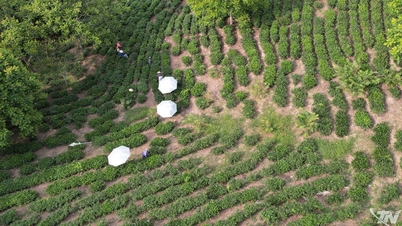
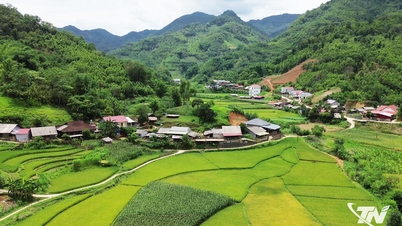
| A corner of Quoc Tuan village, Van Lang commune, Thai Nguyen province. |
The fire never goes out.
"Houses may age with time, pillars may wear down from rain and sun, but the hearth fire of our Tay and Nung ethnic people must never go out," said Mr. Nong Duc Chi, 80 years old, from Quoc Tuan village, Van Lang commune, as he began his story about a beautiful traditional cultural aspect of his people.
The old man leaned away as if to avoid the thin wisp of smoke that drifted lazily up and stung our eyes, then led us back to a realm of nostalgia: "Yes, stilt houses are the 'soul' of our Tay and Nung people. Decades ago, this whole region was covered in vast forests, with countless ancient trees. People would burn the tree stumps until they fell, and only a few branches could be salvaged for building houses. The trunks, so large that it would take several people to encircle them, were consumed by the smoldering fire. Thinking back now, I feel regret."
Living in harmony with the forest, it can sometimes take generations for a family to gather enough wood to build a stilt house as they desire. It's hard work, but it's the traditional architecture passed down from their ancestors for generations.
"The embers from the firewood in the kitchen crackled like sparks," said Mr. Dinh Nhu Phung, from Na Duong village, in Van Lang commune, the same village as Mr. Chi, with a sense of satisfaction. "When we were young, my wife and I spent nine years raising pigs, cultivating rice, and growing corn to save up enough money to buy meals and drinks to invite woodcutters from the lowlands to the forest."
Present at the meeting, Mrs. Dinh Thi Que, his wife, added: "From 1982 to 1990, by saving a little each year, my husband and I managed to build a sturdy stilt house with 45 square pillars, walls made of wooden planks, and a tiled roof."
 |
| Around the fireplace, the elderly tell their children and grandchildren about the history and traditional culture of their people. |
Time passed quickly, and the rain and sun caused the house to deteriorate. In 2024, Mr. and Mrs. Phung demolished the old stilt house, reusing the good pillars and beams to rebuild a new stilt house with 36 pillars. He proudly said: "Seeing me demolish the stilt house, many 'tycoons' from the provincial center came to make deals: If you leave the pillars for them, they will build a villa to compensate. But I didn't dare trade my ethnic tradition for modernity."
Following the rhythmic sounds of chiseling and hammering, I arrived at a stilt house under construction nearby. The homeowner, Mr. Dinh Duy Thang, cheerfully said: "I haven't traveled much, but I know that in the Coc Ray hamlet of Na Duong village, out of 14 households, 12 live in stilt houses. Basically, all the households in the hamlet build stilt houses according to the same design, consisting of three main rooms and two side rooms. The columns and beams are made of ironwood, the purlins are made of square galvanized pipes, and the staircase has concrete steps, but this doesn't detract from the aesthetics of the traditional stilt house. My family will move into the new house for the Lunar New Year of the Horse 2026."



"Settling down and establishing a livelihood." With secure housing, guaranteed health, and stable morale, people can confidently work and produce, strive for legitimate wealth, and participate in local emulation movements.
Furthermore, traditional stilt houses always exude a warmth of human connection. Around the stilt house fire, after a day's work, the whole family gathers to share stories and chat, fostering closeness; neighbors also come together to discuss matters around the stilt house fire.
 |
| Many families are using reinforced concrete instead of wood for the steps leading up to their houses. |
Preserving traditional customs
At the Vietnam Ethnic Culture and Tourism Village (Dong Mo, Son Tay, Hanoi), the Tay and Nung ethnic groups from Thai Nguyen province were chosen by the Ministry of Culture, Sports and Tourism to represent the Tay and Nung people nationwide by having two traditional stilt houses built. Inside, generations of artisans take turns keeping the tradition alive, telling visitors stories of their villages, about the land and people of their respective regions, and the exquisite cultural beauty of their ethnic group.
Returning to the gateway region to Hanoi, Thai Nguyen province has 92 communes and wards, nearly 1.8 million inhabitants, and 39 ethnic groups. Notably, among the 8 most populous ethnic groups, the Tay and Nung are two. Therefore, Tay and Nung cultures are almost representative of the region.
Mr. Ma Dinh Soan, from Ban Quyen village, Phu Dinh commune, proudly stated: "Out of 36 households in the village, 20 live in traditional stilt houses. Most households living in stilt houses have received financial support from the government for repairs, upgrades, and preservation."
In modern times, many stilt houses are built with reinforced concrete, but still retain the traditional stilt house architecture. All the concrete pillars are painted to resemble wood and… look as beautiful as wood.
 |
| In modern times, stilt houses are still erected as a symbol of the traditional architectural culture of the ethnic minorities in the highlands. |
Standing in front of her family's traditional stilt house, Mrs. Hoang Thi Hau, from Khuon Tat hamlet, Phu Dinh commune, excitedly said: "The forest has run out of valuable timber trees, so we built our stilt house using iron, steel, and cement."
Mr. Ma Dinh Sung, from Da Bay hamlet, Binh Yen commune, confidently stated: "In recent years, with economic development and stable living conditions, many households have been able to build stilt houses made of reinforced concrete. These modern stilt houses feature a traditional fireplace in a separate corner and enclosed outbuildings."


Spanning from the northern to the southern communes of our province, we encountered stilt houses with reinforced concrete structures, and many others made of steel frames with corrugated iron roofs, but still retaining the traditional stilt house design of the Tay and Nung ethnic groups. These stilt houses were built against the mountains, with their doors facing the rice valleys.
In a conversation with us, Mr. Hoang Van Toong, a Nung ethnic minority resident of Tan Do hamlet, Van Lang commune, said: "The hamlet has 123 houses, of which nearly 70 are stilt houses. Many of these houses are over a hundred years old, with pillars made of ironwood and teak, and tiled roofs. These houses are like historical witnesses, observing the cultural and spiritual life of the people of Tan Do since the village was founded."
Even as time passes and old stilt houses are dismantled and replaced with new ones, the materials don't matter. Within these stilt houses reside the refined cultural traditions of the Tay and Nung ethnic groups, preserved and passed down through generations.
And by the fireplace in the stilt house, the village elders would tell their grandchildren stories about the founding of the village; about participating in the revolution to drive out the invaders; about building a new rural area; and about cultural lifestyles in the digital age.
Source: https://baothainguyen.vn/van-hoa/202601/ngay-xuan-am-bep-lua-san-f403b10/