

Around 11 a.m., in the rubber plantations of Tánh Linh district, it's easy to spot many people making a living by collecting rubber latex – also known as rubber sap.
They diligently search for leftover rubber sap in cups, on the tapping surfaces, and under the rubber trees, bringing it back to sell for money to support their lives. Most of those who collect rubber sap are women, and they all share a common background of poverty.
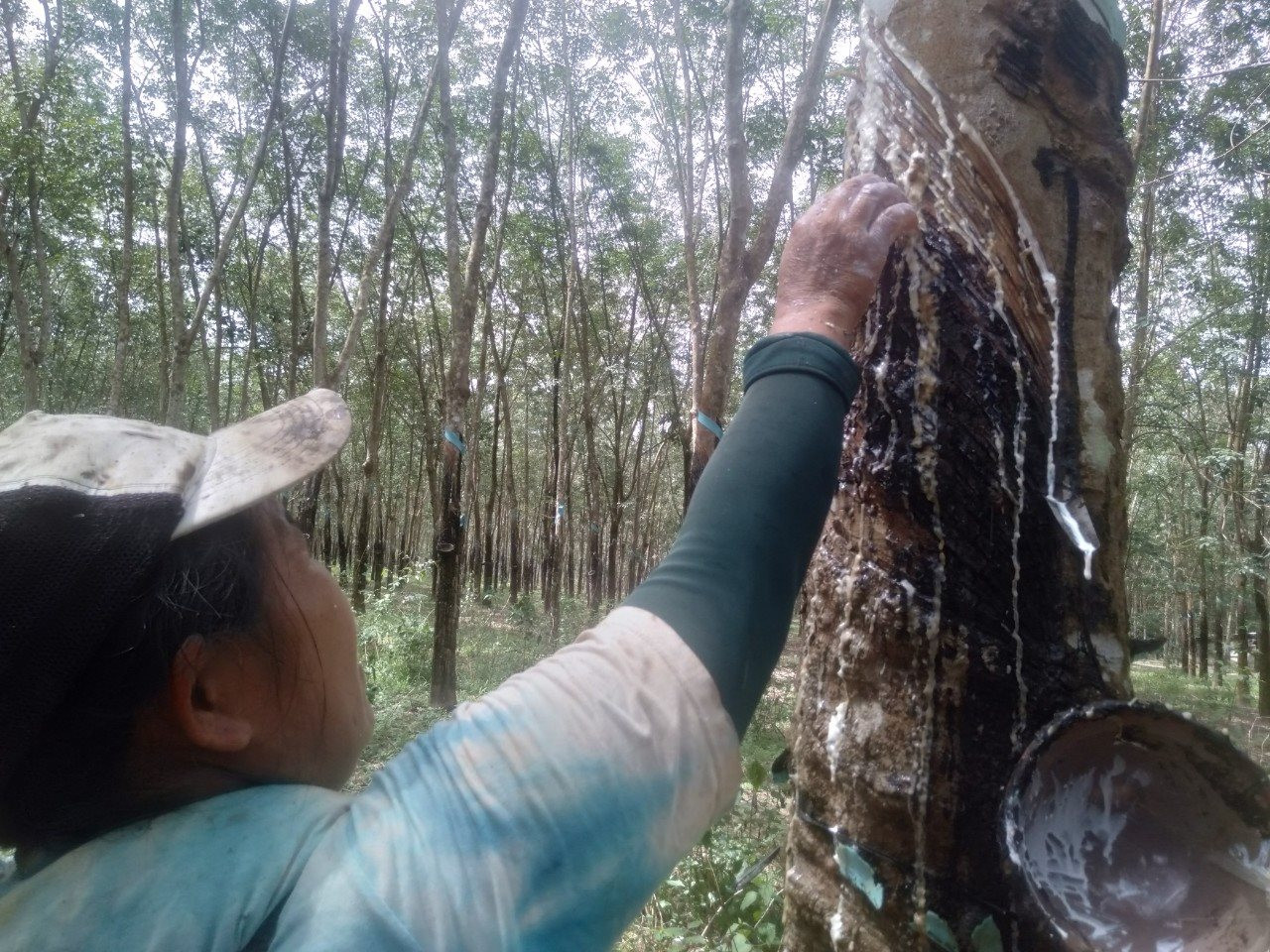
Crackling sounds emanate from the dry, decaying rubber tree branches, sometimes accompanied by the rustling sound of stepping on them, the scraping of leftover rubber sap from the tapping cups, and many other noises from the activities of those who make a living scavenging for rubber sap in the vast rubber plantations. A woman in her 50s is diligently and attentively scraping the remaining rubber sap from the tapping cups and putting it into a plastic bucket she carries. Her name is Nguyen Thi Hoa, residing in Lac Ha neighborhood, Lac Thanh town. Due to difficult family economic circumstances and having to raise two young children, she is the main breadwinner but is often ill and lacks stable employment, so she has had to choose scavenging for rubber sap to make ends meet. According to Ms. Hoa, scavenging for rubber sap doesn't require waking up at dawn with a headlamp like rubber tappers, but the job is still hard and tiring. Around 8 a.m., she has to prepare her equipment to start working. Although her tools were simple—just a bucket for collecting latex, lunch, and water—after preparing her belongings, including clothes, a face mask, and a conical hat, she mounted her old bicycle, a woven basket already tied to the back of the seat to hold the latex she had collected after a hard day's work. Following a small, winding path that crossed many small streams, she entered the vast rubber plantation that stretched as far as the eye could see. She arrived around 10 a.m., a time when all the rubber tappers had finished their work and gone home, leaving the quiet space for those who gleaned the latex. After resting and preparing her tools, Mrs. Hoa began her work of gleaning. From tree to tree, row to row, plot to plot, she didn't miss a single rubber tree, carefully picking up any remaining drops of latex from the cups, the tapping cuts, and even drops that had fallen at the base of the trees, collecting them all in her bucket. Around 3 or 4 PM, as the sun was about to set behind the rubber trees and the weight of the latex on her shoulders had become heavy, Mrs. Hoa packed up and cycled home. Each day she collects about 15-20 kg of latex, selling it for 12,000 VND per kg. On average, she earns around 200,000 VND per day, depending on the fluctuating price of latex.
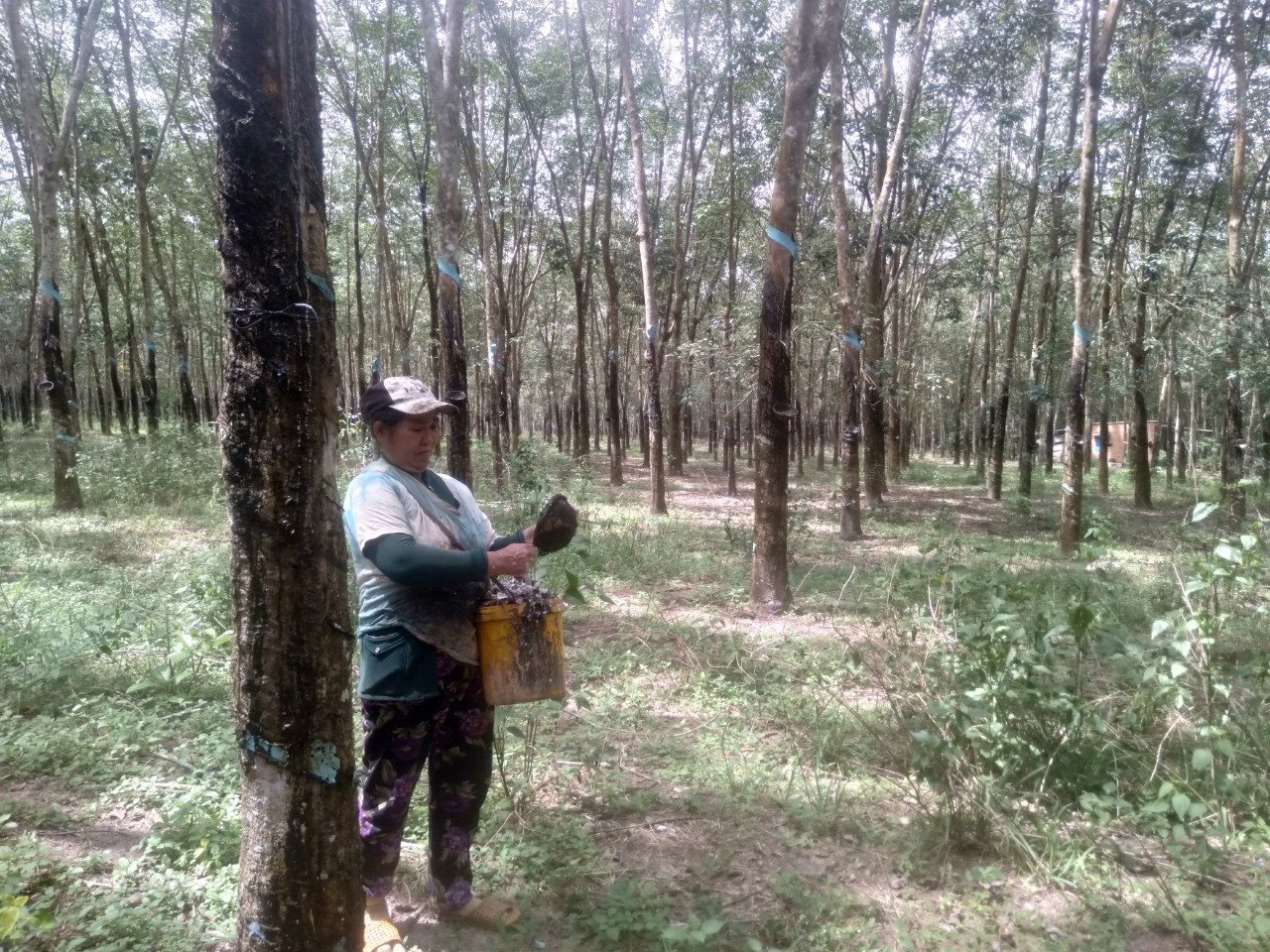
Ms. Dong My, from the Cham neighborhood of Lac Thanh town, who has been collecting rubber sap for many years, said: "Although the hard-earned money each day is only around 200,000 dong, it's very precious because all four members of my family depend on this money. Therefore, I regularly go into the rubber forest every day to collect rubber sap. On days when it rains heavily and people can't go out to tap rubber, I have to stay home and do odd jobs. On cloudy days with light rain, I'm surrounded by mosquitoes that suck my blood, causing terrible itching." Many other people in the Cham neighborhood, like Ms. My, also collect rubber sap.
In recent years, the price of rubber latex has dropped, causing some rubber plantation owners to lose interest in their trees. Some owners have stopped investing in care, while others don't even bother to speak up during harvest season, as any investment would only cover the costs of fertilizer, pesticides, and labor. However, those who collect rubber latex from the wild, like Mrs. Hoa and Mrs. My, still persevere to make a living. This is considered their main job and primary source of income to support their families. While the price of rubber latex was only around 220 VND/degree at the beginning of the season, it has now increased to about 300 VND/degree. The increase in latex price has encouraged some plantation owners who were initially hesitant to speak up to now hire workers to tap the latex, thus generating more income. The increase in latex price also means an increase in the price of wild latex, which is incredibly good news for those who make a living by collecting it. They are working even harder to increase their daily income.
Tanh Linh District has approximately 22,836 hectares of rubber plantations, with an annual production of over 30,000 tons. The rows of rubber trees are straight, lush green, stretching endlessly like vast green forests. The weather, already cool in the early mornings, signals the approaching dry season. In about two months, the rubber plantations will enter the leaf-shedding season, forcing plantation owners to temporarily stop tapping, and those who collect the remaining latex will also have to end their livelihood with this tree once known as "white gold." From now until the end of the rubber harvesting season, those who collect the latex will diligently peel and separate the remaining latex each day, hoping to earn more than the previous day and a little more money to cover daily expenses and save a little for the upcoming traditional Tet holiday.
Source




![[Image] Nearly 125,000 Hanoi students completed the Literature exam for the 10th grade entrance exam.](https://vphoto.vietnam.vn/thumb/1200x675/vietnam/resource/IMAGE/2026/05/30/1780117233041_ndo_br_thiet-ke-chua-co-ten-2-png.webp)























![[Photo] Admire the coral "masterpiece" amidst the million-year-old heritage of Dak Lak province.](https://vphoto.vietnam.vn/thumb/1200x675/vietnam/resource/IMAGE/2026/05/30/1780107638639_y25-jpg.webp)




































































Comment (0)