

Science and technology are transforming every day, reshaping every aspect of life and production.
In this context, Vietnam is gradually asserting its role through initiatives and scientific works by Vietnamese people, while simultaneously strengthening connections with the international scientific community.
The Politburo 's issuance of Resolution No. 57 on breakthroughs in national science, technology, innovation, and digital transformation has created a strong impetus for accessing new knowledge and technologies and for sustainable development of the country.
From attracting Vietnamese scientists living, researching, and working abroad to international experts, to linking research with prestigious institutes and universities, and building a global innovation network, the Resolution opens a new phase of development, bringing Vietnamese science and technology to the regional and global level.
Overseas Vietnamese intellectuals - A strategic resource
Regarding Resolution 57, many overseas Vietnamese believe that it is a crucial driving force helping Vietnam to rise and develop. The overseas Vietnamese intellectual workforce is a highly potential human resource in Vietnam's journey to develop alongside the world.
Dr. Le Duc Anh, Chairman of the Association of Vietnamese Intellectuals in Japan, believes that young intellectuals and students studying in Japan can become "knowledge ambassadors," bringing back to Vietnam not only new technologies and knowledge, but also new ways of thinking and modern approaches, contributing to connecting and attracting technological resources and investment from Japan into Vietnamese businesses.
To effectively utilize this young talent, according to Dr. Le Duc Anh, the State needs to build flexible mechanisms to create conditions for young intellectuals, even those abroad, to participate in the development of science and technology in the country.
In addition, there is a need for policies to support research, encourage cooperation between Vietnam and other countries, and establish funding to enable Vietnamese scientists abroad to collaborate on research with their colleagues at home.
At the same time, building a network of overseas Vietnamese experts and promoting technology investment from foreign businesses into Vietnam is extremely necessary.
Dr. Le Duc Anh also believes that Vietnamese experts working at large corporations in Japan are a strategic bridge, contributing to further deepening the scientific and technological cooperation between Vietnam and Japan; thereby promoting the country's development in the new era.
Realizing global cooperation
Vietnam currently has scientific and technological cooperation relations with nearly 70 countries, possesses more than 80 science and technology agreements at the government and ministerial levels; and is also a member and partner of hundreds of prestigious research organizations, institutes, and universities worldwide.
A series of effective models of cooperation in science, technology, and innovation have been implemented, ranging from scholarship programs and affiliated institutes and universities to technology transfer projects and research centers collaborating with leading countries. These are not only "gateways" to knowledge but also "bridges" that bring Vietnamese intelligence to the global stage.
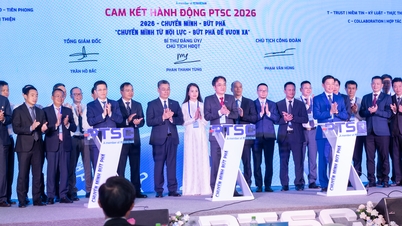
In Hanoi, the "Australia-Vietnam Strategic Technology Centre," a crucial link in the comprehensive cooperation, particularly in the field of science, technology, and innovation, between Vietnam and Australia, has just been inaugurated.
Located at the Posts and Telecommunications Institute of Technology (PTIT), this center was established through a cooperation agreement between the Australian Department of Foreign Affairs and Trade and the Vietnamese Ministry of Science and Technology, with technical support from Nokia and professional coordination from the University of Technology Sydney.
With initial funding exceeding A$2.1 million, the center aims to promote next-generation research in 5G/6G, cybersecurity, artificial intelligence, and satellite technology, helping to lay the foundation for robust digital transformation.
The Australia-Vietnam Strategic Technology Centre is a model that realizes the spirit of Resolution 57 by attracting international experts, building a globally standardized center, and deeply connecting the science and technology ecosystem between countries.
With an open, interdisciplinary, and in-depth approach, Vietnam's science, technology, and innovation sectors are being built to integrate deeply and reach further, contributing to making knowledge a direct productive force in the new development phase.
According to Mr. Nguyen Diep, Director of the Australia-Vietnam Strategic Technology Centre, global research cooperation is a key factor in the development of modern science and technology. Therefore, the Vietnamese and Australian governments have supported the establishment of the Australia-Vietnam Strategic Technology Centre with the goal of creating conditions for scientists from both countries to jointly develop technologies that are both in line with bilateral interests and have a global vision. This model realizes Resolution 57, creating an environment to attract international experts and promote highly applicable research in Vietnam.
Citing specific examples of artificial intelligence (AI) technologies – a rapidly developing field that also poses significant challenges to user security and privacy – Mr. Nguyen Diep argued that the application of technology must be accompanied by risk control mechanisms to ensure cybersecurity and individual rights. Similarly, in the national digital transformation process, 5G is considered a strategic infrastructure, but it also places high demands on information security and safety.
The challenge is how to deploy these advanced technologies effectively while controlling potential risks. Therefore, through international cooperation, these problems are expected to be solved with the joint efforts of countries and partners.
Another objective of the Center is to support Vietnam and its partners in rapidly accessing the world's most advanced technologies, such as quantum technology in information security or space technology applied in production and daily life.
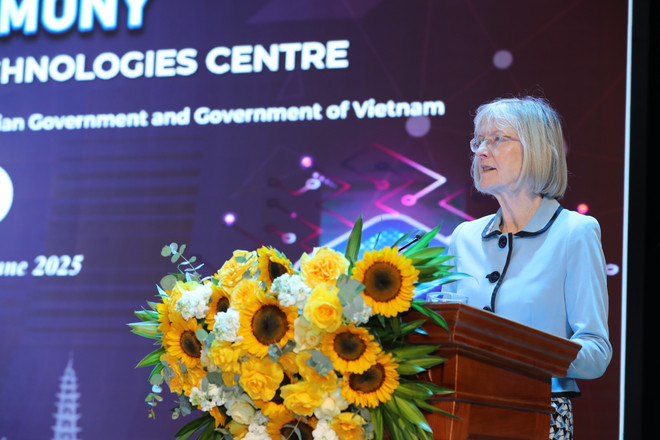
According to Ms. Gillian Bird, Ambassador Extraordinary and Plenipotentiary of Australia to Vietnam, long-standing cooperation in many fields, especially science, technology and innovation, has become a strategic pillar within the framework of the Comprehensive Strategic Partnership between the two countries. Australia is proud to be working alongside Vietnam in promoting innovation and digital transformation, two essential elements for Vietnam's sustainable growth.
The center is a concrete example of Australia's commitment to supporting science and innovation development in Vietnam, through promoting strategic research and connecting Vietnamese organizations with Australia's leading education, research, and innovation networks.
Ambassador Gillian Bird affirmed that Australia wishes to work alongside Vietnam in implementing Resolution 57, with the expectation of bringing about practical, measurable results that directly serve the country's scientific, technological, and socio-economic development.
In addition, many other models have also shown remarkable effectiveness. The VinFuture Foundation has attracted hundreds of leading scientists from around the world to Vietnam. International universities such as the Vietnamese-German University, the Vietnamese-Japanese University, and the Hanoi University of Science and Technology have collaborated with the French government to train thousands of highly qualified engineers and PhDs.
The National Innovation Center is also playing a key role in connecting Vietnamese technology businesses with global corporations. All these models clearly reflect an open, collaborative mindset and concrete actions in the fields of science, technology, and innovation, in line with the spirit of Resolution 57.
Transforming science and technology into a driving force for breakthrough development is not just a goal, but a consistent strategy established in Resolution 57.
With a strong commitment to deep integration, while proactively leading and building its national position, Vietnam is gradually realizing its dream of becoming a regional innovation hub.
Source: https://www.vietnamplus.vn/nghi-quyet-57-don-bay-dua-khoa-hoc-cong-nghe-viet-nam-hoi-nhap-va-dan-dat-post1049248.vnp

![[Photo] Prime Minister Pham Minh Chinh presides over a meeting on private sector economic development.](/_next/image?url=https%3A%2F%2Fvphoto.vietnam.vn%2Fthumb%2F1200x675%2Fvietnam%2Fresource%2FIMAGE%2F2025%2F12%2F20%2F1766237501876_thiet-ke-chua-co-ten-40-png.webp&w=3840&q=75)
![[Photo] Prime Minister Pham Minh Chinh presides over the conference announcing the establishment of the International Finance Centre in Vietnam.](/_next/image?url=https%3A%2F%2Fvphoto.vietnam.vn%2Fthumb%2F1200x675%2Fvietnam%2Fresource%2FIMAGE%2F2025%2F12%2F21%2F1766309817714_ndo_br_dsc-3400-jpg.webp&w=3840&q=75)





































































Comment (0)