

Parents, two words of love.
According to folklore researcher Nhat Thanh, the terms "father" and "mother" have existed since ancient times. The "Hong Bang" legend in the book Linh Nam Chich Quai records that whenever the people needed help, they would call upon King Lac Long: "Wherever you go, Father, why don't you come and save us?" Below that sentence, the author notes: "The people of the South call their father 'bo' (father) from that time." The word "bo" (a homophone of "bo" - father) is still used today, such as "bo lao" (elderly person) referring to an old man, equivalent to an old father.
The book "Kham Dinh Viet Su Thong Giam Cuong Muc" records: In the year Tan Vi (791), Phung Huong from Duong Lam (Phuc Tho district, Son Tay province today) led an uprising against the Tang dynasty's occupying government. After his death, the soldiers enthroned his son to succeed him. Out of admiration for him, they built a temple and honored him as Bo Cai Dai Vuong, considering him a great benefactor and a father figure.
"The terms 'father' and 'mother' have endured for centuries and still retain their vitality in the Vietnamese language and literature," researcher Nhat Thanh affirmed. Our proverbs include: "A foolish child brings shame to the mother" or "In September, tangerines ripen at the bottom / In March, the wild mangoes sprout, and the mother returns" (the term "mother" refers to the child).
Besides calling parents "father" and "mother," many localities in the Red River Delta region also call them "teacher bu," "tia ma" in the South, and "ba me" in Phu Yen . In the book "Customs and Traditions of the Countryside," researcher Nhat Thanh states that parents are also called "cousin" and "aunt." This was a fashionable trend that emerged in Vietnam from the feudal era to the Westernization movement in the early 20th century: "In the old days, workers in official households and even ordinary people were accustomed to calling the sons and daughters-in-law of this class "cousin" and "aunt," and then the children of these young masters and ladies followed suit, calling their parents "cousin" and "aunt," and in those families, people took pride in and liked it. Gradually, this custom spread, starting from the civil service (during the French colonial period, many civil servants held ranks no less than high-ranking officials) and then to merchants in the cities."
"The terms 'uncle' and 'aunt' were rising like a kite, wanting to overshadow and replace 'father' and 'mother,' but suddenly they vanished, discreetly and fearfully retreating into silence at the same time the bureaucratic regime came to an end in August 1945. From then on, the terms 'uncle' and 'aunt' were returned to their original, pure meaning: 'uncle' means mother's younger brother and 'aunt' means uncle's wife," Nhat Thanh expressed his opinion.
Nhat Thanh also emphasized that the affectionate call to parents, although expressed differently in each locality, remains deeply cherished in Vietnamese families. Those who leave their parents' homes to study and build a career in the city still long for the day they can return to their parents' side to receive their comforting embrace. Parents always consider their children naive and foolish, even when their hair has turned gray.
“Through countless ups and downs, the words 'father' and 'mother' remain the official terms. Folk songs, proverbs, literature, and poetry rarely leave room for other words. 'A son surpassing his father brings blessings to the family'; 'The father eats salty food, the son thirsts for water'; 'A mother raises her child with boundless love, a child repays their mother by counting the days'; 'A son, a daughter-in-law, is like another's daughter-in-law' (Le Quy Don - Poem on Mother's Advice to Her Son on Going to Her Husband's Home),” Nhat Thanh concluded.
The proverb "The eighth month is the anniversary of the father's death, the third month is the anniversary of the mother's death" has been passed down to this day and still retains its value. It reminds each of us to remember the annual commemoration ceremonies of King Bat Hai and Hung Dao Vuong in the eighth month and Princess Lieu Hanh in the third month of the lunar calendar. It reflects the beauty of cultural and religious beliefs – where both mother and father, both goddesses and deities, are sincerely revered by the people.
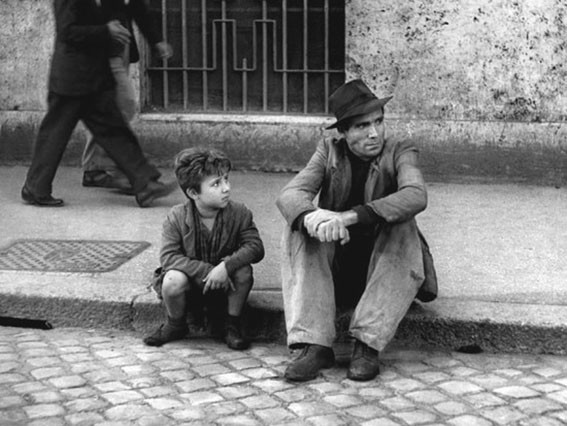 |
Scene from the movie Bicycle Thieves. (Source: ST) |
"I grieve for my father whose great ambitions were not fulfilled."
“In the old days, father sat drinking wine, mother sat knitting/Outside, in winter, the banyan tree shed its leaves…/In the old days, mother sat by father's bedside, far away/Looking at father, pitying him for his great ambitions unfulfilled…” (Tran Tien - My Mother)
These lyrics are very familiar to me. I think of my father, the time he planned to go to Eastern Europe. He went to Hanoi and waited for a long time, but then the bloc collapsed and my father became unemployed and returned home to farm. Life was so hard then; my mother, besides teaching, had to do extra work selling goods, and my father, a former official, was completely unfamiliar with farming. The hardships of our family at that time made me truly understand the lyrics, "I grieve for my father whose great ambitions were not fulfilled."
A song by composer Tran Tien is about a mother, but the father's figure is more somber. The image depicts him sitting and drinking, a man down on his luck, yet beside him, a woman knitting a sweater, providing him with warmth. Though his great ambitions shattered, he still wanted to be a pillar of support for his family, but circumstances led him astray. As Tan Da said, "High talent, low status, suppressed ambition / Wandering aimlessly, forgetting his homeland." This song portrays the down-on-his-luck father with a deep affection for his family, clinging to each other and supporting each other in times of hardship.
A major cinematic masterpiece from 1946, "The Bicycle Thief" by director Vittorio De Sica, continues to move viewers even today, despite being considered a classic. It tells the story of Ricci, an unemployed man in Rome who, after a long time, finally finds a job posting advertisements, on the condition that he owns a bicycle to get to work.
This forced his wife to sell many of their belongings just to buy a car. However, while he was posting posters on the street, his means of livelihood was stolen. He and his son, Bruno, had to desperately search for the car in the vast city, home to hundreds of thousands of impoverished people like themselves.
And finally, when the thief was caught, he was protected by a crowd, so he couldn't get his bike back. In desperation and confusion, he tried to steal another bike but failed... The Ricci family's journey to find and steal their bicycle revealed a part of Italian history and society at the time. The bicycle in the film captivated the world. It is always considered a quintessential example of realism and won the Oscar for "Best Foreign Language Film" in 1949. It is voted the greatest film of all time.
The film leaves a profound and poignant sadness about their unfortunate circumstances, as they find themselves at a dead end, abandoned, and without a future. However, deep within their hearts, the father and son still harbor faith, love, and optimism for each other.
The film I recently watched was "That Mountain, That Man, That Dog" by Chinese director Jianqi Huo. It's an inspiring film about the father-son relationship. A resilient, loving, and inspiring story of a father and son who work as mail carriers for people in the mountains of Hunan, China, in the 1980s.
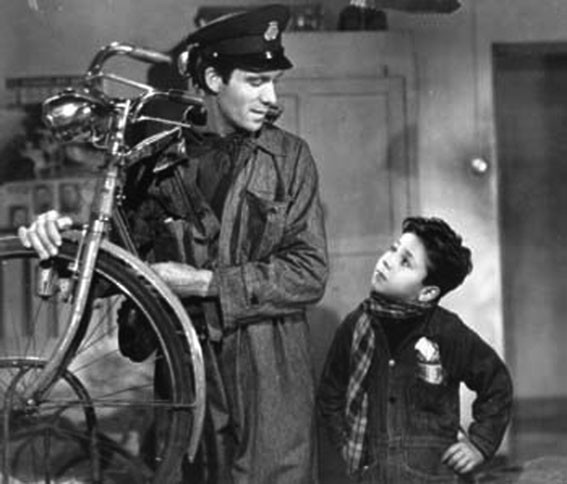 |
Scene from the movie Bicycle Thief. (Source: ST). |
A lonely old woman sat at the front door of her house on the mountainside. She waited for the postman to bring a letter from her grandson, who had left home long ago and, for some unknown reason, hadn't returned. She had cried herself blind with grief and longing for her grandson. In truth, there was no letter from her grandson. The postman understood her longing and wrote a blank letter, which he read to her. Each time she heard it, she wept and held the letter close to her heart. And even after the postman and his son left, she remained there, hoping for their return one day… It was a haunting scene for me.
The father was preparing to retire, and the son followed in his father's footsteps. His first mail delivery trip was accompanied by his father, and it was also his last. His dog, named Lao Nhi, was his constant companion. For three days, they delivered mail through villages, traversing fields, forests, streams, and steep slopes... the father taught him how to work, meet people, greet them, and distribute mail. The story seems simple, but following in his father's footsteps, the young man learned many things.
The principle was "the mail route must be the mail route," meaning you couldn't take a bus; you had to walk to be accurate. Each letter represented the recipient's eagerness and response, so it had to be handled with great care, never lost or forgotten. In the film, there's a scene where the letter is blown away by the wind, and the father panics. He understands that losing the letter would cause the recipient to lose contact, connection, and the anticipation of receiving information from each other...
The son learned from his father's experience, while the father saw his youth reflected in his son's playful moments with the mountain girl. He married the mountain girl after a chance encounter. He said he felt sorry for his wife, who had waited for him her whole life because of his work that kept him away... He also saw his son grow up and take on the work he had dedicated his life to.
He did this job so patiently, without asking for a promotion, and he wanted his son to continue his work. He told his son to find joy in the job: "This job is tough, but when you travel a lot and meet people, you see that the work is normal, and life feels very peaceful."
These are remarkable works of art about fathers. Fathers who are not successful, wealthy, or famous. They are men who are past their prime, poor, unemployed, or working ordinary jobs, but their love and sacrifice for their families are always immense and complete. So that the call of "Dad!" always resonates in the family, no matter the circumstances.
Source: https://baophapluat.vn/nghi-ve-cha-trong-doi-song-va-cong-nghe-post551754.html


![[Photo] Prime Minister Pham Minh Chinh presides over a meeting on private sector economic development.](/_next/image?url=https%3A%2F%2Fvphoto.vietnam.vn%2Fthumb%2F1200x675%2Fvietnam%2Fresource%2FIMAGE%2F2025%2F12%2F20%2F1766237501876_thiet-ke-chua-co-ten-40-png.webp&w=3840&q=75)





















































Comment (0)