


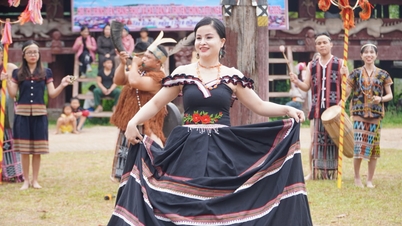
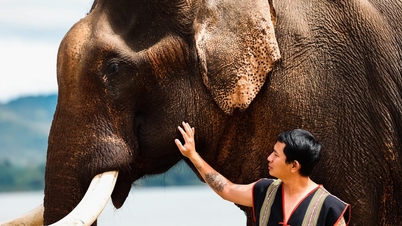
Exactly two years ago, Elder Y Kông attended the funeral of a Katu village elder in Song Kon commune, and afterwards helped the family with the funeral arrangements. Elder Y Kông's presence at that time was a great comfort to the family and the Katu community because not many young people know about traditional funeral customs, especially for respected individuals with significant roles in the local community. Throughout the many days of the funeral, people still saw an elderly former district chairman, despite his failing health, wearing his finest brocade clothing, agate necklace, wild boar tusks, and a neatly tied headscarf...
Elder Y Kông was a highly respected figure in the Cơ Tu community, a spiritual pillar, a symbol of unity, and considered a "living museum" of traditional culture. His entire life was dedicated to preserving and passing on cultural values to the younger generation. His passing is a great loss to the local community.
Deputy Secretary of the Party Committee of Song Vang Commune, Dinh Thi Ngoi
1. I still maintain the habit of visiting the village elder Y Kông whenever I go up the mountain. Besides greeting him, the visit is an opportunity for me to gather more cultural information from a "living museum" that exists. Many vivid stories are told and explained after each time I "raise a question." Strangely, every time I ask a question, Elder Y Kông is always very willing and... happy.
Elder Y Kông said that the Cơ Tu culture is in danger of disappearing. Part of this is because the Cơ Tu people themselves have not fully recognized the role and cultural value of their community. Therefore, their traditional identity is inadvertently swept away by the allure of the times, prolonging this concern.
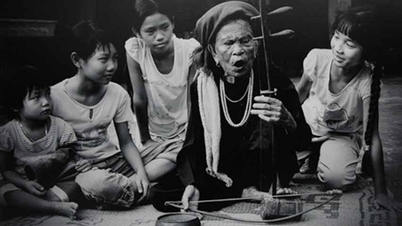
“I’m here every day, and if I’m not sick, I take the time to make drums and carve wooden statues. Only the elderly occasionally come to watch, ask questions, and learn how to do it. It’s rare to see young people interested. That’s why many people now, even in their middle age, are not yet proficient in playing drums and gongs, performing rituals to worship spirits, or funeral rites for the deceased, let alone reciting and singing folk songs or building Co Tu tombs,” Elder Y Kông once confided.

During a recent meeting, the conversation seemed to quiet down as the rain fell, and old Y Kông voiced his concerns: even in Tống Coói village (Sông Vàng commune), where he lives, many households lack traditional brocade fabrics and gongs. Whenever they need them, they have to borrow or beg for them. He acknowledged that while the pace of life is now vastly different from the past, "being too different isn't necessarily a good thing."
Not wanting that situation to continue, in recent years, whenever he has free time and good health, Elder Y Kông has taken the opportunity to make more drums and decorative wooden statues. Besides selling these items to tourists, he occasionally donates these "cultural treasures" back to the community, reviving the value of their identity in young people. Through this, Elder Y Kông's small house has gradually become a destination for many Cơ Tu people and tourists.
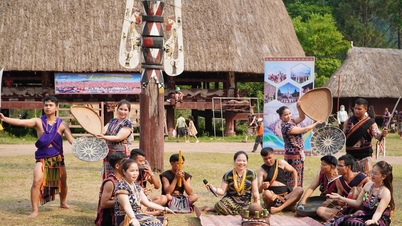
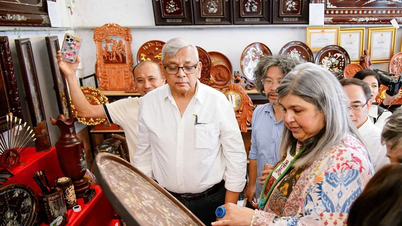
Then, Elder Y Kông built a moong (traditional community center). He funded this with savings from selling wooden statues and drums to visitors. Many unique cultural products are displayed inside the moong, and anyone who comes and sees them firsthand is inevitably amazed. A traditional Katu cultural space is formed and illuminated by the story and spirit of this respected village elder.

2. Ms. Dinh Thi Thin, a Co Tu ethnic group tour guide in Song Kon commune, recounts that for many years, she has utilized the Co Tu cultural narrative to create unique tourism products and experiences for visitors. Among these ideal destinations is the cultural space of village elder Y Kong.
“At the village elder Y Kông's place, many international tourists are not only fascinated by the unique cultural space, but also impressed and captivated by the story and journey of preserving and promoting traditional values of a respected village elder in the community. After each meeting, many tourists order products from Elder Y Kông, such as wooden statues, cowhide drums, bamboo flutes, etc., to make souvenirs for their relatives,” Ms. Thìn shared.
It's no coincidence that Ms. Dinh Thi Thin chose the cultural space of village elder Y Kong as a stop for her tourists. In addition to other unique destinations like the Bho Hoong cultural tourism village, Dho Roong weaving village, A Pang hot springs, and Dong Giang Sky Gate, the house of elder Y Kong is the "number one choice," connecting a comprehensive journey of exploring the in-depth indigenous Co Tu culture.
“Tourists are often more interested in a specific story than in seeing a product on display. Elder Y Kông is a real person, with real stories. His simple storytelling style, after being translated, amazes and earns praise from tourists. They express respect and admiration for the way of thinking and behaving of an elder in his culture and community,” Ms. Thìn recounted.
3. Last year, I gave the village elder Y Kông a portrait I had taken a few months earlier. In the bottom left corner of the photo was a quote from him that had been published in the local Party newspaper. At that moment, joy was clearly visible in his eyes. After carefully examining it, Elder Y Kông took my hand and said, "If the bottom part were translated into English, more people would understand the meaning of the photo."

I was slightly taken aback, because even at nearly 100 years old, Elder Y Kông was still very perceptive and deeply interested in the spread of Cơ Tu culture and spirit. He said that in the context of integration, the Cơ Tu people are welcoming many international tourists. Therefore, they are seen as "ambassadors" bringing Cơ Tu culture and stories closer to international friends…
The Katu culture is inseparable from the village elder Y Kông. A few days ago, despite his declining health, many people still saw the elder sitting in his wheelchair, chatting happily with tourists. His stories were nothing other than Katu culture and its traditional values, and the spirit of community solidarity in the highlands.

Elder Y Kông, whose real name was Nguyễn Dưl, was born in 1928 in Ba commune (Dong Giang district, former Quang Nam province), now Song Vang commune, Da Nang city. He left his family and joined the revolutionary movement in 1955.
Elder Y Kông held many important positions: Chairman of the People's Committee of Đông Giang District (1971 - 1975), Chairman of the People's Committee of Hiên District (1976 - 1979), Chairman of the Vietnam Fatherland Front Committee of Hiên District (1979 - 1982). He was honored by the Party and State with the First Class Resistance Medal, the First Class Liberation Medal, the Third Class Independence Medal, and the 65-Year Party Membership Badge.
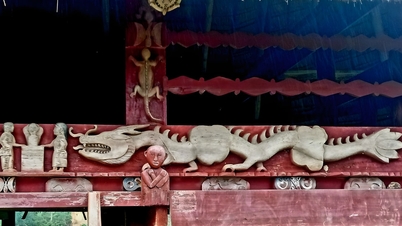
Elder Y Kông is likened by the Cơ Tu community to the Triing bird, a type of hornbill (ground phoenix) that commonly lives in the eastern Trường Sơn mountain range. In Cơ Tu culture, the Triing is a sacred bird, often depicted on the roofs of gươl (traditional communal houses), symbolizing exquisite beauty and authority.
Source: https://baodanang.vn/ngung-dap-mot-canh-chim-triing-3315362.html

![[Photo] General Secretary and President To Lam presides over a meeting on preparations for the review of one year of operation of the three-tiered government system.](https://vphoto.vietnam.vn/thumb/1200x675/vietnam/resource/IMAGE/2026/06/02/1780391821195_a1-bnd-4595-9717-jpg.webp)





























































Comment (0)