


To entertain esteemed guests from afar, hosts often bring out tà vạc, tr'đin, a'poh… local specialties considered the "heavenly wines" of the mountains and forests. Amidst the warm spring weather, hosts and guests chat and savor the fragrant flavors of these naturally fermented herbal wines.
"Gifts" for honored guests
When guests visited his home during Tet (Vietnamese New Year), the elderly Pơloong Bhí (72 years old, from Chi Nêết village, Sông Kôn commune) hurried out to greet them. Inside, his family had already prepared a feast with wine and food, waiting for us. Because there were so many guests, we were seated in a small hut directly opposite the main house. The feast that day featured a full spread of traditional Cơ Tu dishes, from buffalo horn-shaped cakes and jellied meat to smoked meats ...
As the feast began, Elder Pơloong Bhí brought out a jar of tà vạc wine as an appetizer. During the New Year, in addition to the usual delicious dishes, the Cơ Tu people reserve the finest and most precious wines to treat special guests. This pure tà vạc wine, freshly brought from the "heavenly wine" distillery, is fermented with the bark of the chuồn tree. After only a few hours of sealed fermentation, it produces a special milky white wine with a sweet and slightly spicy taste that is believed to nourish health.
To obtain pure tà vạc wine, several days prior, the elderly Pơloong Bhí and a few friends followed the mountain slopes to find mature tà vạc trees to extract the wine. Having been involved in the craft of collecting this "heavenly wine" for over 30 years, Pơloong Bhí is intimately familiar with each traditional extraction step, from cleaning the fruit chambers to stimulating the wine to seep out drop by drop.
Because it is extracted entirely from natural ingredients, tà vạc wine has long been a distinctive product of the mountains and forests. “When guests come to our house on New Year’s Day, we offer them a glass of this wine first. It’s not about showing off a delicious wine, but about offering clean wine, wine from the forest. Offering guests tà vạc is an offering of affection and respect from the family to the guests,” explained elder Pơloong Bhí.
According to Chi Nêết Pơloong Cường, the village head, tà vạc wine is a product of a completely natural fermentation process, without any processing. “After gently tapping around the tà vạc tree trunk with a stick, the liquid drips out drop by drop. Skilled people familiar with the forest and the trees can collect dozens of liters of tà vạc liquid each day. This liquid is then mixed with the bark of the chuồn tree to ferment and become wine used to entertain honored guests,” Mr. Cường said.
A few years ago, during the Lunar New Year, brothers from the mountainous region of Song Kon commune came down to the city to visit their families. In their hands, they carried jugs of rice wine and tubes of fragrant grilled meat. That evening, amidst the peaceful setting, the festivities among these "sons of the mountains" harmonized with the shimmering lights, as they enthusiastically shared stories of the mountains and forests...
Fragrance that unites communities
For the people of the highlands, tà vạc wine is an integral part of their community. When guests arrive, the host pours a cup of tà vạc; when there is a joyous occasion in the village, everyone gathers around a celebratory pot of wine. The wine is made from the trunk of the tà vạc tree, a type of palm tree that grows naturally in the forest, which is why the highlands still commonly call it "heavenly wine".

According to Mr. Pơloong Plênh, Deputy Head of the Culture and Social Affairs Department of Tây Giang commune, people in mountainous areas often observe the lunar cycle of the month to determine the best time to harvest tà vạc wine. This is a long-standing tradition to obtain a larger quantity of tà vạc wine. Typically, the best time is when the moon is full and the weather is coolest. At that time, the tà vạc plant absorbs more water, its leaves and stems are green and vibrant, and its fruit clusters are large and healthy.
“Highlanders drink tà vạc to savor the taste, not to get drunk. This type of liquor is often used during festivals, traditional village gatherings, and celebrations. Therefore, out of affection and respect for one another, they sincerely offer a cup of tà vạc, so the aroma of the liquor is seen as a connecting thread, expressing feelings and appreciation within the highland community,” Mr. Pơloong Plênh shared.
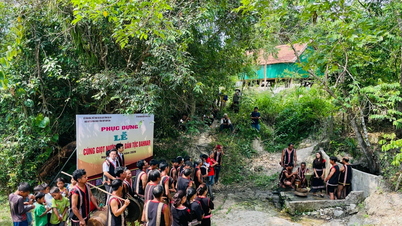
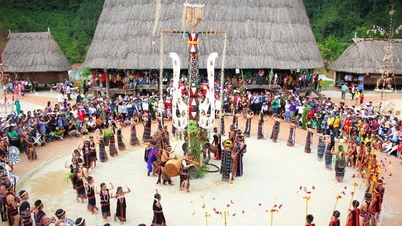
Mr. Pơloong Plênh's words reminded me of a few months ago, when the Katu community arranged trays of rice wine inside the space where the village elders recited and sang folk songs during the first Katu Traditional Culture Festival in Sông Kôn commune. After each successful exchange of folk songs, when the green banana leaves on the food trays were opened, glasses of rice wine were offered to each other in the joyful atmosphere of those present. The folk songs continued after each "encounter" within the community…
According to Do Huu Tung, Chairman of the People's Committee of Song Kon commune, the locality is encouraging people to demarcate areas, care for, and plant more ta vac and tr'din trees in the community. This is a way to both maintain traditional cultural values through the natural method of extracting wine from the tree trunk, and create a valuable wine product for sale on the market, helping to increase income and opening up opportunities to turn the ta vac wine extraction process into a unique tourism product.
Source: https://baodanang.vn/nham-nhi-mot-chen-ruou-troi-3323558.html



















































































Comment (0)