

Incorporate real-life situations into your lectures.
I met Lieutenant Colonel Nguyen Hoang Vu on a breezy afternoon, amidst the vibrant life of Nha Trang ( Khanh Hoa province ). In an open conversation, the lecturer, with his calm and unhurried demeanor, shared about his childhood, his growing up in the sunny and windy central highlands, and his journey to maturity in the military environment.
Nguyen Hoang Vu was born into a farming family in the rural area of Que Tan, Hiep Duc commune ( Da Nang city). His parents spent their lives working in the fields, leading a very hard life, but always dedicated everything they could to their children's education. Witnessing this hardship from an early age, all four siblings in the family vowed to study hard and train themselves to live up to their parents' expectations.
 |
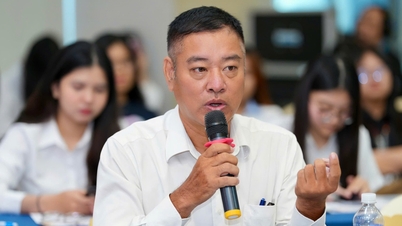
Lieutenant Colonel, Master's Degree holder Nguyen Hoang Vu during a class session, discussing with students. Photo: Xuan Dinh |
Following in his older brother's footsteps, after graduating from high school, Nguyen Hoang Vu passed the entrance exam to the Political Officer Training School. Choosing the military environment was not only a turning point in his life but also a continuation of the tradition of striving for success from a poor farming family. During his studies and training, he gradually demonstrated his intellectual abilities and passion for social sciences, especially Philosophy.
Graduating with a degree in Philosophy as a lecturer in 2009, Nguyen Hoang Vu worked at the Information Officer School and then pursued a Master's degree in Philosophy (2014-2016) at the Political Academy. He quickly realized that to teach theory effectively, a teacher couldn't rely solely on textbooks but had to connect with the vibrant practical lives of soldiers and the development of society. Lieutenant Colonel Nguyen Hoang Vu confided: "My life experiences, my years of training in the Army, especially my time working directly at the grassroots level, are the foundation for me to incorporate everyday realities into each lecture."
From simple stories about family and hometown, and from his own choices, Nguyen Hoang Vu has developed a teaching style that is approachable and authentic. The theories in his lectures are not detached from life, but are always closely linked by concrete examples, helping students understand that knowledge in social sciences and humanities is not separate from life, but serves as a tool for each officer cadet to orient their thinking, cultivate their character, and perfect their personality within the military environment.
This natural connection to life has stayed with Nguyen Hoang Vu throughout his years of service, especially during his time as the company's political officer (2018-2020) at the school. In the early days at the unit, standing before dozens of young trainees with diverse backgrounds, personalities, and skill levels, Lieutenant Colonel Nguyen Hoang Vu frankly admitted that he was sometimes bewildered. Managing soldiers is not like teaching; there, theory, if not connected to real-life situations, is very difficult to apply effectively. He chose a close approach to listen, share, and guide each trainee.
Some students were burdened with the thought of dropping out due to difficult family circumstances. Instead of formulaic lectures, he shared his own experiences as a young man from the highlands who had faced a similar career choice. He analyzed the pros and cons not through commands, but through responsibility to society, family, and himself, which resonated with the young people and led them to change their minds.
Upon returning to the lecture hall, his experiences at the unit became vibrant material for each lecture. He conveyed seemingly dry topics about the State, law, ethics, or philosophy through very real stories. From managing people and handling ideological situations to the psychological developments in a highly disciplined environment, the theoretical lessons were no longer one-sided impositions but became a space for exchange and exploration, making learning more engaging for the students.
Sergeant Nguyen Tran Hung, a student in Platoon 5, Company 15, Battalion 30, Signal Officer School, who directly studied under Lecturer Nguyen Hoang Vu, shared: “Lecturer Vu conveys knowledge clearly and coherently. Difficult topics are analyzed in detail and closely related to the practical realities of students and future officers in their roles and responsibilities at the unit, helping us to easily understand, remember, and apply the knowledge in practice.”
 |
| Lieutenant Colonel, Master's Degree holder Nguyen Hoang Vu during a class session, discussing with students. Photo: Xuan Dinh |
Conducting scientific research to improve the quality of teaching.
According to Lieutenant Colonel Nguyen Hoang Vu, scientific research primarily aims to improve lectures, enabling students to access knowledge more effectively, and also helps the school move faster in the process of reforming military education. From his practical experience teaching social sciences and humanities subjects, he realized that while the learning outcomes have been relatively well-defined, they are still scattered across textbooks, outlines, and documents; access for both lecturers and students is not convenient and does not meet the requirements of digital transformation.
When the Information Officer Training School was selected to pilot digital transformation in education and training, Lieutenant Colonel Nguyen Hoang Vu boldly proposed to the leadership and commanders, and became the project leader, the initiative "Digitizing the output standards of social sciences and humanities subjects according to a logical diagram." What's special is that the person implementing the initiative is not an information technology expert, but a theory lecturer who considers himself a "newbie" in the world of programming. But it was precisely this lack of expertise that allowed him to see the problem from a user's perspective, finding ways to make teaching easier for lecturers, learning easier for students, and management easier for the school.
Thanks to the support of IT staff, he and his colleagues systematized the curriculum of 17 subjects, built logical diagrams for 168 lessons, fully illustrating the requirements for knowledge, skills, and attitudes; all digitized in the form of infographics, operating stably on a digital platform, and usable both online and offline... This initiative won third prize in the 2022 Youth Innovation Award in the Army and is considered to have the potential for replication in military schools.
Not stopping there, Nguyen Hoang Vu continued to develop topics on improving pedagogical problem-solving skills for young lecturers and enhancing political awareness for young officers in the Signal Corps. His research closely followed the practical realities of the school and unit, linking it to the requirements of building political fortitude, motivation, and work capacity for young officers and lecturers.
A common thread in Nguyen Hoang Vu's scientific works is the consistency of his objectives; all his research ultimately serves teaching, students, and the task of building the Army. He doesn't detach himself from the classroom to do science, but rather uses science to return to the classroom with deeper, more modern, and more persuasive lectures.
Colonel Nguyen Anh Tuan, Head of the Faculty of Social Sciences and Humanities, Information Officer School, assessed: “Lieutenant Colonel Nguyen Hoang Vu is a lecturer with good professional competence, actively researching, flexibly and creatively applying teaching methods, enjoying the trust of colleagues and students, and has been an excellent lecturer at the grassroots level for 5 consecutive years. At the same time, he is also proactive and creative in scientific research; he has led and participated in research on many scientific projects at various levels; actively guided students in researching school-level projects; published many scientific articles and conference papers; and exceeded the annual target for scientific research hours.”
After hours in the lecture hall and nights of tireless scientific work, Lieutenant Colonel Nguyen Hoang Vu returns to his daily life with his wife and two young children in a 57m² official apartment in Nha Trang. His wife is his high school friend, who lived with him since their impoverished hometown of Hiep Duc, and later joined him in the coastal city to build a life together. This silent sacrifice is a solid foundation that allows him to dedicate himself wholeheartedly to his work. Many nights, while everyone else is asleep, the lights remain on in the small apartment. Lieutenant Colonel Nguyen Hoang Vu calls this "not going bankrupt with science," a simple expression that reflects his seriousness and dedication to his profession.
With outstanding achievements in teaching, scientific research, and the Emulation Movement for Victory, Lieutenant Colonel, Master's Degree holder Nguyen Hoang Vu has been recognized and rewarded by various levels. Notably, in 2025, Nguyen Hoang Vu was awarded the title of Emulation Soldier of the entire army; prior to that, for many consecutive years, he achieved the title of Emulation Soldier at the grassroots level, Excellent Lecturer at the grassroots level; and received a commendation from the Minister of National Defense. |
Source: https://www.qdnd.vn/phong-su-dieu-tra/cuoc-thi-nhung-tam-guong-binh-di-ma-cao-quy-lan-thu-17/nguoi-giu-lua-nhung-gio-hoc-ly-luan-1022038










































































Comment (0)