

A PROMISE WITH THE BIRD CULTURE
For over 40 years, that man has quietly walked through the mangrove forests and flooded grasslands of Dong Thap Muoi.
From a young student to a man with graying hair, Dr. Tran Triet has almost entirely dedicated his life to witnessing the transformation of Tram Chim National Park day by day.

Dr. Tran Triet vividly remembers his first visit to this place in 1986. He recounted: “At that time, I was a final-year student majoring in Ecology and was invited by Comrade Nguyen Xuan Truong, former Chairman of the People's Committee of Dong Thap province, who laid the foundation for the establishment of Tram Chim National Park, to conduct a field survey in Dong Thap Muoi. That trip led to my long-lasting connection with Tram Chim.”
The first time Dr. Tran Triet saw the flock of red-crowned cranes soaring across the vast grasslands of Tram Chim, he understood that this place was not simply a melaleuca forest.
"The most important thing is not just bringing the cranes back, but restoring the entire ecosystem of Tram Chim National Park." Tram Chim National Park is not only home to the red-crowned crane; its greatest value lies in its entire wetland ecosystem, with numerous endemic plant and animal species coexisting. DR. TRAN TRIET (Born in 1964, lecturer at the Faculty of Biology - Biotechnology, University of Science , Ho Chi Minh City National University; also Director of the Southeast Asian Crane Conservation Program of the International Crane Foundation) |
It is a very special part of the Dong Thap Muoi natural environment that, if lost, would be very difficult to find again. Later, thanks to a scholarship from the International Crane Foundation, he went to the United States to study for a PhD in wetland ecology at the University of Wisconsin, Madison. But the more he studied and traveled, the more he understood the value of natural wetlands like Tram Chim.
Having accompanied Dr. Tran Triet on many field surveys in Tram Chim, we clearly sensed that his affection for Tram Chim was no longer that of a scientist for his research subject, but rather the feeling of someone who had witnessed their beloved land go through countless ups and downs.
During the 2025 flood season, while surveying zone A1 in the Go Lao Voi area of Tram Chim National Park – where over 150 hectares of regenerating sedges were thriving – Dr. Tran Triet stood for a long time amidst the vast expanse of water, bending down to touch the young sedges that had just revived after years of decline. His eyes at that moment were like those of someone reuniting with an "old relative" after a very long separation.
Afterward, Dr. Tran Triet enthusiastically explained to the students of Tram Chim High School about the role of the *Nang Kim* plant, why this plant is important to the red-crowned crane, and why, in order to preserve the cranes, it is first necessary to preserve the ecosystem of Tram Chim...
Walking with Dr. Tran Triet through each section, we finally understood why many people call him the man who "knows every breath of Tram Chim National Park."
There are tiny aquatic species, seemingly ordinary patches of grass, yet he remembers exactly where they appeared, when they disappeared, and why they returned...
A PERSON WHO HAS A DEEP LOVE FOR THE FOREST
Many years ago, in Tram Chim National Park, maintaining deep water for extended periods to prevent forest fires caused an imbalance in the ecosystem. Grasslands gradually disappeared, sunlight declined, and many aquatic species were no longer present as before. The cranes' foraging grounds were lost, and the red-crowned crane gradually disappeared from Tram Chim National Park.
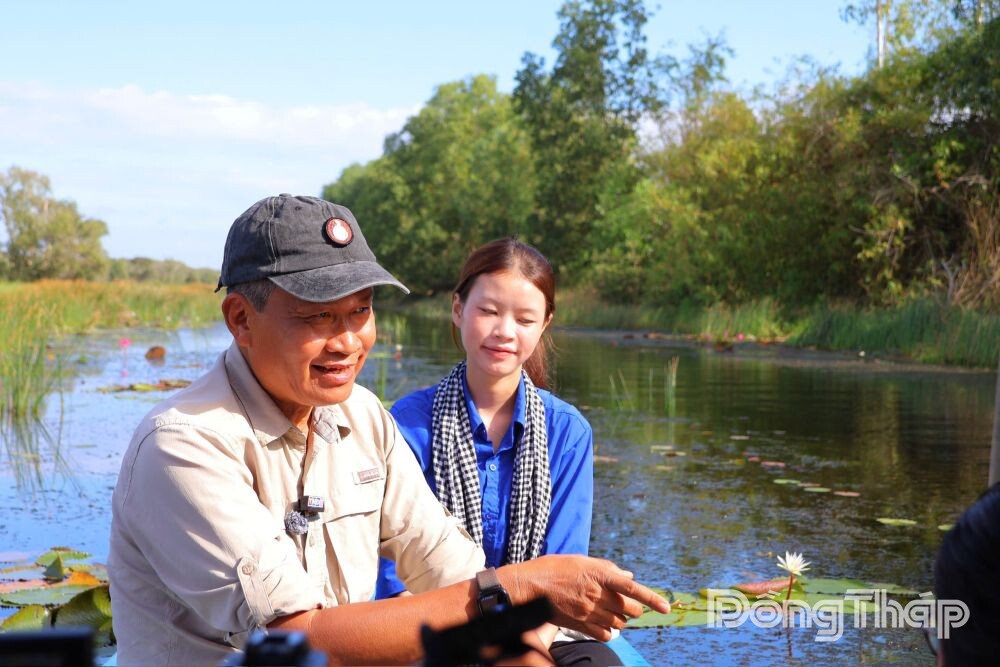
Dr. Tran Triet recounted: "There were periods when I went on surveys and felt extremely anxious."
There were times when I felt very sad seeing Tram Chim in such a desolate state. The recommendations of the scientific community were not fully implemented. I felt helpless seeing the ecosystem deteriorating, and there were times when I thought I would never return to Tram Chim.
But then, my colleagues and I still chose to stay in Tram Chim, continuing our surveys and continuing to offer suggestions and propose solutions for ecosystem restoration.”
Dr. Tran Triet observed: "The biggest shock for this area was when the red-crowned cranes stopped returning to Tram Chim National Park. This absence truly startled many people and prompted them to re-evaluate how they manage the ecosystem."
Since Dong Thap province implemented the Red-crowned Crane Conservation and Development Project with various habitat restoration solutions aimed at making the habitat closer to its natural state.
In just over two years, many positive signs have gradually emerged. The soil has recovered strongly, wild rice has returned, and many species of waterbirds are appearing in greater numbers than before.
WHEN THE BIRD'S NEST STARTS TO TURN GREEN AGAIN
Mr. Doan Van Nhanh, Deputy Director of the Tram Chim National Park Conservation Center, shared that in the journey of restoring the ecosystem and implementing the Red-crowned Crane Conservation Project in Dong Thap, Dr. Tran Triet is one of the scientists who has persistently accompanied Tram Chim National Park.

"There were very difficult periods, but Professor Triet and the experts always stood by Tram Chim National Park."
"He not only conducts research, but also directly goes to the field, guides, and shares his experience with technical staff during the ecosystem restoration process," Mr. Nhanh said.
Currently, alongside Tram Chim National Park and Dong Thap province in the process of restoring the core ecosystem, Dr. Tran Triet, along with many scientists, businesses, and local people, are also gradually changing farming methods in the buffer zone.
"For me, Tram Chim is not just a place for scientific research. It's connected to my youth, my studies, and almost my entire adolescence." |
Many ecological rice production models are being implemented that reduce the use of chemical fertilizers and pesticides, avoid burning rice fields after harvest, and instead use biological products to decompose straw, improve soil, and protect the wetland environment.
According to scientists, saving the Tram Chim ecosystem requires not only the core of the national park but also changes to the surrounding buffer zone to provide waterbirds with foraging space and to allow nature to recover in the most natural way possible.
And perhaps, after more than 40 years of dedication to Tram Chim, what Dr. Tran Triet most hopes for is not just the return of the red-crowned cranes in large numbers as before, but perhaps more simply, to see Tram Chim live in accordance with its natural habitat.
MY LY
Source: https://baodongthap.vn/nguoi-thuoc-tung-nhip-tho-cua-tram-chim-a240870.html





























































































Comment (0)