

 |
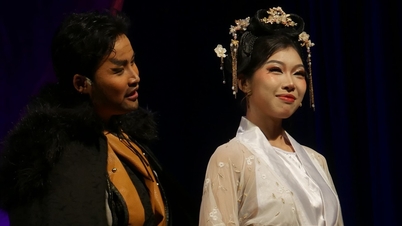
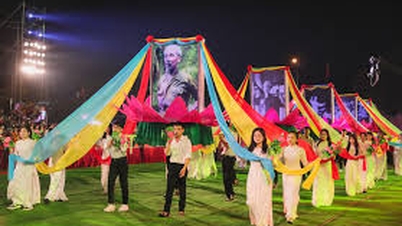
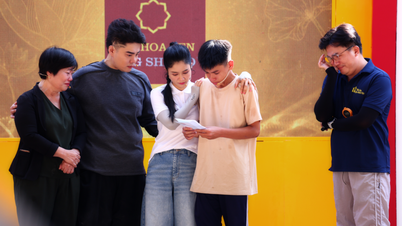
| Artistic program at the celebration of the 260th anniversary of the birth of the great poet Nguyen Du. Photo: baotintuc.vn |
A life of talent, "born in the wrong time".
Nguyen Du's father was Nguyen Nghiem, who served as Crown Prince's Tutor and Prime Minister under the Le Dynasty. His mother was Tran Thi Tan, from Kinh Bac (present-day Bac Ninh ). With such a distinguished family background, Nguyen Du's early life was quite comfortable, if not wealthy and prosperous... But misfortune struck early when he lost his father at just over 13 years old, followed by his mother's death.
Growing up in a turbulent era, Nguyen Du's life was filled with many ups and downs. At the age of 18, he passed the imperial examinations and became an official, but after a short time, he had to abandon his dream of a career in government and immerse himself in the world of the mortals... For more than 10 years, he traveled extensively, both within Vietnam and in China, meeting many people, reading many books, and seeing many different places...
After Gia Long ascended the throne, following the emperor's decree, he assumed several important official positions. Based on the responsibilities entrusted to him and historical records, it can be affirmed that Nguyen Du was an upright, diligent, and talented official. This aspect is often overlooked because later generations tend to focus more on his literary career than his political career...
And of course, the legacy he left for posterity is a vast body of work comprising hundreds of pieces written in both Chinese and Vietnamese scripts, most notably the Vietnamese work "Đoạn trường tân thanh," also widely known as "Truyện Kiều."
The Tale of Kieu was written by Nguyen Du in the lục bát (six-eight) verse form. The lục bát verse form is a Vietnamese poetic form created and widely used in folk songs and anonymous poetry. With The Tale of Kieu, Nguyen Du elevated this form to a new level; almost every Vietnamese person can remember and recite a few lines from The Tale of Kieu. Many verses from The Tale of Kieu are memorized by later generations as if they were folk songs.
 |
| The Tale of Kieu has been translated into more than 20 languages worldwide , with over 60 different translations. (Photo: nhandan.vn) |
Nguyen Du also skillfully used and developed many words, proverbs, and idioms from folk culture and literature, making them easily relatable to readers and enriching the Vietnamese language. Those who have read *The Tale of Kieu* will easily find many national proverbs and idioms incorporated into the story, such as: "sawdust and bitter gourd," "ants crawling to the rim of a cup," "a thief meets an old woman," "being in dire straits and stumbling," "stray cats and wild chickens," "walls have ears," etc. These proverbs and idioms are incorporated into *The Tale of Kieu* in a very fitting and beautiful way, without breaking the rules of the six-eight verse form.
Although it is a long narrative poem with 1,627 pairs of six-eight syllable lines, statistics show that only two lines are completely identical and both express the feelings of Monk Giac Duyen about Kieu's fate: lines 2073 and 2677: "Giac Duyen was devastated upon hearing this."
The Tale of Kieu is considered a pinnacle of descriptive art, both in imagery and emotion. With just a few sentences, or even a single sentence, the reader can visualize or predict the situation. When reading "The horse's hooves stumble, the wheels roll unevenly," everyone understands that this is not only the "stumbling and unevenness" of the carriage but also the "stumbling and unevenness" of Thuy Kieu's life afterward. Similarly, with the line "The lotus fades, the chrysanthemum blooms again / Long sorrow, short days, winter gives way to spring," Nguyen Tien Dien paints before the reader's eyes all four seasons of the year... Regarding the jealousy of married women, Nguyen Du stated, "Jealousy is a common human emotion"...
What makes The Tale of Kieu enduring and great is its profound humanitarian ideology, its empathy and compassion for those whose lives are tragic and oppressed by society, especially the plight of women. The Tale of Kieu is also a portrayal of a society rife with injustice, where money can turn black into white.
Later generations look to the Tale of Kieu to "rediscover human compassion in Nguyen Du's poetry" (lyrics by musician Thuan Yen). From the original Tale of Kieu, posterity has created a number of interesting "games," such as reciting Kieu, composing poems about Kieu, practicing Kieu, and even fortune-telling with Kieu... This further affirms the stature of the Tale of Kieu in the cultural life of the people.
The author of the poetry collection "Dieu Tan," poet Che Lan Vien, remarked with emotion: "When Nguyen Du wrote Kieu, the country was transformed into literature"...
Time may pass, but the "masterpiece" of The Tale of Kieu, with its "words like pearls and lines like embroidered silk" by To Nhu, will forever endure in the consciousness and cultural identity of the Vietnamese people.
Source: https://huengaynay.vn/van-hoa-nghe-thuat/nguyen-du-viet-kieu-dat-nuoc-hoa-thanh-van-161572.html
![[Photo] “Red Journey” 2026: Vietnamese Youth Continue Building the Bridge of Friendship Between Vietnam and China](https://vphoto.vietnam.vn/thumb/1200x675/vietnam/resource/IMAGE/2026/04/20/1776629730866_4055880775670638308-9618-4200-jpg.webp)






































































Comment (0)