

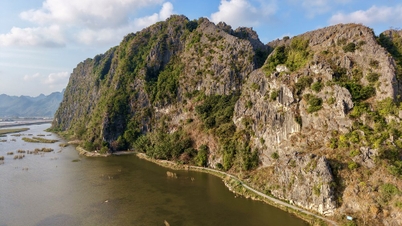
At times, the water level from one side of the river to the other was only a few meters. In some sections, it was almost completely dry. In the old days, there were plenty of fish, shrimp, snails, and clams, and during this time, residents on both banks of the river could freely go down to the river to collect and sift for their daily food, saving money on groceries. Those who were skilled would even catch extra to sell at the market and buy other food items to bring home.
Life on the river in the past was bustling, vibrant, and full of life. Adults pulled nets and cleared traps; young people caught gobies or dived to catch eels and shrimp; children gathered clams, searched for mussels, or simply played, throwing mud at each other, playing hide-and-seek... The sounds of rural life in the riverine region resonated and pulsated.
In my village, there's an elderly woman with eleven children. Her family only owns a few acres of rice paddies, cultivated once a year, providing just enough rice for a family of over ten for the whole year (sometimes they have to supplement with sweet potatoes or cassava). Rice is manageable, but other food is always scarce. Sometimes, they'd boil five duck eggs, dip them in fish sauce with garlic and chili, and add some garden vegetables for dipping. In the old days, meals for many families were always so meager. To improve her children's meals, the mother had to go down to the river every day to catch fish, shrimp, and clams... as persistent as a heron. A hollowed-out, dried gourd served as a container for her catch, a hand-woven scooping basket, and a banana fiber rope tied to her body connecting to the gourd – and so began her struggle for survival. The woman waded from one small stream to another, from one stretch of river to another, raking, sifting, scooping, and scooping for every silver shrimp, coconut goby, and minnow… Whenever the water level was low, she would go into the river, day or night. At night, she would wrap herself in a piece of plastic to keep warm. During the first night rains of the season, soaking her frail body, the plastic clinging to her, making her shiver. On nights when I stayed up late studying, under the bright moonlight, seeing the image of the frail woman fumbling in the river, my eyes would well up with tears. I suddenly remembered the folk song: "The stork that goes out to eat at night…". Yet, that woman raised eleven children who became successful through education—doctors, engineers, teachers… all of them. Her filial and accomplished children were raised from the fish and shrimp of their simple country mother.
One afternoon during the dry season, I sat on the riverbank, gazing at my familiar river. The northeast wind was still blowing fiercely, and I thought I could still see the lingering silhouette of a heron somewhere on the river.
Source: https://thanhnien.vn/nhan-dam-mua-can-18526040418201242.htm



![[Photo] General Secretary and President To Lam presides over a working session with the Central Policy and Strategy Committee on the development of the materials industry.](https://vphoto.vietnam.vn/thumb/1200x675/vietnam/resource/IMAGE/2026/05/21/1779359935432_a3-bnd-3129-1412-jpg.webp)







































































Comment (0)