

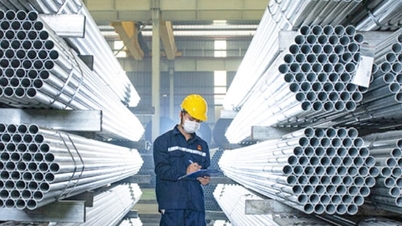
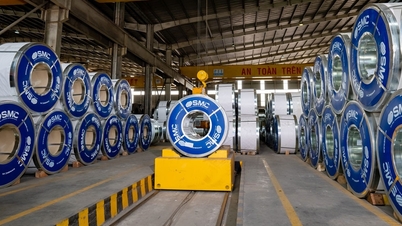
| Self-sufficiency in domestic steel production is an essential requirement. Many solutions are needed to overcome difficulties for the steel industry. |
Steel imports remain high.
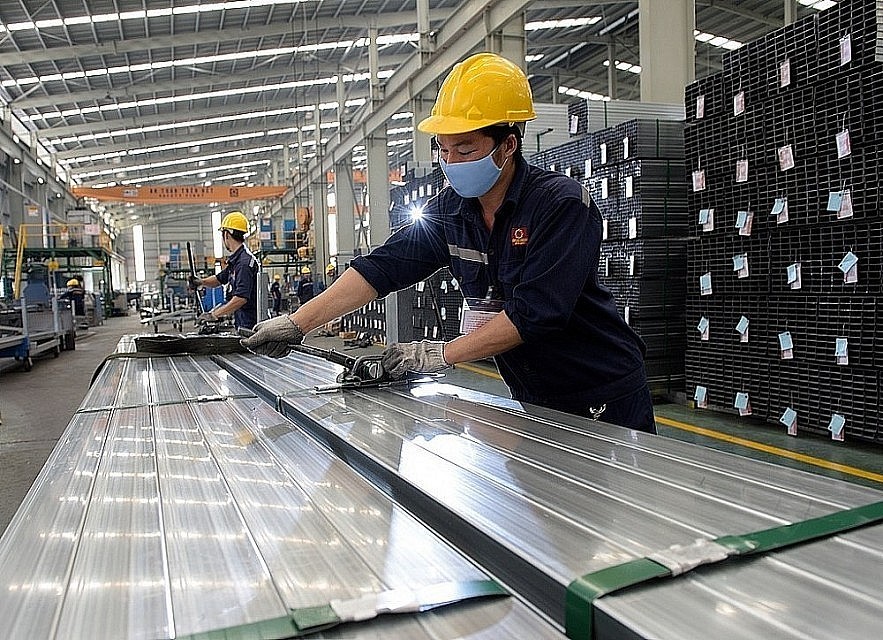
According to the General Department of Customs, the value of imported iron and steel of all types in May reached US$1.72 billion, an increase of 14.9%, or US$223 million, compared to the previous month. Of this, the value of imported iron and steel of all types was US$1.13 million, an increase of 17.9%, with a volume of 1.55 million tons, an increase of 20.6% compared to the previous month.
 |
| The Ministry of Industry and Trade promptly applies trade defense measures (safeguard measures, anti-dumping, anti-subsidy, and trade circumvention measures) to prevent unfair competition and protect domestic production. |
In the first five months of 2024, the country imported $7.48 billion worth of iron and steel of all types, an increase of 26.3%, equivalent to an increase of $1.56 billion compared to the same period in 2023, and approximately the same as the import level of the first five months of 2022. Of this, the import volume of iron and steel of all types was 6.92 million tons, an increase of 50.15%, with a value of $5.02 billion, an increase of 27.6% compared to the same period in 2023.
Vietnam mainly imports various types of iron and steel from the following key markets: China, reaching US$4.77 billion, an increase of 53.8% compared to the same period in 2023 and an increase of 37.9% compared to the same period in 2022; and South Korea, reaching US$735 million, an increase of 4.6% compared to the same period in 2023.
The influx of large quantities of imported steel, especially steel originating from China, is causing significant difficulties for the domestic manufacturing industry.
According to the Vietnam Steel Association (VSA), with the current recovery trend, finished steel production in 2024 is projected to reach 30 million tons, a 7% increase compared to 2023, but this recovery is uncertain, and steel businesses still face many difficulties.
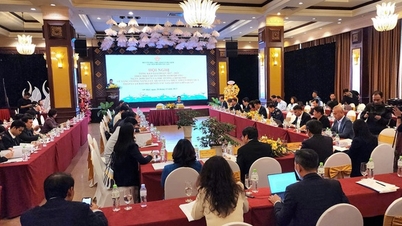
Speaking at a recent conference on resolving difficulties in the construction materials industry, Mr. Nghiem Xuan Da, Chairman of the Vietnam Steel Association (VSA) and General Director of the Vietnam Steel Corporation, pointed out that with China's continued increase in steel exports, Vietnamese steel producers face the risk of losing their domestic market. In the first four months of the year alone, steel imports from China accounted for 40% of domestic steel production.
Regarding this issue, Mr. Nguyen Huu Truong Hung, representative of the Trade Remedies Department (Ministry of Industry and Trade), stated that in the near future, the steel industry will continue to face many difficulties in competing with imported steel from China due to the small scale of production and high production costs compared to large Chinese enterprises. Furthermore, many domestic steel products still rely on imported raw materials from China.
Most domestic businesses are currently only capable of producing basic steel products, serving the real estate sector, and lack the capacity to produce high-quality products. Therefore, it will take another 5-10 years before Vietnam is capable of producing steel products for the mechanical engineering industry, such as steel for car bodies and ship hulls.
Furthermore, the oversupply of many domestic steel products, coupled with the increase in steel imports, will intensify price competition for domestically produced finished steel. In addition, the volatile global market and rising international freight costs also pose significant risks for steel companies.
The urgent need to protect the domestic steel industry.
In light of current difficulties, VSA has proposed that the Government direct relevant agencies to continue developing and improving the system of technical management and quality management standards, as well as technical barriers, to prevent substandard steel products that do not meet safety and environmental technical standards from entering the Vietnamese market.
The Ministry of Industry and Trade promptly applies trade defense measures (safeguard measures, anti-dumping, anti-subsidy, and trade circumvention measures) to prevent unfair competition and protect domestic production.
VSA requests the Ministry of Industry and Trade to continue guiding and supporting steel exporting enterprises to respond promptly and effectively to trade defense cases against steel production abroad.
Regarding the issue of massive steel imports into the market, the Ministry of Industry and Trade has regularly reviewed and assessed the impact of steel imports, promptly received feedback from the business community, and protected domestic businesses through trade defense measures (anti-dumping, anti-tax evasion, anti-subsidy, trade safeguard measures) and technical measures.
In an effort to protect domestic production from the influx of imports, on June 14, 2024, the Ministry of Industry and Trade issued Decision No. 1535/QD-BCT on investigating the application of anti-dumping measures against certain coated steel products originating from China and South Korea.
Also on June 14, 2024, the Ministry of Industry and Trade announced that it had received complete and valid dossiers requesting an investigation into the application of anti-dumping measures against hot-rolled steel (HRC) products from India and China.
To address the difficulties facing the steel industry, regarding loan support, the Ministry of Industry and Trade has proposed that the Ministry of Finance review, update, and implement appropriate import tax policies for certain steel products with significant price fluctuations; and proposed that the State Bank of Vietnam direct and encourage commercial banks to implement preferential credit packages to support investment, production, and trading in the steel industry.
Simultaneously, the Ministry of Industry and Trade is developing and is expected to soon submit to the Prime Minister the Strategy for the Development of Vietnam's Steel Industry until 2030, with a vision to 2050. Accordingly, the Ministry is finalizing the draft to report to the Government for submission to the National Assembly for the promulgation of the Law on the Development of Key Industries. The long-term goal is to develop the steel industry into a national foundational industry, meeting domestic demand and rapidly increasing exports.
| According to the Ministry of Industry and Trade, the development strategy for the steel industry needs to be considered and researched based on the capacity, competitiveness, and market demand characteristics of each domestically produced steel product. Through this, the objectives, solutions, and development directions will be more appropriate and feasible for the steel industry in general and for each domestic steel product in particular when this development strategy is approved in the near future. |
Source: https://congthuong.vn/nhap-khau-thep-tang-giai-phap-nao-bao-ve-nganh-thep-trong-nuoc-327926.html


![[Photo] Prime Minister Pham Minh Chinh presides over a meeting on private sector economic development.](/_next/image?url=https%3A%2F%2Fvphoto.vietnam.vn%2Fthumb%2F1200x675%2Fvietnam%2Fresource%2FIMAGE%2F2025%2F12%2F20%2F1766237501876_thiet-ke-chua-co-ten-40-png.webp&w=3840&q=75)









































































Comment (0)