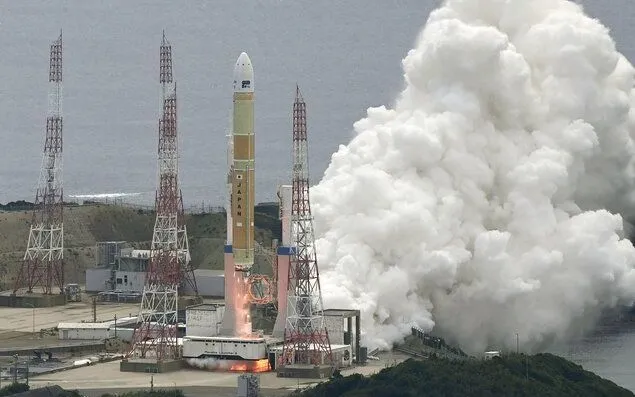
The H3-6 rocket, carrying six small satellites, lifted off from the Tanegashima Space Center in Kagoshima Prefecture, Japan, on June 12, 2026. (Photo: Kyodo)
The Japan Aerospace Exploration Agency (JAXA) announced that the H3 No. 6 rocket was successfully launched from the Tanegashima Space Center in Kagoshima Prefecture, southwestern Japan, at approximately 9:55 a.m. local time on June 12.
The launch took place two days later than originally planned due to unfavorable weather conditions at the launch site.
According to JAXA, this is the first time Japan has launched a rocket using only liquid-fuel engines, without the addition of a solid-fuel booster. This H3 version has a simpler configuration, consisting of three main engines, which reduces weight and cost compared to some other H3 versions.


The H3 rocket carried six small satellites, including the Umitsubame satellite from the Tokyo Institute of Science , equipped with a high-performance camera for ocean observation, and the Shiraito satellite from Shizuoka University, used to test technology for removing space debris.
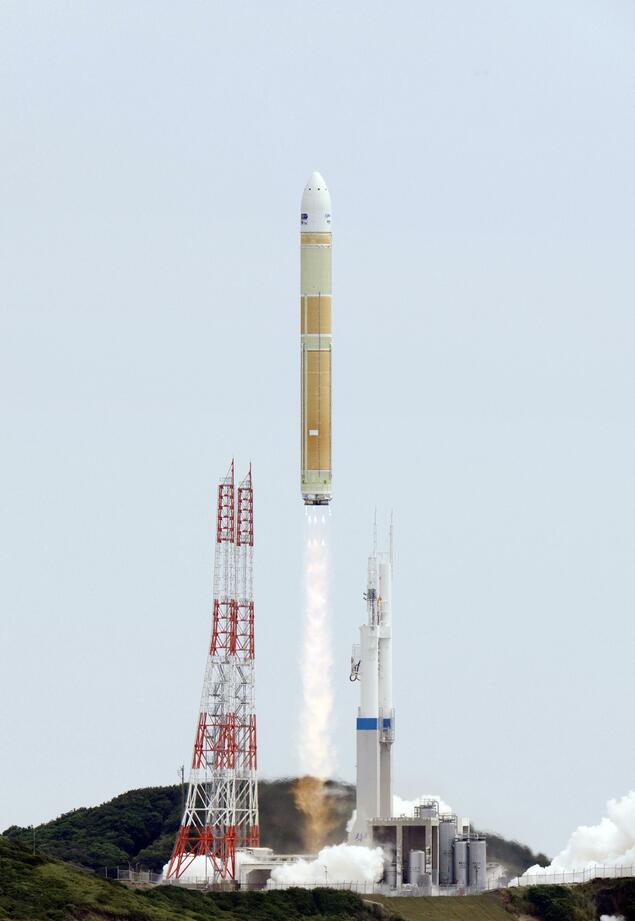
The H3 No. 6 rocket was launched from the Tanegashima Space Center in Kagoshima Prefecture, Japan, on June 12, 2026. (Photo: Kyodo)
JAXA stated that this successful launch completes the H3 rocket's three-configuration system. This is a new generation rocket developed by Japan to enhance satellite launch capabilities and increase competitiveness in the space sector.



Previously, the most recent H3 rocket launch was in December last year, but failed to put a satellite into orbit. The H3's maiden flight in March 2023 also failed after the second-stage engine failed to activate, forcing JAXA to order the rocket to self-destruct. The launch of H3 No. 6 was also delayed after a malfunction was discovered during an engine burn test in July 2025.
Source: https://vtv.vn/nhat-ban-phong-thanh-cong-ten-lua-h3-the-he-moi-100260612161651073.htm