

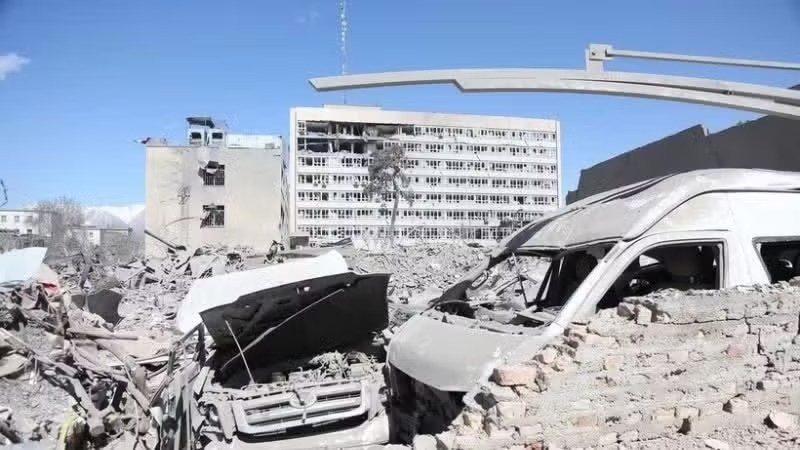
US and Israeli airstrikes against Iran, along with Tehran's closure of the Strait of Hormuz, have driven energy prices up sharply, causing instability in global markets.
Disruptions to shipping in the Strait of Hormuz – a strategic shipping route handling 20% of the world's traded oil – are putting significant pressure on fuel costs, inflation, and global consumer demand.
In the UK, the unemployment rate rose to 5% in the first quarter, attributed to the negative impact of the conflict in the Middle East. The Office for National Statistics (ONS) reported that the number of jobs fell to its lowest level in five years.
Experts warn that rising energy prices will undermine the UK's economic recovery. The European Commission (EC) also lowered its growth forecast for the Eurozone in 2026 to 0.9%, down from the previous 1.2%.
Conversely, the EC raised its inflation forecast to 3%, well above the European Central Bank's (ECB) target of 2%.
EU Vice President for Economic Affairs Valdis Dombrovskis stated that the conflict in the Middle East has created a major energy shock, plunging the continent into a double crisis: slowing growth and high inflation.
The conflict also caused a sharp increase in government borrowing costs in many countries. Yields on 30-year US Treasury bonds rose to their highest level in 19 years, while long-term bond yields in Japan and the UK also reached multi-decade peaks. The global aviation industry also did not escape the shadow of the crisis in the Middle East.
British low-cost airline EasyJet reported a loss of £377 million (over $500 million) in the first half of this year, mainly due to sharply rising jet fuel prices and weak travel demand.
Airbus has had to implement austerity measures, cutting 10% of unnecessary expenses on travel, conferences, and outsourcing.
Japan's tourism industry has also been negatively impacted, with international visitor numbers falling 5.5% year-on-year to 3.69 million, including a significant 21.4% drop in visitors from the Middle East. Conflicts in the oil-rich Middle East have also further depleted the wallets of global workers.
According to statistics from the International Labour Organization (ILO), real labor income will decrease by $3 trillion by 2027 if oil prices are more than 50% higher than they were at the beginning of 2026. Under this undesirable scenario, global working hours would decrease by 0.5% in 2026 and 1.1% in 2027.
This is equivalent to 14 million and 38 million full-time jobs, respectively, while real labor income fell by 1.1% and 3%. The global unemployment rate is expected to gradually increase, rising by 0.1% this year and 0.5% next year.
Remittances—a major source of income for many families and a crucial financial resource for many countries in South Asia and Southeast Asia—are beginning to weaken.
The conflict also led to a sharp decline in migration in the Gulf region due to a dramatic drop in demand for labor in the construction, hospitality, restaurant, and transportation sectors. Beyond the energy sector, global food prices also suffered significant impacts.
The United Nations Food and Agriculture Organization (FAO) warns that a blockade of the Strait of Hormuz risks triggering a serious global food price crisis in the coming months.
This shock is unfolding in stages, involving energy, fertilizer, and seed shortages, declining yields, rising commodity prices, and ultimately leading to food inflation.
The FAO warns that a full-blown food crisis is poised to engulf the world within the next 6-12 months. Conflicts in the Middle East are clearly having unpredictable consequences for the world.
This problem can be solved if the parties involved make concessions, cooperate, and work towards restoring peace and security in the region and the world.
Source: https://nhandan.vn/nhieu-he-luy-kho-luong-post964403.html



![[Image] Close-up view of the interchange connecting the two expressways and Long Thanh Airport.](https://vphoto.vietnam.vn/thumb/1200x675/vietnam/resource/IMAGE/2026/05/25/1779703378210_ndo_br_z7863716673926-224453a31600126cce10622af6290afd-4549-jpg.webp)

![[Image] Hanoi's urban life under the challenge of a "scorching hot" environment](https://vphoto.vietnam.vn/thumb/1200x675/vietnam/resource/IMAGE/2026/05/25/1779706979265_nang-nong-t5-2026-minh-duy-7-4636-jpg.webp)





















































































Comment (0)