

Cars and motorcycles must reduce fuel consumption.
In Decision 876/QD-TTg dated July 22, 2022, the Government requested the application of fuel consumption limits for road motor vehicles according to a roadmap, aiming to minimize fuel consumption and greenhouse gas emissions.

Cars and motorcycles will soon have fuel consumption limits.
On September 30, 2024, the Ministry of Transport (now the Ministry of Construction ) issued Decision No. 1191/QD-BGTVT on the Plan for Reducing Greenhouse Gas Emissions in the Transport Sector until 2030. This decision proposed a fuel consumption limit for newly manufactured, assembled, and imported motor vehicles - the "E17 Measure".
This measure aims for fuel efficiency by 2030 to reach the following targets: "100% of motorcycles sold will meet the standard of 2.3 liters/100km; 100% of all types of automobiles sold will meet the following standards: passenger cars (<1,400cc) will reach 4.7 liters/100km, medium-sized cars (1,400-2,000cc) will reach 5.3 liters/100km, and large cars (>2,000cc) will reach 6.4 liters/100km."
Therefore, by 2030, only cars with fuel consumption levels below 4.7 to a maximum of 6.4 liters of fuel per 100km will be allowed on the market, depending on engine capacity, meaning the application of the MEPS method (Minimum Energy Performance Standards). This fuel consumption level is significantly lower than most car models currently on the market.
According to Mr. Tran Quang Ha, Deputy Director of the Department of Science, Technology, Environment and Construction Materials (Ministry of Construction), many measures in the transportation sector have been and are being implemented to achieve the Net Zero goal by 2050, including the application of energy consumption limits. However, the method of managing energy consumption levels is still under consideration, with the view that it must harmonize economic and environmental benefits.
"From a personal perspective, I believe that controlling energy consumption levels according to CAFC (Comprehensive Average Energy Consumption of the Enterprise) would be more appropriate for the current situation. It would ensure both socio-economic and environmental goals while harmonizing the interests of the enterprise."
"Currently, the Ministry of Construction has assigned the Vietnam Register to develop a set of standards on fuel consumption limits and is expected to issue them this year. This set of standards will serve as a basis for automobile and motorcycle manufacturers and importers to self-assess their ability to meet requirements and make timely preparations and adjustments before the mandatory regulations are implemented. The choice of which method to use for managing fuel consumption levels will be carefully considered to best suit the actual situation," Mr. Ha said.

Under the MEPS regulations, most large-engine, luxury car models face the risk of being discontinued.
A major impact on the automotive industry.
Recently, the Central Institute for Economic Management Research (CIEM) and the Institute of Transport Science and Technology (ITST) collaborated on an "Independent report researching and proposing fuel consumption limits for passenger cars with 9 seats or fewer in Vietnam by 2030, aiming for net-zero emissions by 2050".
According to research, if the E17 measure is implemented, up to 97% of ICE (Internal Combustion Engine) vehicle models will be forced to cease production and import due to not meeting the set quotas. Of these, approximately 21.7% of customers may switch to hybrid or electric vehicles. Thus, the annual decrease in car sales volume under this measure would be 77%.
The research team predicts that applying the MEPS method would have a significant impact on the economy. In contrast, using the CAFC method, while still impacting GDP, would have a much lower effect and would still aim to ensure emission reduction targets are met.
For example, the implementation of MEPS would reduce the industry's contribution to GDP by approximately 574 trillion VND and decrease state budget revenue from domestically produced and imported automobiles by about 377 trillion VND.
While with a scenario of an annual automobile fleet growth rate of 10%, applying CAFC would only reduce the value contribution to GDP by approximately 73 trillion VND and budget revenue by approximately 38 trillion VND.
According to Mr. Dao Cong Quyet of the Vietnam Automobile Manufacturers Association, if MEPS (Medium-Electric Vehicles Permit System) is implemented, which means establishing fuel consumption limits based on engine displacement, only BEV (fully electric vehicles), HEV (self-charging hybrid vehicles), or PHEV (charging hybrid vehicles) will meet the requirements. Consequently, ICE (internal combustion engine vehicles) will have to cease production, assembly, and sales.

This would have a very serious impact on the domestic automotive industry, state budget revenue, and people's jobs.
At the same time, the implementation of MEPS would limit the automotive market to certain types of vehicles, while customer demand would remain unmet.
Customers who are not yet ready to switch to hybrid or electric vehicles tend to prolong the use of their old cars, further putting pressure on environmental protection goals, especially in the areas of vehicle recovery and recycling.

Most countries now apply the CAFC model in managing energy consumption limits.
The CAFC solution helps achieve dual goals.
To date, most other countries that have taken the lead in implementing energy consumption limit regulations (except China) are only applying the CAFC (or CAFE) model.
According to Mr. Dinh Trong Khang, Deputy Director of the Institute of Environmental Science (Institute of Science and Technology for Transport), "We need to carefully consider whether to apply the MEPS management model from China, because they are a country that independently produces vehicles and only applied MEPS in the initial stages of policy implementation with the aim of gradually phasing out outdated technology and old vehicles with high energy consumption and emissions. In later stages, China adjusted its energy consumption limit management policy by simultaneously applying both MEPS and CAFC methods."
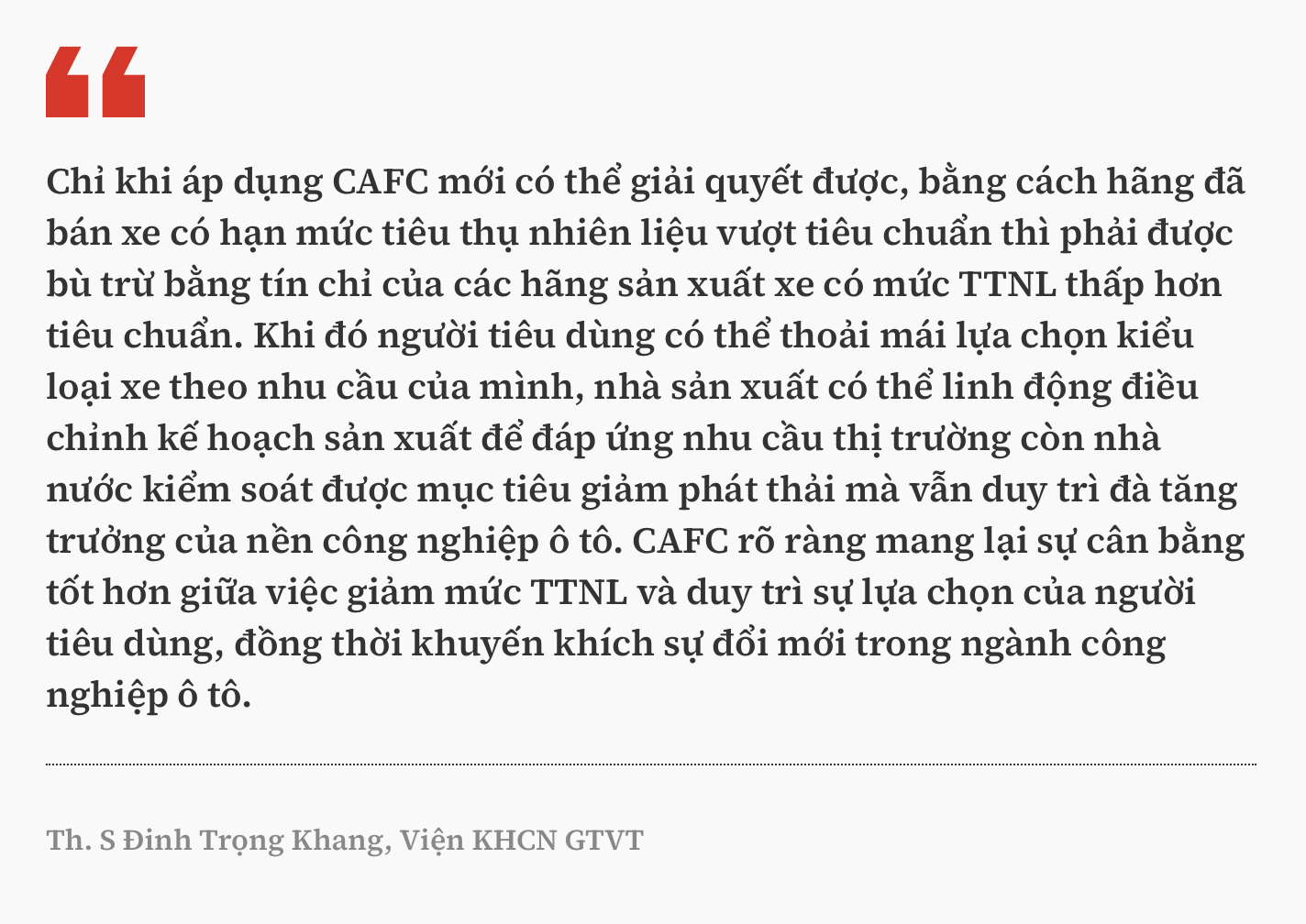
We can disregard MEPS due to its less flexibility compared to CAFC.
CAFC focuses on the average fuel efficiency of the entire fleet sold by a manufacturer, giving them more flexibility in meeting standards. This encourages manufacturers to develop fuel-efficient vehicles while still allowing them to produce high-powered models. Meanwhile, MEPS sets minimum performance standards for each individual vehicle, which can limit consumer choice and make things difficult for manufacturers.
CAFC incentivizes manufacturers to invest in research and development of new fuel-saving technologies, while MEPS may lead manufacturers to focus only on meeting minimum standards, rather than striving to improve fuel efficiency.
"If CAFC is used, controlling fuel consumption limits will be more flexible, allowing the same car manufacturer to still sell vehicles with engines over 2.0L or 1.4L, provided the manufacturer controls the production volume of each vehicle type sold so that the average total fuel consumption of all vehicle types sold in a year is lower than the prescribed standard. In addition, the CAFC model also serves as a basis for building a management system to support carbon market policies in the transportation sector," a VAMA representative said.
Cam Tu - xe.baoxaydung.vn
Source: https://xe.baoxaydung.vn/nhieu-mau-xe-phai-dung-ban-neu-khong-dap-ung-han-muc-tieu-thu-nhien-lieu-192250414115308028.htm

![[Image] First UAV flight test in medical transport](/_next/image?url=https%3A%2F%2Fvphoto.vietnam.vn%2Fthumb%2F1200x675%2Fvietnam%2Fresource%2FIMAGE%2F2025%2F12%2F24%2F1766560655977_thunghiembay-3551-jpg.webp&w=3840&q=75)


![[Image] First Congress of the Vietnam Science and Technology Trade Union](/_next/image?url=https%3A%2F%2Fvphoto.vietnam.vn%2Fthumb%2F1200x675%2Fvietnam%2Fresource%2FIMAGE%2F2025%2F12%2F24%2F1766552551054_ndo_tr_img-1801-jpg.webp&w=3840&q=75)







































































































Comment (0)