

AI-related activities receive the highest level of support.
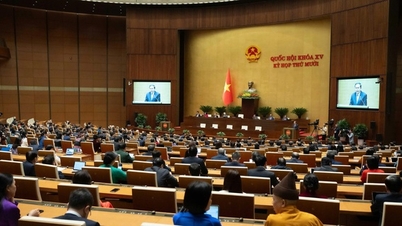
On the afternoon of December 10th, at the 10th session of the 15th National Assembly , the National Assembly voted to pass the Law on Artificial Intelligence, with 429 out of 434 participating delegates voting in favor.
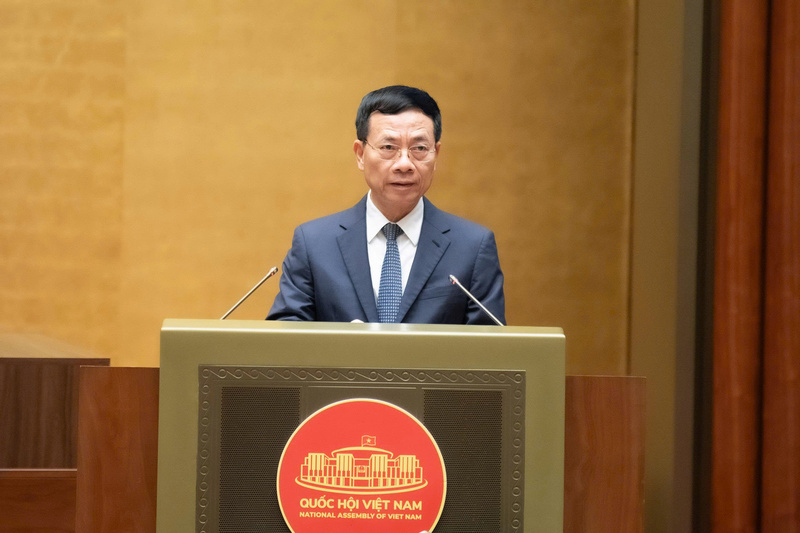
Minister of Science and Technology Nguyen Manh Hung
Before proceeding to the vote, the National Assembly heard a report from the Minister of Science and Technology, Nguyen Manh Hung, acting on behalf of the Prime Minister, on the process of receiving feedback, providing explanations, and revising the draft Law on Artificial Intelligence (AI).
Minister of Science and Technology Nguyen Manh Hung affirmed that the promulgation of the Law on Artificial Intelligence is an urgent requirement to institutionalize the Politburo's resolutions, creating a specialized legal framework for a field with profound impacts on the economy, society, national defense, security, and human rights.
To address concerns about overlap with the Law on Digital Technology Industry, the draft Law clearly stipulates in Article 33 the complete repeal of Chapter IV on Artificial Intelligence of the Law on Digital Technology Industry. This confirms that the Law on Artificial Intelligence will be the sole, unified specialized legal document comprehensively regulating this field, focusing on risk management and ethics, distinct from the industrial scope of the Law on Digital Technology Industry.
The draft law is structured as a "framework law," focusing on core principles (Article 4), prohibited acts (Article 7), and a risk management framework (Chapter II). The approach to drafting the law is to build upon humanity's experience in managing artificial intelligence and adapt it appropriately to AI, including: managing inputs through data; managing the framework for use through laws and ethics; and managing consequences through accountability mechanisms.
Furthermore, the draft law is designed to strike a balance between managing and promoting AI development, ensuring a high level of security against key risks (drawing on the experience of the EU and South Korea), while simultaneously including policies to strongly promote development (similar to Japan's approach) to capitalize on opportunities and avoid stifling innovation.
To concretize this viewpoint, the Government has revised the draft law to ensure a substantive balance between management and development promotion. Regarding promotion policies, the draft law affirms that activities related to artificial intelligence enjoy the highest level of incentives and support to encourage innovation and the development of the AI market (Article 20).
Regarding the testing mechanism, the controlled testing mechanism (Sandbox) in Article 21 has been improved to create more favorable conditions for businesses, including allowing exemptions or reductions of certain compliance obligations and applying a rapid assessment and feedback process as prescribed by the Government.
Regarding resources, the National Artificial Intelligence Development Fund (Article 22) is adjusted to focus on supporting the development of strategic infrastructure and core technologies with a specific financial mechanism. In particular, the draft Law adds a support voucher mechanism (Article 25) to facilitate access to computing infrastructure and training platforms for startups and small and medium-sized enterprises, thereby increasing national competitiveness.
Keeping pace with global AI development trends.
With a high approval rate, the National Assembly affirmed its strong consensus on the necessity of enacting the Law on Artificial Intelligence, a landmark law that will create a pioneering legal framework to help Vietnam catch up with global AI development trends and enhance national competitiveness in the digital age.
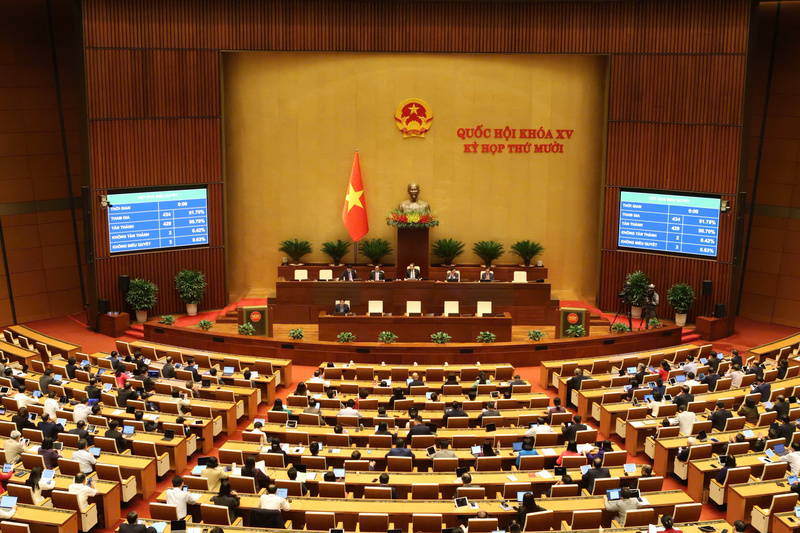
The National Assembly voted to pass the Law on Artificial Intelligence.
This is the first time Vietnam has drafted and enacted a separate law on AI. The law, comprising 35 articles, is designed with a "management-for-development" approach, ensuring a balance between risk control and innovation promotion, in line with international practices and supporting Vietnam's proactive integration with new technological standards.
The Artificial Intelligence Act identifies humans as the central focus, stipulating that AI should serve humans, not replace them, and that human oversight is required in important decisions.
The Artificial Intelligence Law lays the foundation for AI autonomy, from computing infrastructure to data and research capabilities, helping Vietnam build a strong AI workforce capable of competing internationally; it allows the State to invest in a national AI computing center and build a controlled open data system. These directions are expected to reduce computing costs, remove barriers to market entry, and promote a more competitive and transparent AI ecosystem.
The law also creates regulations to promote AI development, such as: establishing a National AI Development Fund, implementing an AI Voucher mechanism to support businesses in applying AI, and establishing a controlled testing sandbox for sensitive AI solutions. These are important tools to reduce risks, lower testing costs, and enable technology companies, especially high-tech startups, to test sensitive AI applications in an environment exempt from certain legal liabilities.
The Law on Artificial Intelligence simultaneously addresses emerging issues such as AI-generated content, algorithmic ethics, and the responsibility of cross-border AI service providers, thereby paving the way for Vietnam to integrate more deeply with international standards while maintaining its digital sovereignty.
A key aspect of the Law is its risk-based management approach. Accordingly, AI systems are classified according to their impact and risk levels, thus linking them to corresponding legal obligations. Applications posing a high risk to the legitimate rights and interests of organizations and individuals (in the fields of finance, healthcare, justice, labor, education, etc.) will have to meet stricter standards regarding data, verification, monitoring, and human intervention mechanisms. This approach allows for a balance between two objectives: encouraging innovation in AI and controlling potential social consequences.
Alongside regulations on technology and management, the AI Law places a significant emphasis on human resource development. The law requires the development of a long-term national AI human resource strategy; the integration of basic AI knowledge into general education; and encourages universities to open new majors, expand academic autonomy, and attract international experts. The national AI human resource development program will contribute to the formation of a high-quality workforce of AI experts and engineers in the future.
The National Assembly's approval of the Artificial Intelligence Law is considered a necessary and timely step as AI is deeply penetrating all aspects of life. A comprehensive and clear legal framework will help Vietnam avoid the risk of falling behind, ensure data security, privacy, and the sustainable development of the AI ecosystem.
From here, Vietnam officially enters a new phase, a phase of developing AI proactively, responsibly, safely, and creatively, creating a foundation for AI to become one of the most important growth drivers of the digital economy.
Artificial intelligence is a new field that has recently experienced rapid development, impacting the economy, culture, society, security, and national governance at a profound level. The enactment of the Artificial Intelligence Law in Vietnam is necessary to create a legal framework for sustainable development, ensuring proactive seizing of opportunities and managing risks.
Quynh Nga
Source: https://congthuong.vn/luat-tri-tue-nhan-tao-dat-nen-tang-cho-tu-chu-ai-434226.html
![[Photo] Prime Minister Pham Minh Chinh holds a phone call with the CEO of Russia's Rosatom Corporation.](/_next/image?url=https%3A%2F%2Fvphoto.vietnam.vn%2Fthumb%2F1200x675%2Fvietnam%2Fresource%2FIMAGE%2F2025%2F12%2F11%2F1765464552365_dsc-5295-jpg.webp&w=3840&q=75)



![[Photo] Closing Ceremony of the 10th Session of the 15th National Assembly](/_next/image?url=https%3A%2F%2Fvphoto.vietnam.vn%2Fthumb%2F1200x675%2Fvietnam%2Fresource%2FIMAGE%2F2025%2F12%2F11%2F1765448959967_image-1437-jpg.webp&w=3840&q=75)










































![[OFFICIAL] MISA GROUP ANNOUNCES ITS PIONEERING BRAND POSITIONING IN BUILDING AGENTIC AI FOR BUSINESSES, HOUSEHOLDS, AND THE GOVERNMENT](https://vphoto.vietnam.vn/thumb/402x226/vietnam/resource/IMAGE/2025/12/11/1765444754256_agentic-ai_postfb-scaled.png)












































Comment (0)