

The National Assembly's consideration and approval of the Law on Artificial Intelligence during this session is also considered an important step forward, creating the first legal framework for a field that is developing explosively and has a profound impact on all aspects of life.
AI is an intelligent infrastructure.
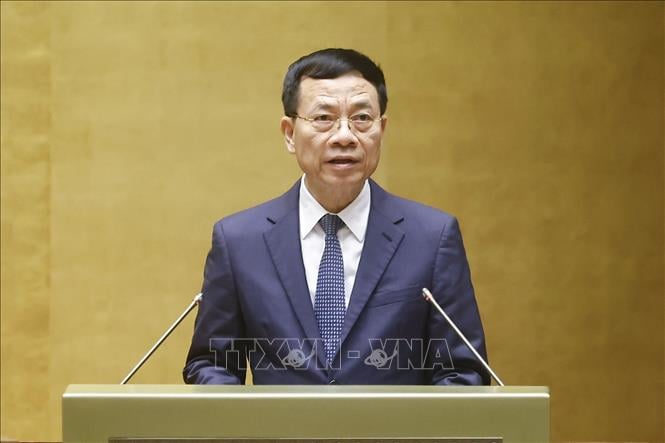
Evaluating artificial intelligence, Minister of Science and Technology Nguyen Manh Hung emphasized: AI is an intelligent infrastructure. AI is not just an applied technology; it is becoming a national "infrastructure," similar to electricity, telecommunications, or the Internet. Whoever masters AI will have a significant advantage in production, business, healthcare, education , national governance, and even defense and security. Vietnam must have its own AI intelligent infrastructure. Vietnam is rapidly building a national AI supercomputing center and open AI data. "We will implement AI faster, as fast as possible," Minister Nguyen Manh Hung stated.
Minister Nguyen Manh Hung also suggested that popularizing AI and promoting AI education among the general public should be similar to the English learning movement of the past, or the literacy campaign 80 years ago. Every Vietnamese person will have an AI assistant; the population will not increase, but social intelligence will at least double. Previously, only ministers and above had assistants, costing thousands of USD, but now, an ordinary citizen can also have an assistant, costing only 10 USD.
The first institutional step for the AI sector is the adoption of the Law on Artificial Intelligence. Regarding this draft Law, Minister Nguyen Manh Hung said that the Law on Artificial Intelligence (AI Law) is a short, framework law, focusing on defining principles and governance frameworks, ensuring flexibility for the Government in organizing implementation. The Law does not regulate the model because the model is the result of internal creativity of enterprises and is constantly changing. The Law only regulates the output, that is, the behavior of using AI and the risks arising from AI's impact on society. This is international practice and ensures that it does not hinder innovation.
Commenting on the proposed Artificial Intelligence Law being discussed and expected to be passed by the National Assembly, Mr. Ho Duc Thang, Director of the National Institute of Digital Technology and Digital Transformation, stated that the core spirit of the AI Law "is not about tightening management, but about creating a transparent and safe legal framework," based on risk management to promote innovation. This is how institutions lead the way, paving the path for technological development. This also reflects Vietnam's "clear vision," along with its "aspiration to gradually rise to mastery, towards self-reliance, and affirm national digital sovereignty in AI."
The Law on Artificial Intelligence is just one of a series of strategic steps that Vietnam is implementing to seize the "historic opportunity" in the new technological revolution. Along with institutions, computing infrastructure, financial and human resources are important pillars.
Considering the passage of the Artificial Intelligence Law as the biggest opportunity for Vietnamese semiconductor businesses, Mr. Ho Duc Thang believes that the development of AI infrastructure will create "huge orders" for the domestic chip industry, from design and packaging to testing, and even "Make in Vietnam" chips.
Creating a "push" for Vietnam to gradually master technology
Regarding the National Artificial Intelligence Development Fund stipulated in the draft Law, according to Minister Nguyen Manh Hung, the view of the drafting agency is that although there are funds such as the Science and Technology Development Fund, the Technology Innovation Fund, and the Venture Investment Fund, a separate fund for AI is still needed. AI needs a fast and flexible disbursement mechanism for development. AI is the most important technology of the Fourth Industrial Revolution, requiring huge investments of billions of USD. Existing funds cannot meet the demand. The AI Fund has also been requested to be established by the Steering Committee of Resolution 57.
In response to some concerns about the establishment of this fund, the Ministry of Science and Technology explained that the National Artificial Intelligence Development Fund is a non-budget state financial fund, operating not for profit, playing the role of mobilizing and allocating resources for research, development, application and management of AI. The establishment of the fund is expected to create a strong push for Vietnam to gradually master technology, making a substantial contribution to socio-economic development.
Unlike many existing technology support funds, the National Artificial Intelligence Development Fund is designed with specific, long-term and strategic goals, focusing on four key task groups: Developing AI technical infrastructure; funding core technology research; training and attracting highly qualified AI human resources; supporting special tasks according to socio-economic development and national security and defense requirements.
With these tasks, the Fund becomes a key policy tool for the State to proactively coordinate resources to develop a field that is still very new but has great potential for breakthroughs.
The Fund’s financial resources are formed from charter capital provided by the state budget, along with contributions, aid, and sponsorship from domestic and foreign organizations and individuals. This design allows the Fund to mobilize social resources widely, while creating conditions for technology corporations, large enterprises or international organizations to accompany the Vietnamese Government in AI development. The combination of public and private resources is considered an important condition for Vietnam to catch up with the world’s development speed in the context of increasing demand for investment in computing infrastructure, data and AI research.
One of the Fund's prominent priorities is investing in the development of key artificial intelligence infrastructure, including high-performance computing (HPC) infrastructure, big data infrastructure, and shared platform models. These are essential infrastructures that determine a country's deployment and competitiveness in the field of AI.
In fact, leading AI countries such as the United States, China, South Korea and Singapore all own supercomputers, modern data centers and large models that they own. Vietnam's clear determination of its responsibility to invest in AI infrastructure shows its long-term vision and strong commitment to its national digital transformation strategy.
In addition to infrastructure, the Fund also devotes significant resources to research activities, especially research on core and source technologies in AI. This is a field that requires large, continuous investment and high risk, making it difficult for many businesses to participate without State support. With flexible funding and support mechanisms and simplified procedures for strategic tasks, the Fund can create conditions for strong domestic research groups to break through, develop algorithms, models, platform tools or AI solutions specific to Vietnamese, education, healthcare, agriculture and many other fields. The ability to master core technologies is the decisive factor in helping Vietnam reduce its dependence on imported technology and ensure technological sovereignty.
In particular, the Fund applies a special financial mechanism, allowing flexible capital allocation according to project progress, not limited by the budget year, and at the same time, shortening procedures for strategic tasks. This mechanism creates the necessary flexibility to support at the right time, at the right needs, especially in the context of AI technology changing at a very fast pace. Fund management is also regulated according to the principles of publicity, transparency, efficiency and non-duplication with other state financial funds, ensuring that resources are used for the right purposes and bring the greatest impact.
According to experts, the establishment of the National Artificial Intelligence Development Fund will be a "financial lever" for Vietnam to be more proactive in researching, developing and applying AI, contributing to the goal of building a self-reliant, modern and highly competitive digital economy.
The promulgation of the Law on Artificial Intelligence is an inevitable requirement in the context of AI being increasingly widely applied in many fields. The Law on Artificial Intelligence project is expected to create a major turning point for the AI market in Vietnam, paving the way for AI to become a new growth driver of the digital economy. If passed, Vietnam will be among the pioneering countries with specialized laws on AI, along with the European Union (EU), South Korea and Japan. If there is a delay in the legal corridor, Vietnam may fall behind or face uncontrollable risks related to data security, technology ethics and user protection...
Source: https://baotintuc.vn/chinh-tri/luat-tri-tue-nhan-tao-dat-nen-mong-cho-ha-tang-tri-tue-quoc-gia-20251210121249969.htm


![[Photo] Explore the US Navy's USS Robert Smalls warship](/_next/image?url=https%3A%2F%2Fvphoto.vietnam.vn%2Fthumb%2F1200x675%2Fvietnam%2Fresource%2FIMAGE%2F2025%2F12%2F10%2F1765341533272_11212121-8303-jpg.webp&w=3840&q=75)


![[Photo] The captivating scenery of the fragrant maple forest in Quang Tri](/_next/image?url=https%3A%2F%2Fvphoto.vietnam.vn%2Fthumb%2F1200x675%2Fvietnam%2Fresource%2FIMAGE%2F2025%2F12%2F10%2F1765353233198_lan09046-jpg.webp&w=3840&q=75)


















![[Video] The craft of making Dong Ho folk paintings has been inscribed by UNESCO on the List of Crafts in Need of Urgent Safeguarding.](https://vphoto.vietnam.vn/thumb/402x226/vietnam/resource/IMAGE/2025/12/10/1765350246533_tranh-dong-ho-734-jpg.webp)





































































Comment (0)