

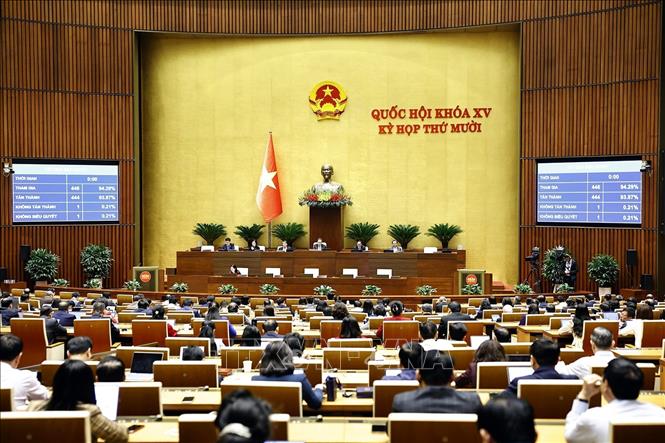
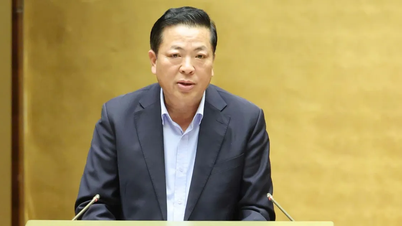
Based on research incorporating the opinions of National Assembly deputies in group discussions, as well as in plenary sessions of the National Assembly; and the opinions of the Standing Committee of the National Assembly, the drafting agency, in coordination with the verification agency and relevant agencies, has revised, perfected, and supplemented several articles of the draft Law on E-commerce. On behalf of the drafting agency, Minister of Industry and Trade Nguyen Hong Dien presented the report on the incorporation, explanation, and revision of the draft law with several contents.
Regarding e-commerce activities on social media and livestreaming sales methods, taking into account the opinions of many National Assembly deputies, the drafting agency has clearly defined the responsibilities of each entity participating in the livestreaming sales process (including sellers, livestreamers, and platform owners) to enhance information transparency, improve the legal responsibility of all parties, and create a basis for inspection, supervision, and handling of violations.
For social networks engaging in e-commerce activities, the draft Law defines them as a separate, independent type of platform, designed with a system of obligations appropriate to their nature. It avoids mechanically applying regulations as it does to intermediary e-commerce platforms, while still ensuring there are no gaps in responsibility, particularly in managing business content, coordinating the handling of violations, and protecting consumer rights.
Regarding regulations on seller identification on e-commerce platforms, they are built on the basis of leveraging the national electronic identification and authentication system (VNeID) to contribute to cleaning up the e-commerce market and limiting counterfeit goods and goods infringing intellectual property rights through the ability to trace sellers, while also effectively supporting tax management and combating revenue loss for the state budget.
In drafting this regulation, the Government adhered to the principle of maximizing the use of existing digital infrastructure and data of the State, avoiding the creation of unnecessary administrative procedures for citizens and businesses, while still ensuring an effective management tool for state agencies.
Regarding the responsibilities of foreign platform operators operating in Vietnam, the draft Law has been revised based on the operating model and functions of e-commerce platforms. Accordingly, the requirements for appointing authorized representatives, establishing legal entities, or appointing legal entities under authorization will be applied based on the operating model and functions of the e-commerce platform, ensuring compliance with international commitments to which Vietnam is a signatory, while simultaneously enhancing the effectiveness of state management and protecting the legitimate rights of domestic consumers.
The Law on E-commerce consists of 7 chapters and 41 articles. The law regulates policies for the development of e-commerce; e-commerce platforms and the responsibilities of organizations and individuals in e-commerce activities; e-commerce with foreign elements; the responsibilities of organizations providing e-commerce support services; and the application of technology in managing and handling violations in e-commerce.
The Law on E-commerce applies to domestic and foreign organizations and individuals participating in e-commerce activities in Vietnam and will take effect from July 1, 2026.
Regarding the development of implementing guidelines, immediately after the Law is passed, the Government will issue an Implementation Plan, which will require that the implementing guidelines ensure clear, complete, feasible, and consistent regulations with related laws; not create new burdens for businesses and citizens; and at the same time, promote post-audit based on data and risk management; clearly define the responsibilities of each entity in e-commerce activities and ensure that the implementing guidelines take effect simultaneously with the Law.
According to delegate Be Trung Anh (Vinh Long), the Law on E-commerce uses modern language, adopts a global approach, and clearly reflects the spirit of a proactive state, a market-led approach, and technology-supported governance. This is one of the progressive draft laws in terms of legislative thinking during the digital transformation period, clearly demonstrating the aspiration to make Vietnam a leading dynamic and transparent trading nation in the region.
Representative Nguyen Thi Lan (Hanoi City National Assembly Delegation) highly appreciated the efforts, innovative spirit, and meticulous preparation of the drafting agency. She noted that the law has a logical structure, comprehensive content, and accurately reflects the rapid development of e-commerce both domestically and internationally. In particular, the law has expanded its scope to include social networks, livestreaming sales, and multi-service integrated platforms; added management mechanisms for foreign organizations and individuals; and emphasized green e-commerce, consumer protection, cybersecurity, and personal data protection. This is an important step towards a transparent, modern, and secure legal environment for e-commerce activities in Vietnam.
In addition to the major issues mentioned above, many National Assembly Deputies have given deep and specific comments on the draft Law, such as the transaction threshold of foreign platforms; the deposit mechanism for some foreign e-commerce platforms to ensure the fulfillment of compensation obligations to consumers in Vietnam and financial obligations to the State; (3) Reporting regime of platforms; regulations on administrative procedures; handling violations and e-commerce development policies...
Source: https://baotintuc.vn/thoi-su/tu-172026-siet-quan-ly-livestream-ban-hang-va-dinh-danh-nguoi-ban-tren-nen-tang-so-20251210130624818.htm
























![[Video] The craft of making Dong Ho folk paintings has been inscribed by UNESCO on the List of Crafts in Need of Urgent Safeguarding.](https://vphoto.vietnam.vn/thumb/402x226/vietnam/resource/IMAGE/2025/12/10/1765350246533_tranh-dong-ho-734-jpg.webp)






















































Comment (0)