


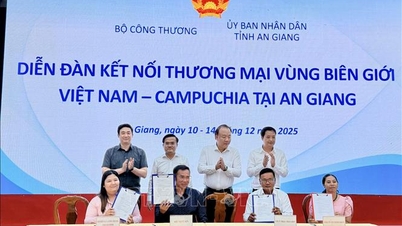
The forum is an event connecting businesses, introducing potential, investment opportunities and promoting import and export through Vietnam - Cambodia border gates.
According to the Ministry of Industry and Trade , Cambodia is considered a strategic trading partner of Vietnam, possessing a 1,137 km long land border that runs through 8 provinces of Vietnam and 9 provinces of Cambodia. The system of border gates along the entire border creates important conditions for promoting import and export and trade between the two countries.
According to Decision 1200/QD-TTg of 2023, issued by the Prime Minister, approving the Border Gate Planning on the Vietnam-Cambodia land border for the period 2021-2030, with a vision to 2050: The goal by 2030 is to establish border gate areas with comprehensive development in trade, logistics, tourism, and services. This aims to maximize the potential and advantages of the border line, contributing to local economic development, strengthening cultural and social exchanges, and ensuring smooth flow of goods.
In the first nine months of 2025, import and export turnover through border gates between Vietnam and Cambodia reached US$5.9 billion, an increase of 15.5% compared to the same period in 2024. Of this, Vietnam's imports and exports to Cambodia through land border gates reached US$5.83 billion, an increase of 16.6% compared to the same period in 2024. Vietnam's main exports include textiles, steel, and seafood; while imports from Cambodia mainly consist of rubber, cashew nuts, and other agricultural products. The structure of goods is complementary, but there is still a potential risk of seasonal trade deficits.
To boost border trade, the Ministry of Industry and Trade aims to achieve a bilateral trade turnover between Vietnam and Cambodia of US$20 billion by 2030. Simultaneously, it seeks to accelerate the transformation of trade quality, diversify goods, and upgrade logistics infrastructure. By 2027, the goal is for 100% of border gate warehouses to meet storage requirements, with 80% providing comprehensive logistics services and effectively connecting to domestic supply chains.
Ms. Vu Thi Minh Ngoc, Head of the Trade Infrastructure Department - Domestic Market Management and Development Agency, stated: Bilateral agreements between Vietnam and Cambodia over the years have created an important foundation for the development of border trade. Specifically, the 2019 Memorandum of Understanding on the development of border trade infrastructure, the 2024 Border Trade Agreement, and the Agreement to promote trade for the period 2025-2026 have opened up a comprehensive legal framework, helping localities such as Tay Ninh, An Giang , Dong Thap, Gia Lai… to accelerate the planning and connection of border gate infrastructure, border markets, warehouses, and logistics centers.
According to Ms. Ngoc, the implementation of these cooperation mechanisms is strongly promoting the "digital border gate" and "one-stop shop" models, thereby shortening customs clearance time and increasing the volume of goods, especially on important economic corridors such as Moc Bai - Phnom Penh, Tinh Bien - Takeo, and Ha Tien - Kep. At the same time, provinces such as Tay Ninh, An Giang, and Dong Thap have included logistics centers, bonded warehouses, supermarkets, and commercial centers in their planning, creating favorable conditions to attract large enterprises to invest through socialized investment.
Ms. Ngoc emphasized that, with the advantage of a long border with Cambodia and possessing many international border gates such as Moc Bai, Xa Mat, Tinh Bien, Khanh Binh, and Ha Tien, the Vietnam-Cambodia border region has the potential to become a "trade gateway" for Vietnam connecting with the Cambodian market and, more broadly, ASEAN, playing a driving role in promoting regional economic growth.
Currently, most provinces bordering Cambodia have border markets and border gate markets. Many localities such as Tay Ninh, Dong Thap, and An Giang have supermarkets and convenience stores. Simultaneously, major border gates such as Moc Bai, Xa Mat, Tinh Bien, and Ha Tien are located on important transportation routes, directly connecting to Vietnamese economic centers such as Ho Chi Minh City and Can Tho.
According to the Ministry of Industry and Trade, although the border trade infrastructure between Vietnam and Cambodia has developed significantly, it currently lacks synchronization and regional connectivity. Specifically, border market projects, warehouses, and logistics centers are scattered and have not yet formed a closed "market - warehouse - logistics - trade center" chain. Furthermore, many border markets are dilapidated, with poor facilities that do not meet modern trade standards; logistics are mainly small-scale and lack value-added services. Provinces without large-scale trade centers at the border fail to attract consumers and businesses.

Ms. Nguyen Duy Linh Thao, Deputy Director of the Department of Industry and Trade of An Giang province, emphasized: To develop border trade, An Giang province will focus on improving border gate infrastructure and logistics. Specifically, the province will accelerate investment in infrastructure for the Tinh Bien, Khanh Binh, and Ha Tien border economic zones; build large-scale inland ports, bonded warehouses, and cold storage facilities; and develop a transportation system connecting border gates with national highways, expressways within and outside the province, and industrial zones.
Ms. Thao also stated that An Giang province is focusing on promoting digital transformation in border trade; supporting businesses in expanding into the Cambodian market; and developing trade and services in border areas. An Giang is also focusing on upgrading border markets; developing new types of trade such as duty-free shopping centers, logistics services, and international transportation; strengthening bilateral cooperation with Kandal and Takeo provinces; and organizing annual Vietnam-Cambodia border fairs in Tinh Bien and Long Binh.
According to the development plan for Vietnam-Cambodia border trade infrastructure until 2030, with a vision to 2035, the Ministry of Industry and Trade stated that it will prioritize the completion and upgrading of the trade infrastructure system at border gates. The focus will be on developing logistics centers, bonded warehouses, and cold storage facilities at important international border gates such as: Binh Hiep, Moc Bai (Tay Ninh); Ha Tien - Giang Thanh, Tinh Bien - Vinh Xuong (An Giang); Thuong Phuoc - Dinh Ba (Dong Thap); Hoa Lu (Binh Phuoc); Le Thanh (Gia Lai)... to meet the increasing demand for goods movement.

In addition, the Ministry of Industry and Trade is aiming to standardize and modernize the system of border markets, supermarkets, trade centers, and shopping malls; transforming temporary and fragmented markets into standardized markets capable of attracting business investment and effectively serving the sustainable consumption needs of border residents. The Ministry of Industry and Trade is also focusing on building and operating a smart, one-stop border gate model, linked with the widespread implementation of electronic customs and centralized collection points. This aims to shorten customs clearance time, reduce logistics costs, and enhance the competitiveness of businesses.
By 2030, border trade fair and exhibition centers will be established in areas with significant trade and tourism potential, such as Chau Doc - Tinh Bien, An Giang. These centers will be key to promoting trade, advertising goods, and connecting businesses along the production-distribution-logistics chain. Simultaneously, Vietnam and Cambodia will strengthen bilateral cooperation in planning, constructing, and developing border trade infrastructure; promoting linkages between border gates and seaports, border gates and industrial zones, and high-tech agricultural zones to form inter-regional supply chains and distribution centers.
By 2030, the Ministry of Industry and Trade aims to increase the percentage of border trade infrastructure meeting national standards; reduce logistics costs by 10-15%; and increase import and export turnover through border gates. Simultaneously, it aims to ensure socio-economic development is linked to national defense and security, and to improve the living standards of residents in border areas.
Source: https://baotintuc.vn/kinh-te/ket-noi-thuong-mai-vung-bien-gioi-viet-nam-campuchia-20251210131810858.htm



![[Photo] Explore the US Navy's USS Robert Smalls warship](/_next/image?url=https%3A%2F%2Fvphoto.vietnam.vn%2Fthumb%2F1200x675%2Fvietnam%2Fresource%2FIMAGE%2F2025%2F12%2F10%2F1765341533272_11212121-8303-jpg.webp&w=3840&q=75)















![[Video] The craft of making Dong Ho folk paintings has been inscribed by UNESCO on the List of Crafts in Need of Urgent Safeguarding.](https://vphoto.vietnam.vn/thumb/402x226/vietnam/resource/IMAGE/2025/12/10/1765350246533_tranh-dong-ho-734-jpg.webp)

























































Comment (0)