

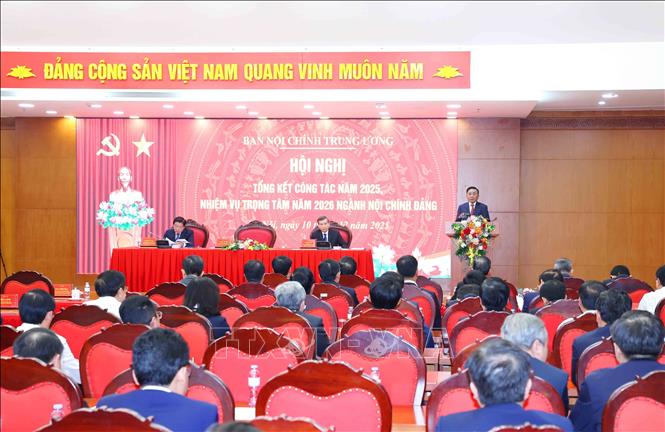
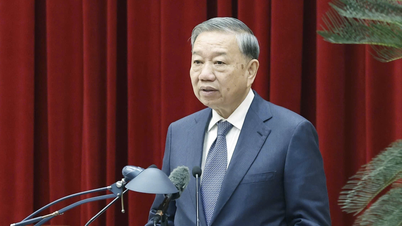
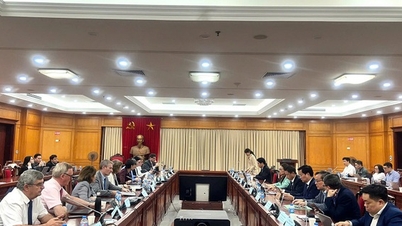
Politburo member and Standing Committee Secretary Tran Cam Tu attended and chaired the conference. Also present were Politburo members: Central Committee Secretary and Head of the Central Internal Affairs Commission Phan Dinh Trac; and Hanoi Party Secretary Nguyen Duy Ngoc. Also attending the conference were Central Committee Secretaries: Deputy Head of the Standing Committee of the Central Internal Affairs Commission Le Minh Tri, and Ho Chi Minh City Party Secretary Tran Luu Quang.
This is a very important conference aimed at evaluating the results of the Party's Internal Affairs sector's work in 2025, in conjunction with the results achieved from the beginning of the term to date; and at the same time, determining the direction and tasks for 2026 and subsequent years.
Information presented at the conference indicated that in 2025, the global landscape will undergo rapid and complex changes. Domestically, the entire Party and political system are focusing on implementing numerous strategic policies and addressing many important issues across all sectors: socio- economic development, national defense, security, foreign affairs, Party building, and the political system. After nearly five years of implementing the Resolution of the 13th National Congress of the Party, major goals and targets have been largely achieved, with some exceeding expectations, creating an important foundation for subsequent terms, including significant contributions from the Party's Internal Affairs sector.
The entire sector has closely followed the directives of the Central Committee, the Politburo, and the Secretariat, especially the three major orientations and six key tasks as directed by General Secretary To Lam , thereby achieving many outstanding results in various fields. Notably, the sector has researched and proposed many major policies, orientations, mechanisms, and solutions of the Party on internal affairs, anti-corruption, anti-waste, and judicial reform, some of which are strategic and represent strong breakthroughs.
Since the beginning of the term, the Central Internal Affairs Commission has advised and submitted to the Central Committee, the Politburo, and the Secretariat over 30 major projects. The internal affairs commissions of provincial and city Party committees have promptly advised the Party committees on leadership and guidance to concretize and effectively implement these projects at the local level.
The Central Internal Affairs Commission and local internal affairs commissions have effectively fulfilled their role as the Standing Agency of the Central Steering Committee and provincial-level steering committees on preventing and combating corruption, waste, and negative phenomena; truly acting as the "center" and "focal point" in coordination and consultation, contributing to promoting and creating new breakthroughs in the fight against corruption, waste, and negative phenomena. The entire sector has detected and advised on the handling of over 1,000 cases and incidents. The Central Internal Affairs Commission advised the Central Steering Committee on monitoring and directing 149 cases and 84 serious, complex incidents of public interest.
The fight against corruption has entered a new, more comprehensive and in-depth phase, with new methods and approaches, which have been well received and highly appreciated by officials, Party members, and the people. Social opinion surveys show that the vast majority of people (98%) express confidence in the Party's leadership in this area.
The entire sector also proactively coordinated to monitor the situation and advise on the timely handling of many complex and emerging issues related to national security and social order, especially religious and ethnic security, and complex and protracted mass complaints. In 2025, the internal affairs committees advised on the handling of more than 255 complex cases; received and held dialogues with over 1,500 citizens; and resolved many petitions and denunciations, contributing to maintaining political stability.
The work of guiding, monitoring, urging, inspecting, and supervising the implementation of policies and guidelines on internal affairs and the prevention and fight against corruption, waste, and negative practices, as well as judicial reform, is becoming increasingly systematic and effective. The organizational structure, functions, and tasks of the Party's Internal Affairs sector have been streamlined for greater efficiency and effectiveness. Following the restructuring, the staff and civil servants are more united, have improved in terms of skills and work quality; and the sector's position and prestige are increasingly affirmed and enhanced.
Presiding over the conference, Standing Committee member of the Party Central Committee Tran Cam Tu highly appreciated and commended the efforts and achievements of the Party's Internal Affairs sector in 2025 and throughout the past term; and requested the entire sector to seriously acknowledge existing shortcomings and limitations in order to promptly overcome them.
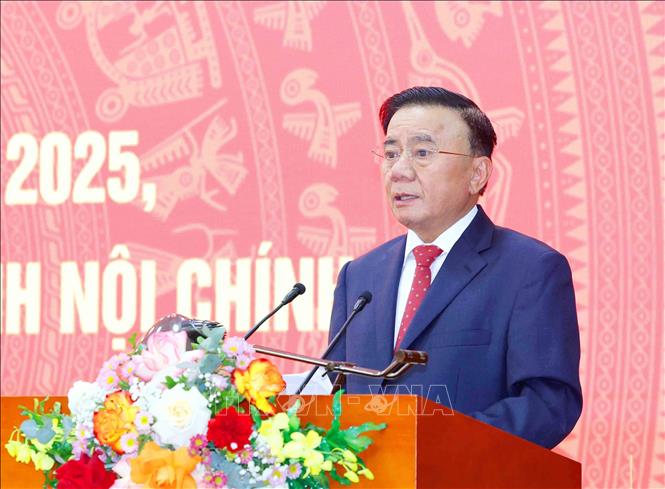
The Standing Committee of the Party Central Committee pointed out that 2026 is a year with many important events, the central task being the organization of the 14th National Congress of the Party and the election of the 16th National Assembly, as well as the election of People's Councils at all levels for the 2026-2031 term. In that spirit, the Standing Committee of the Party Central Committee emphasized that the Party's internal affairs sector needs to focus on studying, understanding, and effectively implementing the policies, tasks, and solutions on internal affairs, combating corruption, waste, and negative phenomena, and judicial reform as outlined in the documents of the 14th National Congress.
First and foremost, the sector needs to focus on seriously implementing the directives of General Secretary To Lam at the National Conference summarizing the work of preventing and combating corruption, waste, and negative phenomena during the 13th Party Congress term. The sector must urgently complete the projects and tasks for 2025, ensuring no delays or omissions; and research, develop, and advise on the issuance of a Central Committee Resolution on strengthening the Party's leadership over the work of preventing and combating corruption, waste, and negative phenomena in the new period.
The Standing Committee of the Party Central Committee noted that the Party's Internal Affairs sector should focus on advising and directing the inspection, investigation, and decisive handling of corruption, waste, and negative cases under the supervision and direction of the two Steering Committees. The sector should urge the review and completion of the implementation of conclusions and recommendations from inspections, audits, investigations, prosecutions, trials, and enforcement of judgments, ensuring strict and thorough implementation without delay; maximizing the recovery of assets for the State; and focusing on preventing, deterring, and effectively addressing petty corruption and the harassment and inconvenience caused by corrupt officials to citizens and businesses.
In parallel, the advisory sector is stepping up efforts to create even stronger changes in the fight against waste throughout society; reviewing and handling projects that violate land laws, and projects facing difficulties and obstacles in inspection, audit, and court rulings, in accordance with the Politburo's policies and conclusions, but without legitimizing violations; and proposing to include a number of large-scale wasteful projects under the Steering Committee's oversight to focus on resolving them definitively.
The Standing Committee of the Party Central Committee requested that the entire sector proactively coordinate and advise leaders on the thorough understanding and serious implementation of viewpoints, objectives, tasks, and solutions to ensure national defense, security, and social order and safety. First and foremost, this involves advising and directing efforts to further improve the work of receiving citizens, engaging in dialogue with the people, listening to and effectively resolving feedback, suggestions, complaints, denunciations, and legitimate aspirations of the people at the grassroots level; preventing the emergence of "hot spots," and avoiding passive or unexpected situations.
Source: https://baotintuc.vn/thoi-su/thuong-truc-ban-bi-thu-tran-cam-tu-xu-ly-dut-diem-mot-so-cong-trinh-du-an-lang-phi-lon-20251210181254034.htm
![[Photo] Closing Ceremony of the 10th Session of the 15th National Assembly](/_next/image?url=https%3A%2F%2Fvphoto.vietnam.vn%2Fthumb%2F1200x675%2Fvietnam%2Fresource%2FIMAGE%2F2025%2F12%2F11%2F1765448959967_image-1437-jpg.webp&w=3840&q=75)



![[Photo] Prime Minister Pham Minh Chinh holds a phone call with the CEO of Russia's Rosatom Corporation.](/_next/image?url=https%3A%2F%2Fvphoto.vietnam.vn%2Fthumb%2F1200x675%2Fvietnam%2Fresource%2FIMAGE%2F2025%2F12%2F11%2F1765464552365_dsc-5295-jpg.webp&w=3840&q=75)


































![[OFFICIAL] MISA GROUP ANNOUNCES ITS PIONEERING BRAND POSITIONING IN BUILDING AGENTIC AI FOR BUSINESSES, HOUSEHOLDS, AND THE GOVERNMENT](https://vphoto.vietnam.vn/thumb/402x226/vietnam/resource/IMAGE/2025/12/11/1765444754256_agentic-ai_postfb-scaled.png)











































Comment (0)