

The banking system is facing difficulties regarding asset quality due to a rapid increase in bad debts, while Circular 02 on debt restructuring will expire on December 31st.
Asset quality is deteriorating.
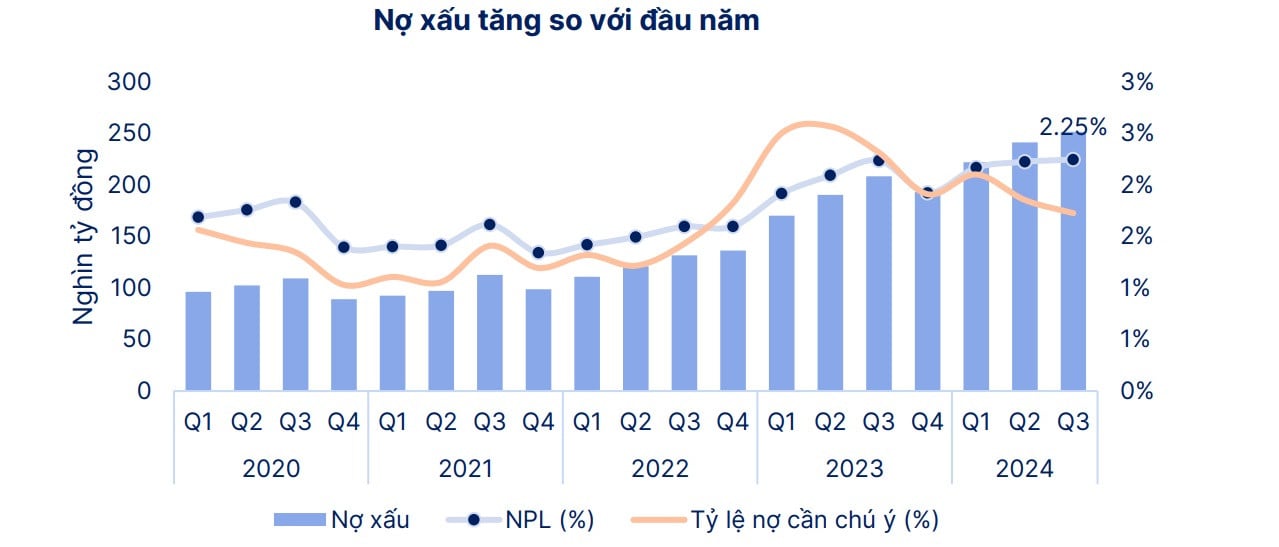
As of the end of Q3/2024, non-performing loans across the entire system of credit institutions stood at VND 252,000 billion (an increase of 20.7% compared to the same period last year and an increase of 30.3% compared to the beginning of the year).
The reason why bad debt shows no signs of decreasing is that the economy and real estate market are still facing many difficulties in the recovery process. Credit is disbursed in a short period of time, mainly with a sharp increase in the real estate business sector - which inherently carries a high risk of bad debt.
Meanwhile, smaller private banks do not have many advantages in customer selection, so their customer base often consists of those with weak financial capacity and slower recovery rates compared to other groups.
According to the banks' Q3 reports, loans in categories 2 and 4 decreased compared to the previous quarter, while categories 3 and 5 both increased by VND 8,000 billion (a 6.4% increase compared to the previous quarter).
Compared to the beginning of the year, debt in categories 2 to 4 all increased, especially category 5 debt, which rose by 0.8%, 41.7%, 6.9%, and 40.4% respectively.
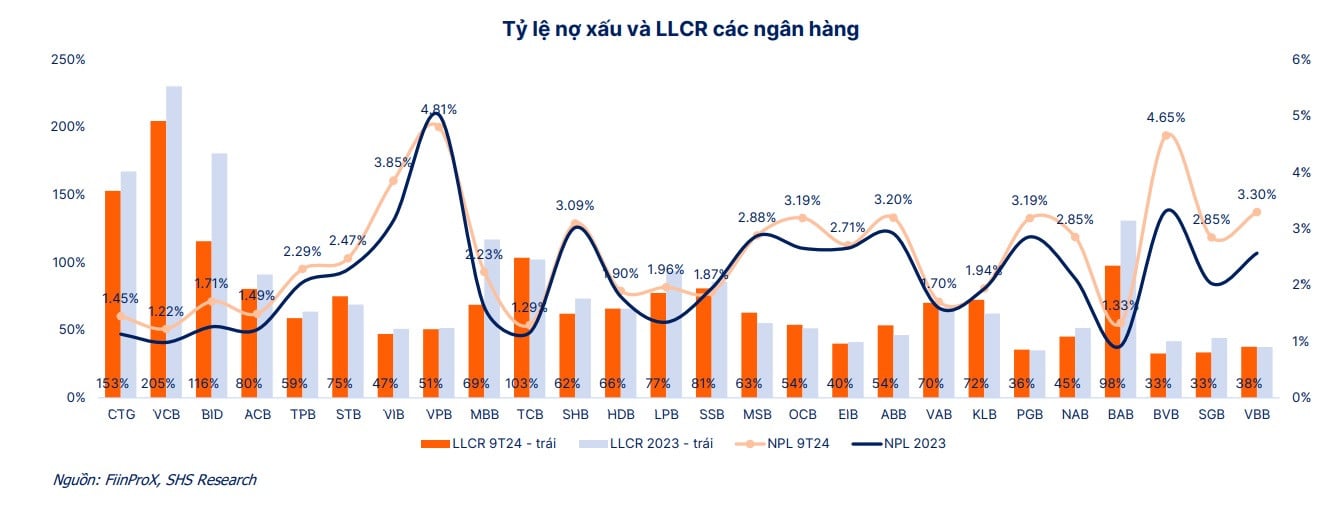
According to Saigon - Hanoi Securities Company (SHS), the increase in the non-performing loan ratio and the decrease in the loan loss reserve ratio (LLCR) indicate a decline in the asset quality of the entire system.
The non-performing loan coverage ratio was 83% in Q3/2024, a far cry from the peak (143.2%) of Q3/2022.
SHS forecasts that the non-performing loan ratio and LLCR will be more positive towards the end of the year, as banks typically focus on using provisions to write off bad debts.
According to a recent report by Vietcombank Securities Company (VCBS), the shrinking buffer of the entire banking sector in the first half of the year has limited the ability to handle bad debts in the future, especially for banks with high-risk customer bases and a high ratio of restructured debt to total outstanding loans.
Banks with a diversified customer base, strong reserve buffers, and a moderate proportion of real estate and corporate bond loans in their total credit portfolio will be better able to control credit costs.
"Credit risk provisioning costs/loan balances have remained at an average level since the beginning of 2022, while thin provisioning buffers lead to increased pressure to make provisions in subsequent quarters, especially in banks with low asset quality," VCBS analyzed.
In addition, high non-performing loan ratios are concentrated in the private banking sector, particularly some retail lending banks.
Among state-owned banks, BIDV saw a sharp increase in its non-performing loan ratio compared to the beginning of the year (from 1.26% to 1.71%).
Banks such as VPB, SHB, MSB, BVB, ABB, and PGB have non-performing loan ratios exceeding 3% after nine months.
Regarding the non-performing loan coverage ratio, among non-state-owned banks, only Techcombank has set aside provisions exceeding 100%, while small and medium-sized banks have lower provision buffers with LLCR ranging from 40-70%.
Impact of the expiration of Circular 02 on debt restructuring
Meanwhile, Circular 02 on debt restructuring will expire on December 31, 2024. There is currently no information from the State Bank of Vietnam (SBV) regarding the extension or cessation of Circular 02's application as planned.
As of the end of Q2/2024, restructured loans under Circular 02 amounted to VND 230,000 billion, an increase of 25.6% compared to the beginning of the year. According to regulations, banks must set aside provisions for restructured loans under Circular 02 in accordance with the loan classification. The difference compared to the current loan classification is set aside at 50% annually, reaching 100% by the end of 2024.
According to SHS, the State Bank of Vietnam's decision not to extend Circular 02 may increase the scale of non-performing loans and reduce the non-performing loan coverage ratio, but will not affect the banks' provisioning.
The expiration of Circular 02 will have different impacts on each bank. Banks with sound asset quality such as BIDV, Vietcombank, VietinBank, Techcombank, ACB, etc., will be less affected due to their strong reserve buffers and good financial health.
Banks with a high proportion of non-performing loans (NPLs) and a low NPL coverage ratio are projected to be more severely affected.
Nevertheless, VCBS believes that the pressure from bad debts in the second half of 2024 will not be too great considering factors such as: bad debts are cooling down along with the recovery of the economy in general; bad debts arising from the impact of Typhoon Yagi are not too large at the moment, but more time is needed to assess them.
According to preliminary statistics from the State Bank of Vietnam as of September 20th, an estimated VND 116 trillion in outstanding loans in affected provinces and cities are estimated to be affected. The percentage of bad debt relative to the total affected loans will remain low and will be reflected in the following year, following the State Bank of Vietnam's directive to commercial banks regarding flexibility in debt collection, including temporarily freezing, postponing/extending repayments, and reducing interest rates on loans that are due or about to become due.
Non-performing loans will also vary among banks. Banks with good asset quality will record moderate levels of non-performing loans and restructured loans. Banks with a high proportion of corporate loans (including corporate bonds) and low non-performing loan coverage ratios may face increased risk of non-performing loans and pressure to make provisions in 2024-2025.
Source: https://vietnamnet.vn/nhieu-ngan-hang-chiu-ap-luc-no-xau-tang-nhanh-2352250.html

![[Photo] Prime Minister Pham Minh Chinh presides over a meeting on private sector economic development.](/_next/image?url=https%3A%2F%2Fvphoto.vietnam.vn%2Fthumb%2F1200x675%2Fvietnam%2Fresource%2FIMAGE%2F2025%2F12%2F20%2F1766237501876_thiet-ke-chua-co-ten-40-png.webp&w=3840&q=75)






























































































Comment (0)