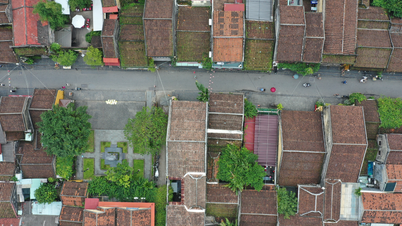
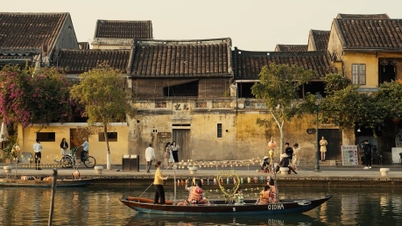
Looking back at the formation of villages in the ancient town of Hoi An - including the Hoi An, Hoi An Dong, Hoi An Tay wards and Tan Hiep island commune, which are now part of Da Nang city - is about returning to our roots to continue promoting that beautiful identity in the face of modern changes…
Thanh Ha preserves the traditions of the old village.
According to archaeologists, the ancient land of Hoi An is rich in cultural sediments, dating from the Sa Huynh to the Champa periods.
During the course of history, this land belonging to Chau Ri was offered by the Champa king Jaya Simhavarman III (Che Man) as a wedding gift to Princess Huyen Tran of Dai Viet in 1306, and was later renamed Chau Hoa.
However, the formation of Vietnamese villages here in particular, and in Quang Nam province in general, took place vigorously from the end of the 15th century, when King Le Thanh Tong conquered Champa and established Quang Nam Thua Tuyen in 1471.
The formation of Vietnamese villages in Hoi An, of which Thanh Ha village is a prime example.
According to Master's student Nguyen Chi Trung, through scientific research, "more than 2,000 years ago, people lived on the land of Thanh Ha. These were inhabitants belonging to the Sa Huynh cultural complex in Central Vietnam. They belonged to the Melanesian race, within the Malay-Polynesian ethnic group in Southeast Asia."
This group of people knew how to grow wet rice, raise livestock and poultry; knew how to exploit products from rivers and seas; knew how to weave cloth, forge iron to make production tools, knew how to make jewelry…; society had differentiation and had economic and cultural exchange in the region with the role of an early port city or pre-port city…"(1).
Despite its rich history, information about the Vietnamese ancestors who founded the village here has not been fully preserved.
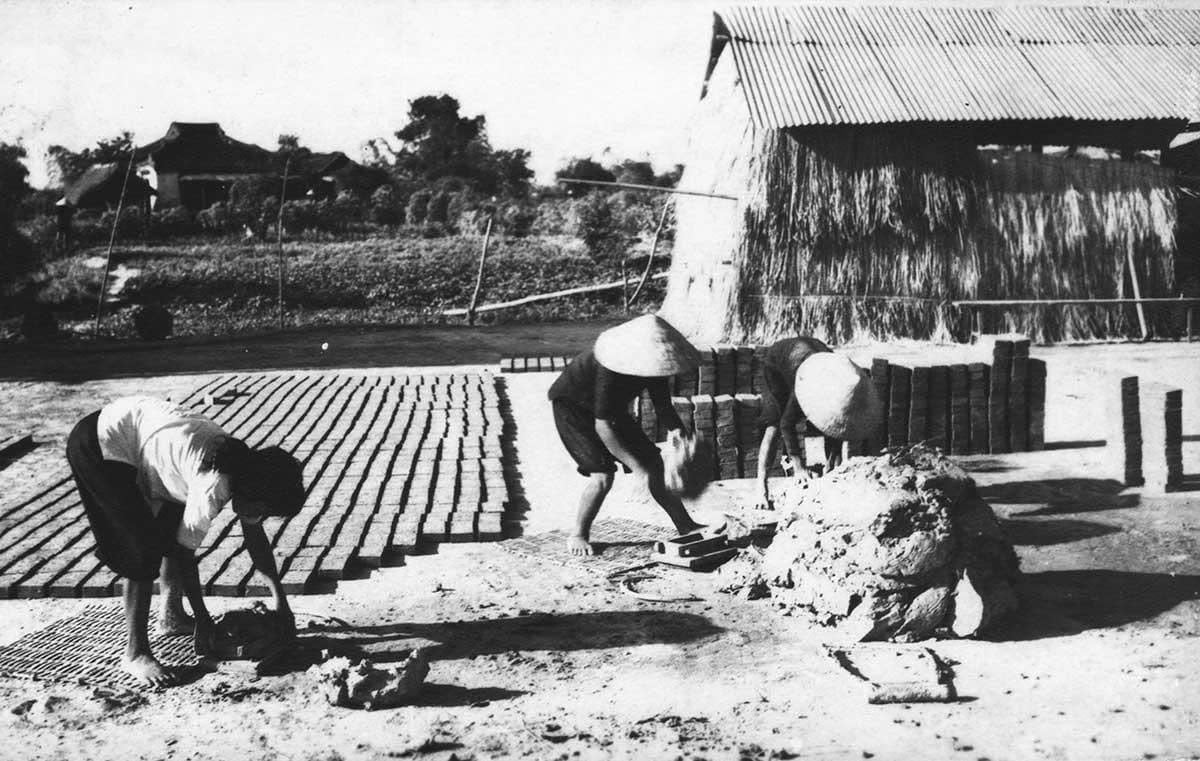
Brick production in Thanh Ha ancient village in Hoi An. Photo courtesy of Hoi An World Cultural Heritage Conservation Center.
According to the Quang Nam Village Chronicle, compiled by the French Institute of Far Eastern Studies (1943-1945), "the pioneering efforts of the village's ancestors are truly worth writing about; a magnificent village, a great achievement, yet today, who still remembers their names?"
According to the established sayings and beliefs of this village, there are about eight clans that served as founding ancestors, known as the Eight Venerables: Nguyen Van, Nguyen Viet, Nguyen Duc, Nguyen Kim, Nguy Nhu, Bui Phuoc, Vo Dinh, and Vo Van.



In these 8 clans, every clan still has descendants in the village in large numbers, but the Nguyen Tan clan is now extinct. Although these 8 clans do not have any commemorative steles, they have clearly had ancestral tablets for a long time" (2).
When Thanh Ha village was established, it belonged to Dien Ban district, Trieu Phong prefecture, Hoa province.
After 1604, Thanh Ha belonged to Phu Triem Ha commune, Dien Khanh/Dien Phuoc district, Dien Ban prefecture, comprising 13 hamlets: Hau Xa, Thanh Chiem, An Bang, Boc Thuy, Nam Dieu, Cua Suoi, Bau Oc, Trang Keo, Trang Soi, Dong Na, Tra Que, Con Dong, and Ben Tre.
Thus, the ancient Thanh Ha village, in modern times, has two names associated with tourism in the ancient town of Hoi An: Thanh Ha pottery village and Tra Que vegetable village, now part of Hoi An Tay ward.
Cam Pho - From village to city
While Thanh Ha village continued on the basis of Sa Huynh and Champa inhabitants, the exact time of its establishment as a Vietnamese village is unclear. According to author Nguyen Thanh Duong: "Cam Pho is one of the three earliest ancient Vietnamese villages formed in the Hoi An area... Along with Vong Nhi and Hoai Pho villages, at the end of the 15th century, the first Vietnamese inhabitants from the Thanh-Nghe-Tinh region, belonging to four families: Huynh, Le, Tran, and Nguyen, came to settle and establish Cam Pho village..."
The ancient Cam Pho village was located in the center of present-day Hoi An city, its geographical boundaries were defined as including two wards, Cam Pho and Cam Nam”(3).
During the development of the Hoi An trading port from the 16th century, Cam Pho village soon transformed into an urban area.
In the Quang Nam village chronicle, Cam Pho is identified as both a ward and a village: “Cam Pho village is a large village including public and private land (Cam Pho ward) with an area of over 500 acres, and white sand burial ground of over 150 acres. The population, including residents and permanent residents, is over 10,000 (10,000) people…”
The villagers have a wide variety of occupations: farming, silkworm breeding, silk reeling, trade (within the city limits), boat trading, fishing, masonry, carpentry, and many more, too numerous to list…”.
From the case of Cam Pho village, author Tong Quoc Hung argues: “Throughout its history, Hoi An has been a “unique city” that is a “village city,” with villages within the city. In reality, it has been proven that during the Nguyen lords' era, the Hoi An trading port had two cities of Japanese and Chinese people. These two cities were mainly located on the land of Minh Huong, Hoi An, Cam Pho, and Son Phong communes; although each city and each community (Vietnamese - Chinese - Japanese) had its own way of life, on the general level they mainly lived in a village style with friendly relationships, caring for and helping each other, and all had the spirit of “respecting elders and showing reverence” no different from villages in rural areas. This is very rare in urban areas, especially in an international trading port like Hoi An” (Cultural characteristics of Hoi An during the Nguyen lords' period)(4).
Looking at the two ancient villages of Thanh Ha and Cam Pho, it's clear that, whether they still preserve their traditional crafts or have become urbanized since a very early time, both the land and the people here always prioritize promoting their unique cultural identity.
Among these, family traditions and gentle manners are the hallmarks that the people of Hoi An have preserved and passed down through generations, despite the dramatic changes taking place in this ancient city.
It can be said that this is thanks to the conscious effort of generations of people in Hoi An to carefully select and pass on the beautiful cultural traditions of Vietnamese villages.



This is a valuable lesson that will serve as a foundation for the economic, cultural, and social development of Hoi An in the new era…
Note
(1) Overview of natural conditions and history of Thanh Ha village - https://hoianheritage.net/
(2) Villages and communes in Hoi An through Nguyen Dynasty land register documents and Quang Nam commune history - Hoi An Cultural Heritage Conservation Management Center, Da Nang Publishing House, 2020.
(3) and (4) Hoi An in the history of 550 years of the name Quang Nam 1471 - 2021 - Multiple authors, Da Nang Publishing House, 2021.
Source: https://danviet.vn/nhin-tu-hai-lang-co-tren-dat-hoi-an-d1435666.html


![[Photo] "Hanoi Lotus Festival" honors the lotus flower that has been associated with Vietnam for thousands of years.](https://vphoto.vietnam.vn/thumb/1200x675/vietnam/resource/IMAGE/2026/06/27/1782516943048_sen-ha-noi-2026-minh-duy-1-jpg.webp)