

January passed, leaving behind dampness. By February, the weather had warmed considerably, allowing the plants to flourish and turn lush green. The rice, peanut, and bean crops were sprouting and growing rapidly. But there were still a few months to go before harvest.
In my hometown, farmers plant two crops a year. After the harvest, the fields are plowed and left to rest. Usually, after the Lunar New Year, they wait for the water to come in so they can plant the new crop. Some years, the water comes early, and while they're still preparing for Tet, they have to plow and sow, and by the 3rd or 4th day of the new year, they're already out in the fields planting. Because they let the fields rest and also focus on preparing for Tet, the days of March and August seem longer. Fortunately, the farmers live off the fields and always think ahead. For example, this season, besides the vegetables they plant, the fields are full of sweet potato leaves, amaranth, purslane... they just need to go down to any field and pick a handful of mixed vegetables to make a very delicious soup. But the special treat of this season that I love most is the baskets of boiled sweet potatoes that my grandfather waited for me in every afternoon after school.
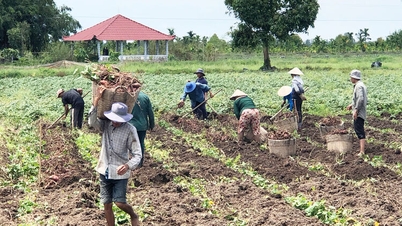
At the end of the year, during the dry, cold days, after the sweet potato plants had withered and the vines had been cut to make pig feed, it was time to harvest the tubers. My mother skillfully tilled the soil on both sides of the rows until the tubers were exposed, then she would carefully hoe the soil around the roots so that she could lift the entire plant, laden with tubers. I loved following her around, picking the potatoes. We carried them home and placed them in a corner of the yard. My grandfather would carefully sort them, bundling the tubers with their roots still intact into bunches and hanging them on poles on the eaves of the kitchen.
The healthy tubers were set aside in a corner of the kitchen. Those that had been dug up, chipped and small, were used to make pig feed. My brothers and I usually chose sweet, cool varieties of sweet potatoes, peeled and eaten raw like jicama. Freshly harvested sweet potatoes would be soft and tender when boiled. But in the cold weather, they would wilt after only a few days, turning into honey sweet potatoes in January, which, when boiled, were fragrant, soft, and deliciously sweet. The sweetest sweet potatoes were of the Hoàng Long variety, with elongated tubers resembling the handles of a sickle or knife, and yellow flesh. After boiling, the skin was brown with a sticky honey-like coating, while the inside was a rich, golden yellow.
|
Boiled sweet potatoes with a runny yolk are a familiar childhood treat for many. Photo: THU HOA |

I remember every afternoon after school, rushing home on my bike, I'd find my grandfather sitting by the kitchen door with a basket of boiled potatoes that were just warm, barely hot. Hungry, I'd immediately dig in and eat them with relish. Occasionally, in my haste, I'd eat a piece that was rotten and bitter.
Back then, compared to the limited variety of sweets and candies available in stores, sweet potatoes were nothing special. There were times when sweet potatoes became tiresome for my siblings and me. But many years later, the further I moved from home and the older I got, the more I remembered them and found them to be the most delicious baskets of sweet potatoes. So much so that whenever I passed by the brewery in the suburbs, the smell of yeast reminded me of the sweet potatoes cooked in the pig feed pots of the past. The women in my hometown once told me that in Hanoi, boiled sweet potatoes cost thirty thousand dong a kilogram, and roasted sweet potatoes cost forty or fifty thousand dong a kilogram – and even those weren't the kind that withered over winter like back home – and they said I was exaggerating. They said that sweet potatoes, which even people in my hometown don't bother growing anymore, have become a delicacy in the city.
Indeed, finding sweet potatoes in the countryside is now even harder than in Hanoi. Farmers' lives have improved; urbanization and industrial zones have encroached on farmland, and people have many other jobs that provide better income than relying on their small plots of land. There's no longer any need to stockpile sweet potatoes to last through the lean season. Occasionally, you might see posts on social media selling sweet potatoes, often emphasizing older varieties like lim, thanh an, or hoang long...
Perhaps the vendor, like me, also has some memories of the countryside, seeking out old-fashioned dishes to sell to those who crave a touch of childhood nostalgia. There, you find the carefree days of hardship, the familiar courtyard and garden, the faces of loved ones now only in memory, and all the flavors of home—flavors that, no matter how much time and the hardships of life add to, can never diminish...
Source: https://www.qdnd.vn/van-hoa/doi-song/nho-ro-khoai-mua-giap-hat-1031409
![[Photo] General Secretary and President To Lam presides over a working session with the Central Policy and Strategy Committee on the development of the materials industry.](https://vphoto.vietnam.vn/thumb/1200x675/vietnam/resource/IMAGE/2026/05/21/1779359935432_a3-bnd-3129-1412-jpg.webp)

![[Photo] National Assembly Chairman Tran Thanh Man working with the Standing Committee of the Law and Justice Committee](https://vphoto.vietnam.vn/thumb/1200x675/vietnam/resource/IMAGE/2026/05/21/1779378929214_ndo_br_1-4610-jpg.webp)









































































Comment (0)