

 |
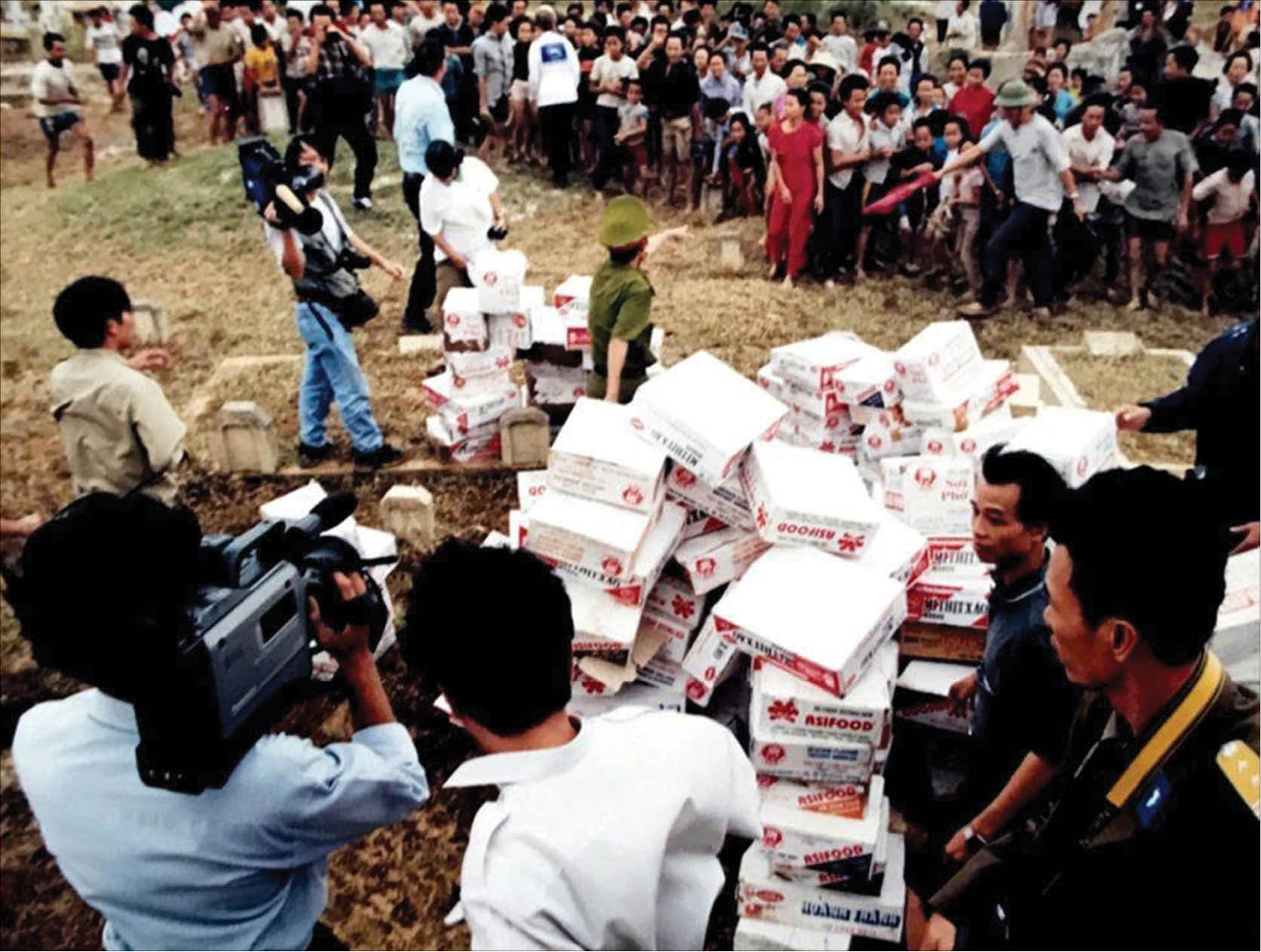
| Rescue and relief efforts after the flood. Photo: Archival material. |
At 3:00 AM on November 2nd, 1999, the phone rang. The person who woke me up was Mr. Le Quang Luy, Head of the Administrative and Organizational Department of Hue Television Station, whose house was in Kim Long. Then, around 5:30 AM, the Director of Hue Television Station, Ngo Quang An, called to report: “The flood is entering the house. I can’t come to the office; Huu Thu, you must handle it proactively.”
Minh Thuc was the first reporter to arrive at the office... Around 7 a.m., except for those far away and trapped by the flood, most reporters were present. We discussed and paid for boat rentals. Around 10 a.m., the Perfume River suddenly rose, turning Hanoi's streets into rivers. I called and learned that the Phu Vang Medical Center was flooded up to 1.8 meters. In many "flood epicenters," houses were submerged up to their roofs. Many families evacuated without having time to take their belongings.
Gathering images from Area A (Ly Thuong Kiet Street), the technicians at Hue Television Station were able to transmit them to Hanoi via fiber optic cable. As for the content, I faxed it to the News Department of Vietnam Television as agreed. Thanks to this, the first images of the flooding in Hue were broadcast in the afternoon news and that same evening. For the first time, VTV decided to implement a "Hanoi - Hue Television Bridge" hosted by presenter Nguyen Thanh Lam.
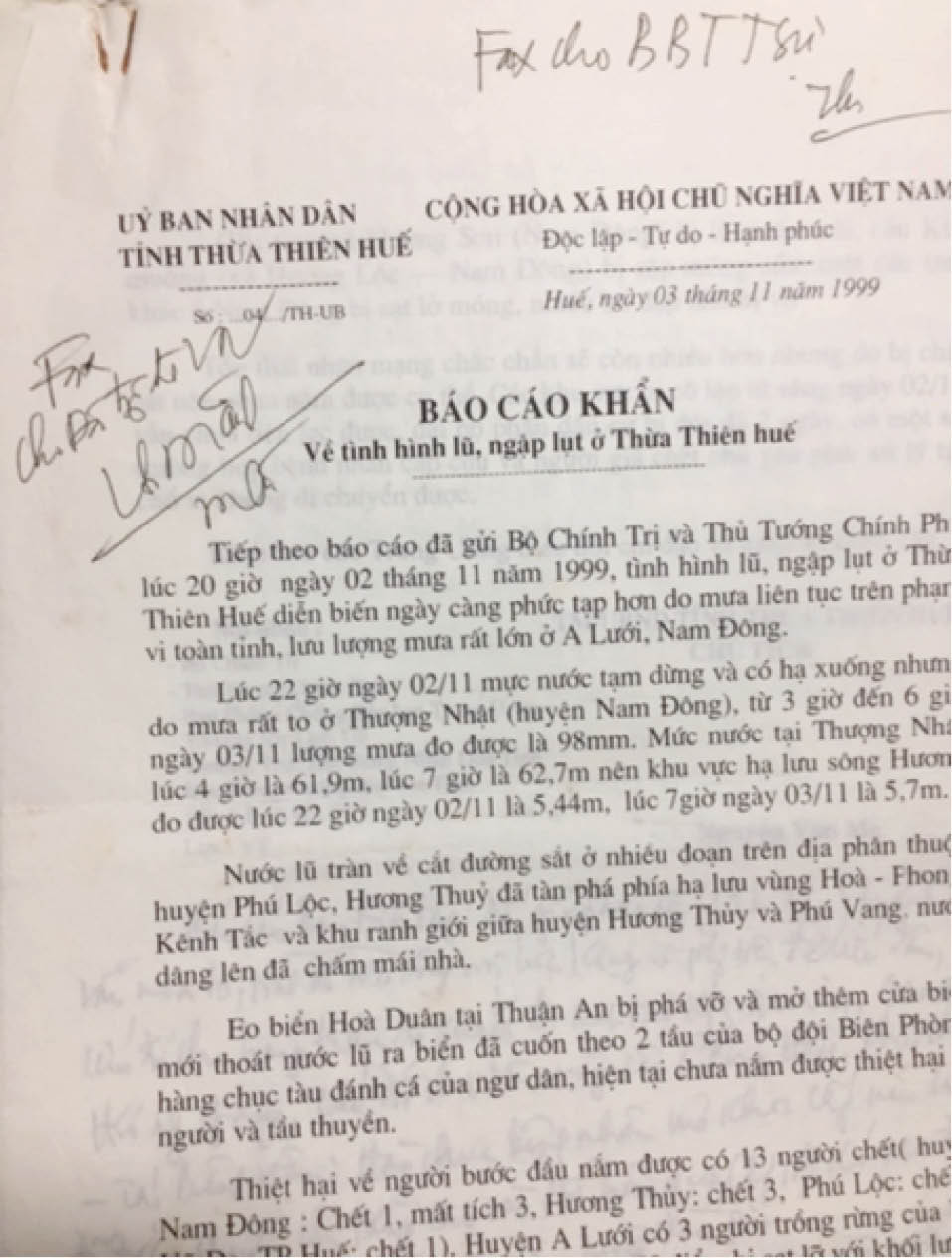 |
| First fax regarding the flood situation, dated November 3, 1999. |
And so, stories of the floods in Hue and Central Vietnam crept into offices, families, markets, schools, and of course, even meetings at the highest levels. The first images from Hue that day showed scenes of people fleeing the flood at Dong Ba Market, houses destroyed and doors shattered by the floodwaters from upstream on the Perfume River, Truong Tien Bridge almost submerged, Morin Hotel and Hung Vuong intersection transformed into rivers with boats and people wading through chest-deep water…
Let's return to the context of November 2nd, 1999. That morning, the Thua Thien Hue Provincial (now Hue City) Flood and Storm Prevention and Control Command only had Chief of Office Mai Quang Hue and engineer Nguyen Van Hung. The Head of the Command, Vice Chairman of the Thua Thien Hue Provincial People's Committee (now Hue City), Le Van Hoang, was stranded in A Luoi.
At exactly 12 noon, all landline telephones lost service. The devastating flood officially began. To maintain command, comrades Ngo Yen Thi, Ho Xuan Man, Nguyen Van Me, Bach Hien, and others decided to relocate the Flood and Storm Control Command Center to the Hue Post Office on Hoang Hoa Tham Street. At 3 PM on November 2, 1999, the "new headquarters" officially began operations. With 8 hotlines established, the Hue Post Office promptly served the Forward Command Center in its operational and command functions. It was thanks to these hotlines that the live broadcast of the flood between Hue Television and Vietnam Television was established at noon on November 3.
To prepare the content for that day's live broadcast, I asked the Steering Committee to intervene. The Standing Deputy Secretary of the Provincial Party Committee (now the Hue City Party Committee), Ho Xuan Man, hastily wrote a few words on the urgent report: "Fax to Vietnam Television." Before sending it, I quickly updated the situation at the end of the report to help the News Department of Vietnam Television process the information; meanwhile, in Area A, under the direction of Deputy Director Nguyen Thai Binh, we quickly transmitted the images captured by the news reporters. Based on this, from Hanoi, News Editor Nguyen Thanh Lam meticulously crafted each detail, and with his expressive style, he moved viewers nationwide.
Referring to the live broadcast from the scene on the afternoon of November 3rd, the Hue Television studio on Ly Thuong Kiet Street was flooded since noon on November 2nd, causing it to cease operation. The power was out, the backup generator was not working, and the entire Area A was in chaos. Luckily, they found a generator intended for the mobile broadcasting vehicle. Without spare fuel, the technicians siphoned gasoline from their own motorbikes to keep the generator running. When the generator was shut down, everyone breathed a sigh of relief. For us, this was the most vivid and moving scene we've ever witnessed.
*
There's one incident that still sends shivers down my spine when I think about it. It was the morning of November 2nd, 1999. Having directly observed the flooding on Hanoi's streets, I had a feeling the water level would rise, so I proactively suggested to my colleagues that we approach the Morin Hotel. If we stood on the rooftop, we would surely capture a historic image: the floodwaters overflowing the Truong Tien Bridge. After setting the goal and task, I simply appealed for self-awareness because the flood was raging.
Surprisingly, all the reporters present, including Ngoc Toan, Duong Chien, Ba Thanh, and Phu Thanh, volunteered. I paid for the boat rental, and Ngoc Toan was in charge of the group. At exactly 10:30 AM, the group set off. I estimated that they would reach their target within an hour at the latest. But it was already past noon, and we waited anxiously, but there was no sign of them. It wasn't until dusk that the whole group returned. When I asked them what happened, I learned that because they couldn't find a boat, they had to wade through the water. When they reached the intersection of Tran Cao Van and Pham Hong Thai streets, they encountered a strong current. Thanks to Ngoc Toan, who had a stick, they helped each other and finally clung to the wall of the Agricultural and Rural Development Bank. The speedboat of the Deputy Commander of Hue City Police, Dang Quang, passed by, saw them, and brought them back.
Working continuously for three days, most of the news crew were exhausted. Deputy Director Nguyen Thai Binh requested reinforcements from the Special Features Department. On the morning of November 5th, relief teams traveled by boat to key areas to provide assistance. Quy Hoa captured a rather valuable scene upstream on the Perfume River. Due to prolonged starvation, a man, submerged in the murky water, was devouring a packet of instant noodles and instinctively held out his hand for more.
Finally, I want to dedicate a few lines to Ba Thanh – a resourceful and compassionate cameraman who passed away at a relatively young age. I remember the first night we were eating, Ba Thanh took his bowl of noodles and left the room. Curious, I followed him and learned that he was sharing his meal with Mrs. Theao in Truong An, a street vendor at Dong Ba market who was trapped by the flood and couldn't go home. Holding her bowl of noodles, Mrs. Theao said just three words to Ba Thanh: "Thank you, sir!"
The devastating consequences of the historic 1999 flood have been overcome over time, but for us – the journalists at Hue Television Station – thanks to our unity and cooperation, we overcame that critical period. There were some who worked like true soldiers. I am very proud of them!
Source: https://huengaynay.vn/chinh-polit-xa-hoi/nho-tran-lu-kinh-hoang-1999-154738.html


![[Photo] Prime Minister Pham Minh Chinh receives the Chinese Ambassador to Vietnam](https://vphoto.vietnam.vn/thumb/1200x675/vietnam/resource/IMAGE/2026/04/05/1775397481797_ndo_br_dsc-5512-jpg.webp)






























































Comment (0)