WHEN FARMERS ACTIVELY MASTER TECHNOLOGY
Previously, agricultural practices in the province relied primarily on traditional methods, but now many farmers are familiar with applying science and technology to production.

Mr. Nguyen Tien Ha uses remote control software to automatically water his pomelo orchard.
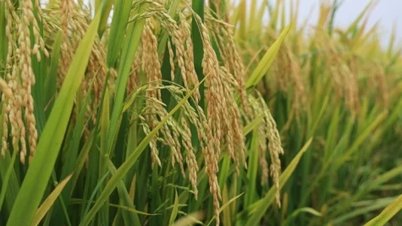
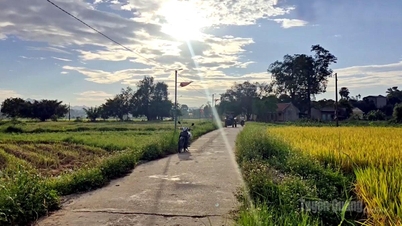
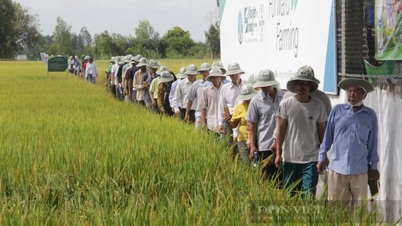
In Tan Phuoc 2 commune, most rice farmers have adopted drones for sowing, spraying pesticides, and fertilizing. In the middle of the rice fields in Tan Hung Tay hamlet, Tan Phuoc 2 commune, drones fly overhead, replacing the presence of farmers.
In many fields, the footprints of farmers are almost no longer visible on the land. The family of Mr. Do Thanh Hung (Tan Hung Tay hamlet) is currently cultivating 3.9 hectares of rice.
According to Mr. Hung, in the past, farmers mainly relied on manual labor for profit, using a lot of manpower, which was quite arduous. However, now, his family and many other farmers in the area are renting drones for sowing, spraying pesticides, and fertilizing.
According to the Department of Science and Technology of Dong Thap province, in recent times, the province has aggressively implemented digital transformation in priority sectors and fields, contributing to improved management efficiency, administration, and the quality of public services. In agriculture, the focus is on developing high-tech and smart agriculture; managing planting area codes on software, updating electronic farming logs; applying specialized software for disaster prevention and control; supporting the listing of agricultural products on e-commerce platforms, and tracing their origin using QR codes. |
Mr. Hung shared: "Farming now doesn't require as much effort as before. Thanks to technological advancements, farmers only need to bring seeds and supplies to the field, and someone will operate a drone to sow seeds and spray pesticides, replacing manual labor."
According to Mr. Ngo Vinh Khang, the owner of a drone in Tan Phuoc 2 commune, the cost of renting a drone for rice sowing is 40,000 VND per hectare, and for spraying pesticides it is 15,000 VND per hectare. In the locality, about 80% of farmers currently rent drones for sowing, spraying pesticides, and fertilizing.
"Local farmers have increasingly applied technology to production, moving away from traditional methods. The application of technology in production has made things less strenuous for the people," Khang shared.
Meanwhile, in Dong Son commune, Dong Thap province, farmers have recently been stepping up the application of science and technology in production. The family of Mr. Truong Van Trung (Binh Hoa Dong hamlet, Dong Son commune) has spent almost their entire lives working in the fields.
More than anyone else, Mr. Trung understood the hardships of farmers who toil year-round in the fields. With the advancements in science and technology today, he gradually grasped and applied them to his production.
The 2025 autumn-winter crop season was the first time his family hired a drone to spray pesticides on their 9 acres of rice. According to Mr. Trung, when spraying pesticides with a drone, the rice plants are less prone to lodging.
In particular, during the rice flowering or ripening stages, spraying pesticides using traditional methods increases the risk of lodging in the rice plants.
Mr. Trung shared: "For one rice crop, I hired a drone to spray pesticides four times. Compared to hiring people to spray pesticides with a machine before, spraying with a drone saves a little money."
Not to mention, finding labor for farming is becoming increasingly difficult. With this drone-based spraying, all you need to do is make a phone call and someone will bring the machine to spray for you right away.
Besides growing rice, I also grow 1 hectare of corn and hire drones to spray pesticides. Applying technology to production helps me save as much effort as before.”
Not only rice farmers, but many fruit farmers in the province have also proactively applied digital transformation to their production. The family of Mr. Nguyen Tien Ha (My Tho ward, Dong Thap province) cultivates about 5 acres of green pomelo.
To reduce travel costs and improve production efficiency, Mr. Ha's family invested in internet access in their pomelo orchard and installed remote control equipment for automatic watering.
"Applying technology to production is very convenient for farming. I just need to sit at home, open the software, and press the watering button; I don't need to go to the garden," Mr. Ha said.
Paving the way for modern, sustainable agriculture.
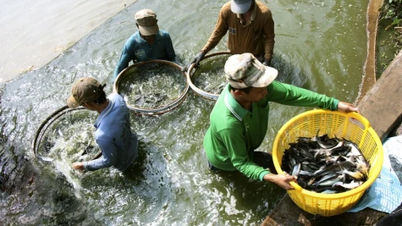
According to the Department of Agriculture and Environment (DARD) of Dong Thap province, in recent years, the province has developed models applying AI and digital transformation in agriculture. A typical example is the model of pangasius farming using smart technology.

Mr. Do Thanh Hung hired a drone to sow rice seeds for the summer-autumn crop.
In recent years, many businesses and aquaculture facilities have applied sensor technology and data analysis systems to monitor the pond environment.
Sensors are installed in the fish ponds to continuously monitor indicators such as water temperature, pH level, dissolved oxygen content, and water turbidity.
Data from the sensors is analyzed to detect early abnormal fluctuations in the water environment. When parameters exceed permissible limits, the system will issue a warning so that farmers can make timely adjustments.
Digital transformation in agriculture is not just about technology, but about the process of reorganizing production based on data. If started in the right direction, this will be an opportunity to increase the value of agricultural products, improve farmers' incomes, and enhance the competitiveness of Vietnamese agriculture. The future of agriculture lies not in equipment or software, but in whether we have the ability to reorganize production using data.” Director of the Department of Agriculture and Environment of Dong Thap Province , Le Ha Luan |
The application of technological solutions in pangasius farming helps minimize disease risks, optimize production costs, and increase farming productivity.
Many gardeners have applied smart technologies in flower and ornamental plant production to improve product quality.
Some implemented models include: automatic irrigation systems combined with humidity sensors; temperature and light control systems in greenhouses; and digital platforms for managing the production and consumption of flowers and ornamental plants.
These applications help optimize plant care processes, reduce labor costs, and improve the quality of flowers and ornamental plants.
At the same time, digitizing data on flower-growing areas also supports management agencies in planning the development of the flower and ornamental plant industry and promoting agricultural tourism.
According to the Department of Agriculture and Environment, in the coming period, the province aims to focus on developing ecological agriculture, with civilized farmers as the main actors and modern rural areas as the foundation.
Accordingly, Dong Thap will focus on developing an ecological agriculture that harmonizes economic, social, and environmental aspects, based on diversifying production models to create high value, developing large-scale agriculture linked to value chains; promoting the application of science, technology, innovation, and digital transformation to improve the productivity, quality, and competitiveness of agricultural products.
Local authorities will use innovation, science, technology, and institutional reform as driving forces to develop civilized farmers.
The focus is on building a professional team of farmers, gradually forming a class of farmers with a market-oriented mindset, proactively transforming production models, and possessing a sense of responsibility, cooperation, and connectivity.
According to the leaders of the Department of Agriculture and Environment of Dong Thap province, in the coming time, the agricultural sector will continue to apply scientific and technical advancements to agricultural production in the direction of high technology, focusing on smart agriculture and adaptation to climate change…
T. DAT
Source: https://baodongthap.vn/chuyen-doi-so-ve-ruong-dong-a239221.html


![[Photo] General Secretary and President To Lam presides over the meeting to approve the draft report on the results of the second inspection by the Politburo of the Standing Committee of the Hanoi City Party Committee.](https://vphoto.vietnam.vn/thumb/1200x675/vietnam/resource/IMAGE/2026/05/26/1779789811432_a2-bnd-4430-9620-jpg.webp)













































Comment (0)