

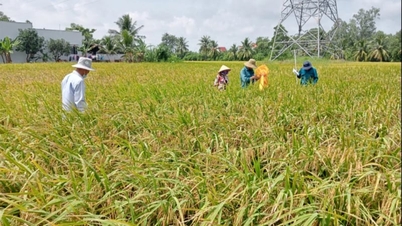
"In the old days, we thought the more rice we sowed, the better the harvest, and we only felt secure when the fields were flooded," recalled Ms. Ho Thi Thuy Hang from My Qui commune, Dong Thap province, remembering the familiar rice farming methods of farmers many years ago.
Those farming practices are gradually changing as she participates in the TRVC project - a program for reducing emissions from rice cultivation, contributing to the implementation of the plan to develop 1 million hectares of high-quality rice in the Mekong Delta.
Within the framework of this model, Ms. Hang's family participated in four rice cultivation cycles on 1.5 hectares, in collaboration with Vinarice - a unit of Vinaseed - part of the PAN Group's ecosystem, responsible for organizing production and implementing the low-emission rice farming model.
According to Ms. Hang, farmers are guided to apply the "1 must, 5 reductions" process, where "1 must" is using certified seeds, and "5 reductions" include reducing the amount of seeds sown, fertilizers, pesticides, irrigation water, and post-harvest losses. This method helps lower input costs and reduce emissions in production.
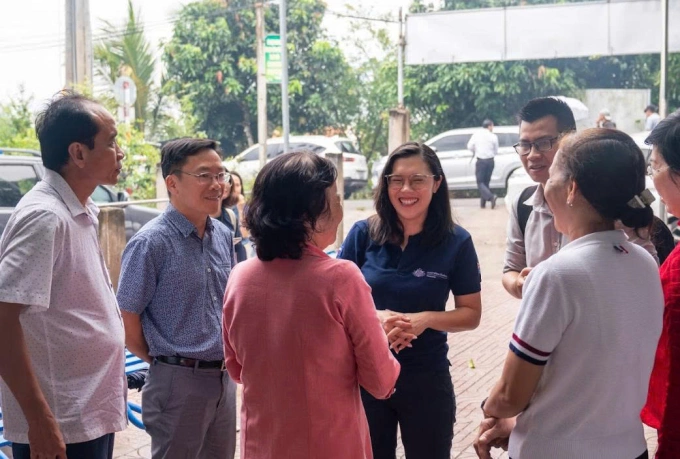
"Previously, whenever we saw pests or diseases, we would increase the amount of pesticides and sow seeds densely to be on the safe side. Now that the fields are more open, there are fewer pests and diseases," she said.
Thanks to the adoption of new farming methods, Ms. Hang's family's production costs decreased from approximately 30 million VND to 25 million VND per hectare, while productivity remained stable. Each harvest, the family earns around 40-50 million VND per hectare depending on market prices, with profits ranging from 17-20 million VND, and sometimes reaching 20-30 million VND.
In addition to changing their sowing practices, many households in this region have also adjusted their water management in the fields – a factor that greatly influences production costs.
The family of Ms. Nguyen Thi Moi, in My Qui commune, cultivates 5 hectares of rice and has participated in the two-crop rice cultivation model. Instead of keeping the fields continuously flooded, the water is regulated according to each growth stage of the rice plant, combined with alternating drying.
"At first, seeing the fields dry up made me very worried, afraid the rice would die," she recounted. But after applying the method, the rice plants were healthier, had fewer pests and diseases, and the cost of electricity for pumping water was reduced.
According to Ms. Moi, profits increased by about 2 million VND per hectare, but the bigger change lies in reducing reliance on chemicals and labor.
At the cooperative level, Mr. Nguyen Thanh Nghiep, Chairman of the Board of Directors and Director of My Dong III Agricultural Service Cooperative, said that the unit is implementing the model on approximately 267 hectares.
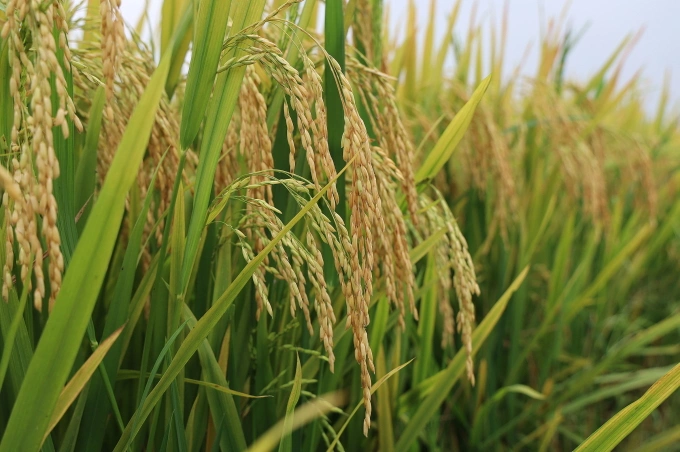
The synchronized production system helps reduce input costs by 10-15%, while productivity remains stable at around 6.5-6.7 tons per hectare.
Rice straw after harvest is collected instead of being burned, which reduces environmental pollution and can be used as a raw material for mushroom cultivation, helping to create an additional source of income for farmers. At the same time, the rice output is guaranteed by businesses, helping farmers reduce price risks.
Besides the achievements, Mr. Nguyen Van Be Hai, Acting General Director of Vinarice, said that the biggest challenge when implementing the model on a large scale is changing the long-established farming practices of farmers.
Many households, accustomed to using safe seeds and inputs, were initially concerned that changing the process would affect productivity.
However, the reality is that productivity remains stable while costs decrease, thereby improving farmers' income.
The model operates on a "reward-based" mechanism, where actual emission reductions are converted into rewards. These rewards are reinvested in the project, with 30% distributed directly to farmers, 10% to cooperatives, and the remainder allocated to training and technology transfer.
Emission reduction models are being implemented within the framework of the Project to develop 1 million hectares of high-quality, low-emission rice in the Mekong Delta by 2030, as per Prime Minister 's Decision 1490.
The project is being implemented in 12 provinces in the Mekong Delta region, aiming to reorganize production along the value chain, reduce emissions, and increase farmers' income.
According to the Ministry of Agriculture and Environment, the target for the 2024-2025 period was 180,000 hectares. However, after two years of implementation, the area has reached over 354,000 hectares, exceeding the set plan. The models apply sustainable farming techniques, significantly reducing the amount of seeds, nitrogen fertilizer, and the number of pesticide applications compared to traditional methods.
According to data from 2024 models, the income of rice farmers in the model increased by an average of 13.4% or more compared to traditional farming. Along with this, the Vietnam Rice Industry Association has begun to develop the "Green Vietnamese Rice with Low Emissions" brand. To date, the area of rice fields granted this brand has reached 18,087 hectares with a corresponding rice production of approximately 75,060 tons. Of this, 500 tons of rice have been exported to Japan – one of the markets with the strictest requirements for product quality and standards.
At the large-scale enterprise level, the model's effectiveness is extended towards the value chain and export markets.
Ms. Nguyen Thi Tra My, General Director of PAN Group, said the group is implementing the model through Vinarice. After three seasons, the participating area reached approximately 48,500 hectares, accounting for nearly 60% of the total area of the TRVC project. Each season involves about 5,500 farming households, equivalent to 11,000 households after three seasons of implementation. According to her, farmers' profits increased by 50-58%, far exceeding the project's expected 30%.
Alongside production, the company has perfected a closed-loop value chain from seeds to export. Thanks to traceability, many rice batches fetch around $1,300 per ton, and one specialty purple rice variety has even been exported to Europe at $2,300 per ton.
"There were times when we almost cried with joy seeing our fellow villagers change their farming methods and earn more income," Ms. My said.
According to vnexpress.net
Source: https://baodongthap.vn/trong-lua-kieu-moi-nong-dan-loi-them-hang-chuc-trieu-dong-a241341.html
![[Photo] The heat at the fireworks display site on the opening night of the Da Nang International Fireworks Festival 2026](https://vphoto.vietnam.vn/thumb/1200x675/vietnam/resource/IMAGE/2026/05/27/1779889741485_ndo_br_z7872039145157-fecaba5112f39e8352544099d7ef4738-5140-jpg.webp)

![[Photo] The courage of new recruits of Brigade 144 on the training ground.](https://vphoto.vietnam.vn/thumb/1200x675/vietnam/resource/IMAGE/2026/05/27/1779881651341_anh-man-hinh-2026-05-27-luc-18-32-52.png)








































![[Photo] The courage of new recruits of Brigade 144 on the training ground.](https://vphoto.vietnam.vn/thumb/402x226/vietnam/resource/IMAGE/2026/05/27/1779881651341_anh-man-hinh-2026-05-27-luc-18-32-52.png)
















Comment (0)