

During the resistance against the French (1945-1954), Viet Bac was known as the "capital of resistance," or more poetically, the "capital of the mountain winds" (as in the poem "Morning in May" by poet To Huu).
It was called that because Viet Bac, a vast region north of Hanoi, was the headquarters of the Viet Minh government, where the leaders of the Communist Party of Vietnam formulated the strategy and led the entire army and people in the resistance against the French.
From Lang Son, Highway 4 winds its way through the rolling hills and mountains of the Northeast, heading towards Cao Bang . Familiar historical landmarks appear one after another: That Khe, Dong Khe, Bong Lau Pass… Peeking out from behind the trees, beside the stream, are villages with many stilt houses whose wooden staircases gleam in the early morning sun. I close my eyes, trying to imagine that exactly three-quarters of a century ago, this very road was synonymous with the resounding victory during the anti-French resistance, the result of the Border Campaign of 1950…
From Cao Bang, we continued south to Bac Kan, Thai Nguyen, and Tuyen Quang. The rolling hills and endless rows of tea plantations stretched as far as the eye could see. If the entire Viet Bac region was the capital of the resistance, then this place was its center. According to historical records, after the National Resistance Call (December 19, 1946), the Central Committee of the Party sent people here to select a location for the Central Committee and the Government. The area bordering three provinces – Dinh Hoa, Dai Tu, and Phu Luong (Thai Nguyen); Cho Don, Cho Ra, and Cho Moi (Bac Kan); and Chiem Hoa, Son Duong, and Yen Son – was chosen. During the nine-year period (1945-1954), President Ho Chi Minh, along with comrades Truong Chinh, Pham Van Dong, and Vo Nguyen Giap, operated and directed the revolution here.
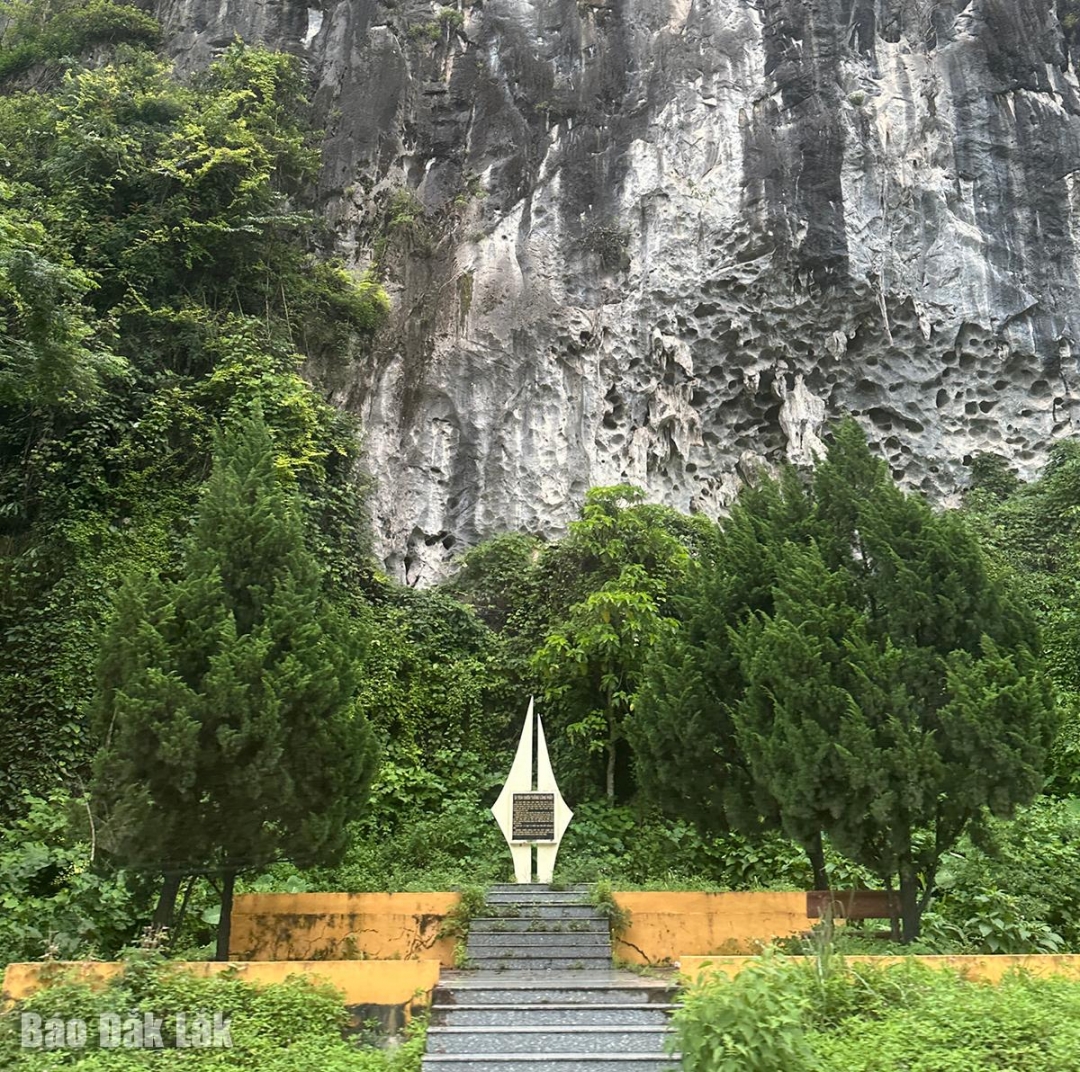 |
| The monument commemorating the victory at Bong Lau Pass is located on Highway 4. |
The Khuon Tat historical site, where President Ho Chi Minh spent many years, is one of 13 sites within the ATK Dinh Hoa Special National Historical Site. The Khuon Tat site comprises three locations: President Ho Chi Minh's hut on Na Dinh hill, the Khuon Tat banyan tree, and the Khuon Tat stream. The hut on Na Dinh hill was where President Ho Chi Minh lived and worked during the periods from November 20-28, 1947; January 1-3, 1948; April 5-25, 1948; and the early part of 1954. Looking at these timeframes reveals the difficulties faced by revolutionary leaders in maintaining their lifestyle in what was considered the nerve center of the resistance, simultaneously moving to avoid the enemy and conducting field research to chart a course for the fledgling revolutionary forces. Yet it was here that President Ho Chi Minh signed many important documents that contributed to the victory of the Vietnamese people's resistance and nation-building efforts.
I wandered along the paths of the historical site. The banyan tree still provided shade, and there was a volleyball court and a wide lawn. Every afternoon after a day's work, President Ho Chi Minh would practice sports and martial arts with his guards and assistants. About a hundred steps away was the clear, green Khuon Tat stream with its rocky banks, where President Ho Chi Minh bathed, rested, and fished after stressful hours of work.
Sipping a cup of the famous green tea from Thai Nguyen, its flavor imbued with the aroma of the Northeast mountains and forests, I gazed out at the vast green hills covered in tea plantations, and suddenly recalled the verses from the revolutionary poet To Huu's poem "Viet Bac": "Remember when the enemy came and hunted / The forests and mountains, we fought the Westerners together / Mountains formed a thick iron fortress / The forest sheltered our soldiers, the forest surrounded the enemy / Vast and boundless on all sides, shrouded in mist / Our land and sky, a single-minded war zone…"
In just one day wandering through the Định Hóa Revolutionary Base Area (Thái Nguyên), I was able to recognize a capital city of winds from the past, echoing the spirit of the past. The winds of patriotic tradition from millennia ago are blowing again, the winds of freedom and democracy are sweeping away a century of colonial darkness, so that the people are no longer slaves…
Pham Xuan Hung
Source: https://baodaklak.vn/xa-hoi/202509/nhung-duong-viet-bac-cua-ta-ed0129f/















































































Comment (0)