

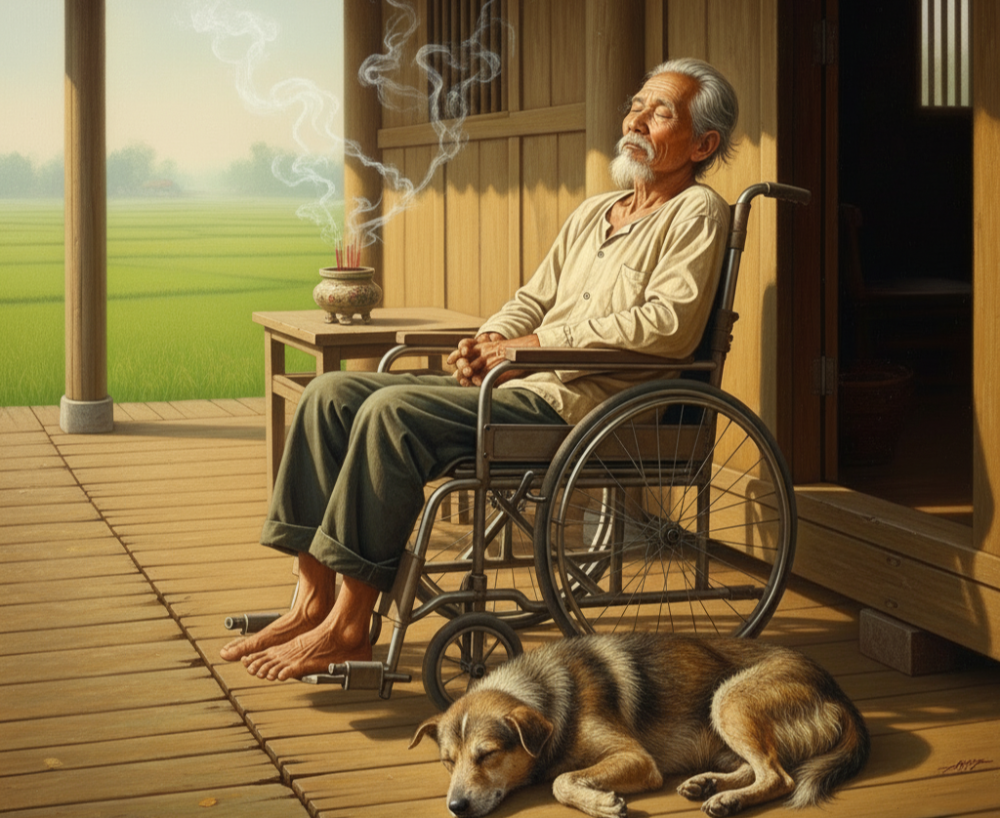
(AI)
Even as I sat gasping for breath by the roadside after a bus crammed full of people and luggage, I couldn't believe I'd returned to this place. Would those dreams still haunt my dreams? The two-story house before me no longer gleamed enough to make me stare in amazement. One side of the gate was broken, almost collapsing, but the lock remained loosely attached. Patches of moss covered the walls, grass grew up to the third, and the sinking ground made the house seem slightly tilted. Everything seemed harmless, at least to me. I strained to look through the gate into the house. The dog, seemingly as old as the house itself, let out weak, half-hearted barks. The old man in the wheelchair looked at me, muttering incoherently. I recoiled in fear, just like when I was eight.
It was the first time I'd ever traveled so far with my grandmother. I remember we had to lie on the boat for three days before we arrived. I couldn't get a wink of sleep while my father snored loudly behind me. My grandfather sat at the front of the boat, puffing on his pipe; I could see the pensive expression on his face even with his eyes closed.
The night dew began to fall. The flickering light in Grandma's hand was the only thing that told me I wasn't sleepless alone. I tried to shift my position, my stomach rumbling more and more. Seeing me stir, Grandma flicked the cigarette ash into the river and helped me sit up.
- Get up and eat some porridge to feel better. Let Grandma reheat it for you.
Grandma helped me sit with my back against the side of the boat, covered my lap with a blanket, then bent over to the stern to heat up some porridge. I didn't respond to anything, but my eyes were always fixed on her. The rustling sounds made Grandpa sit up, look around to make sure no one had disappeared, then propped himself up on his pillow and lay back down on the plank, leaving me to struggle with seasickness, with gnawing hunger, and with the old man rummaging through a jumble of memories.
The boat docked, parting the saltwater grass on the shore in two directions, branches snapping against the sides of the boat with a crisp sound. The dogs in the house, startled by the strangers, rushed out barking fiercely. I hurried back to the boat while my father and grandfather tried to reason with the aggressive dogs. A plump woman, dressed in a black traditional Vietnamese dress, with her hair tied up in a bun, peeked through the gate, casting a suspicious glance. After a long moment, scrutinizing the strangers from head to toe, the woman showed her displeasure at the sudden appearance of the weary group.
- Who are you looking for?
The old man glared at the insolent woman, his hand still brushing off the swarming yellow ants crawling all over him.
- Who else would you look for besides the landlord?
- Just tell me what you need, you don't think you can just find me whenever you want, do you?
Not wanting the argument to drag on, my grandfather took a few puffs of his cigarette and whispered.
- I told the homeowner I'd take the bones again.
The woman herded the dogs into the house and opened the back gate after informing the homeowner. On the veranda, a boy about my age was banging his superhero toy up and down, yelling loudly. The arrival of the three strangers didn't seem to affect the superhero's... world- saving mission. The woman led the way, occasionally glancing back to make sure the three strangers didn't separate from the group or touch anything around the house. The four of us went to the back of the house along a small path paved with neatly arranged stones, bordered by a muddy ditch teeming with fish. Through the window, I saw a shirtless man holding a TV remote, constantly changing channels, while his wife was blowing on her freshly painted fingernails. Like the boy earlier, they didn't bother to look at the faces of the strangers.
The woman stood before the wooden bridge, gesturing towards the cluster of graves on the other side of the ditch, and spoke in an indifferent tone.
- The grave is on the left. Remember to fill it back in after you've dug it.
Having said that, she turned and went inside, leaving my grandfather and father standing there stunned in front of the bridge. My grandfather let out a long sigh and walked past silently; I could tell he was biting his lip even though he didn't turn around. I lingered for a long time in front of my great-grandfather's grave. And that was the first time I had ever seen a Chinese grave. It overwhelmed me, mesmerized me, then withered me away by the ridiculous thought: what need is there for such splendor in death? The semicircular tomb, covered in stone, rested on a high mound, decorated with scrolls densely inscribed with Chinese characters, and above it was a strip of lush green grass dotted with scattered yellow flowers. There was no trace of time etched on the stones; everything seemed to glow in the sunlight. I secretly touched the tombstone and recoiled in shock. A feeling of unease began to grow within me.
Grandma sat down on the ground, her eyes staring blankly at the small, narrow grave before her. Dad took a match from the hat he was wearing and lit incense. I watched the wisps of smoke drift away on the wind, feeling a pang of melancholy. Dad gave the incense to Grandpa and then turned to look at me.
- Light incense and call your great-grandmother to come and live with you.
I knelt before my great-grandmother's grave – a woman I only knew through my grandmother's stories. At that moment, I felt as if she were sitting there, meticulously retracing the steps of each house the merchant boat had passed, reminding her taciturn husband that the house by the tamarind bush was short a hundred grams of sugar, that the old woman who fished by the river hadn't paid her last time, and that the stuttering man was missing a bag of medicinal herbs and fermented soybean paste… Even if my great-grandmother talked until her mouth was dry, her husband wouldn't utter a single word. The things my grandmother had told me gradually unfolded before my eyes, unbelievably real, as if I could see my great-grandmother in flesh and blood, not just an indifferent mound of earth worn down by the sun and rain.
My father and I cleared the grass around the grave, the lush green morning glory vines clinging to it, pulling at it until we were breathless, yet refusing to break. With decisive strokes of the machete, my father cleared away the stubborn vines, sweat streaming down his forehead. Following the vines, I suddenly saw a low, dilapidated grave, its top almost unrecognizable. My father and I lit incense, not knowing who the deceased was. Their life must have been as unfortunate as ours. We didn't light a single incense stick for the person in that magnificent grave. A strange feeling, a growing resentment, took root within me.
With the incense sticks half-burned, my grandfather and father took shovels and began digging the grave, each stroke of the shovel scooping up earth and piling it up in straight rows. When they reached the third layer of shovel, they hit the remains of my great-grandmother. My father told me to run away, not to look. But I didn't. After all, wasn't the person lying there my great-grandmother? My grandmother dropped the shovel and burst into tears. I ran and sat silently with her. My father opened the coffin lid, spread a white rubber sheet on the ground, and placed my great-grandmother's remains on top. Just thinking about it made me sweat; I didn't dare imagine the scene of them covering my great-grandmother with earth. The burial mat had long since rotted away, only a few loose strands of cloth remaining at the head of the mat. The burial clothes were also tattered, some parts missing. Apart from those, we found nothing else.
The bones were gradually unearthed along with the soil and sand, leaving nothing but a handful of remains to be laid to rest. A pang of bitterness washed over me, making my eyes well up with tears as I wondered if she deserved such treatment. Perhaps that's why her spirit still lingers in the mortal world, occasionally appearing in my grandmother's dreams.
Sometimes I would see my great-grandmother standing in the pouring rain on the porch, weeping; other times I would see her standing on top of a bed, crying, "Hai, Mommy's cold!" Or sometimes I would see her sitting with her face turned away, refusing to look at me, even though I was calling out to her until my voice was hoarse. My grandmother believed she was angry because she had left her lying on stranger's land for so long. I spent countless sleepless nights with my grandmother, listening to these stories that seemed to never grow old. At that time, I believed it was a message my great-grandmother was trying to send. The year we finally bought a piece of land to settle on, my grandmother became pregnant; the year we bought a boat, we ran out of money for rice; and the year after year, we suffered crop failures, not enough to feed nine mouths. My grandmother put aside her efforts to bring my great-grandmother home and lived with these persistent dreams. It wasn't until more than ten years later that she finally jumped into the boat, started the engine, and crossed the river to bring my great-grandmother back.
Grandma held the bones, neatly arranged as if making sure not a single bone fragment was left out. At that moment, I gazed at the withered green saltwater grass.
- Please come and live with your child, Grandma!
The afternoon sun faded from the trees. My grandfather busied himself arranging the bones in the coffin while my father filled the earth back in as the portly woman had instructed. The soil would surely be covered with green grass, untouched and intact. While my father pounded the earth with a hoe and walked back and forth several times to level it, I lit another incense stick for the unmarked grave next to it as a farewell. I imagined that the person buried there would be sad when they finally left. My grandfather hugged the coffin to his chest and hurried down to the boat without looking back. My father cut down a young banana tree, chopping a small section to use as a place to stick the incense. When he handed me the "incense burner," telling me to call out directions to my deceased, I vaguely guessed the displeased expression on the maid's face when the banana trees in the garden were cut down. The little boy leaned out the window, threw stones at me, and ran upstairs, intending to block my way.
My father and grandfather left me quite a distance behind, as everyone was eager for the return journey. The maid glanced around as if checking if we had taken anything else besides the pile of bones. The woman's gaze frightened me; my small, bony hand couldn't completely cover the banana slice still dripping sap. I lowered my head and hurried past, but her eyes followed me, never stopping.
The man in the house was sitting there plucking stubborn nose hairs, his eyes glued to the television screen. Our presence didn't bother him, as if what had just been taken was merely a tree or a pillar that could be uprooted and easily removed. I suspected this was the same man who had thrown my grandmother's belongings out into the yard, bitten her arm, and deliberately locked her out on a stormy day when her father wasn't home. This man had been cared for, protected, and raised by my grandmother as if he were her own son. But all of that hadn't earned him even a hint of sympathy, not even a glance. The boy pursed his lips and whistled a long tune, raising his eyebrows provocatively at me. I remained unfazed, even though he tried every way to get my attention. Because none of the men in that house were good, and he would end up like his father and grandfather, growing up surrounded by coldness.
The tall, sprawling trees lining the riverbank obscured the evening sky of this strange land. The trees were green, but my grandfather's hair was white. He bent over, untying the boat's ropes, his eyes etched with bitterness. That gaze was like a seed left on this riverbank, taking root and spreading far and wide. This riverbank, surely, where he once stood, wiping away tears with the hem of his shirt, gazing towards the endless grove of reeds at the river confluence. The little boy poked his head out through a gap in the fence, sticking out his tongue and staring wide-eyed at me. I clutched the banana slice tightly in my hand, not shedding a single tear. My father turned the boat around, bent down to start the engine, and left the riverbank without a trace. I looked up at the faint clouds drifting by, speaking unconsciously.
Let's go home, shall we?
Grandma remained seated in the same position, not saying a word since getting into the boat. For some reason, the violent waves no longer rocked me. Dad said it must have been because he was with me and was protecting me.
I leaned against the side of the boat, gazing at both sides of the path before darkness enveloped everything. Suddenly, Grandma came and sat close to me, lit a cigarette, took a long drag, and released a wisp of smoke that floated upwards. The engine continued its "clacking" sound, leaving behind the distant shores. Grandma looked back at where she had been lying and sighed.
Poor great-grandmother.
My grandmother always began her stories about my great-grandmother with the words "poor thing," almost always. I sat and drank in her words, memorizing the misfortunes she had inflicted on my great-grandmother's life. When my grandfather went to war, my great-grandmother left her dilapidated shack and boarded a boat belonging to a widowed Chinese man, sailing down to the far reaches of Soc Ven. Her only possessions were a worn-out set of clothes. She boarded a cargo boat, accepting a life of drifting with the mournful sound of a trumpet playing on the river. The small, old boat, its paint peeling and its bow cracked from countless stops, became a shelter for three drifting souls. My great-grandmother stood on the fringes of their world. Because those affectionate glances and indulgent gestures were reserved only for family members. She spent her days silently at the stern of the boat, only calling my great-grandmother when needed, in a tone that couldn't be more unpleasant. She walked for an hour, her shirt soaked with sweat, just to buy a spool of red thread for the seamstress in Kinh Cung, because her husband's mess didn't have what the customer needed. Her husband told her, "We can't lose a customer. If we don't have it this time, who knows if they'll call our boat again next time?" It was because of that cursed reason that she had been forced onto unfamiliar paths so many times, sometimes feeling like she wouldn't remember the way back.
Tired of a precarious life, Mr. Ba Tau bought land, built a house, and set up his first general store in the Soc Ven area. People in the neighborhood cast envious glances at the items in the store, and she was no exception. She had to report any shortages to her father, and only with his permission could she touch anything. "I thought the shop owner's wife would have it easy. But she's even worse off than me," someone said, watching her timid demeanor before her cold husband. As dusk fell, after tying up the boat and unloading all the goods into the store, Mr. Ba Tau counted the money she had given him, meticulously checking everything in the store. He knew every nook and cranny of the house, the rows of goods arranged in an orderly fashion that no one was allowed to move. Once he was sure there had been no losses while he was away, he leaned back in his chair, fanning himself, while she sat folding the ends of several packets of sugar and MSG, warming them over the oil lamp flame. My stepson still hasn't given up his mischievous antics, constantly pouting and blowing out the lamp, snatching my slippers and throwing them into the yard, and tearing up paper and scattering it on my head.
Night fell, and the oil lamp offered no respite from the cold. That evening, only my father ate dinner. My grandfather and I couldn't swallow a single grain of rice. Sounds, seemingly born from the night, echoed incessantly against the boat.
A woman in a white traditional Vietnamese dress and flip-flops shuffled down from the bow of the boat to where I was sitting. I propped myself up, rubbing my eyes to see her face clearly, but it was too late. The woman sat with her back to me, facing the river, and hadn't said a word since she sat down. My grandmother and father were still fast asleep, as if the sound of my footsteps hadn't been loud enough to wake them up.
- Where did you come from, getting onto my boat in the middle of the night?
The woman's shoulders trembled violently, her sobs growing louder and louder. I asked a few more questions, but all I got in return were cries. I tried to rouse my grandmother, seeking her help, but she only shifted her position. I reached out to pull her back, but she quickly stood up and hurried ashore, her persistent cries echoing along the river. The sky unleashed a torrential downpour of rain. At first, the raindrops only grazed my skin, but gradually they lashed against my face, stinging. The boat seemed submerged in the downpour, the branches of trees along the riverbank lashing against the boat's roof. I woke with a start from my strange dream, a peculiar thought forming in my mind: was that person my great-grandfather, or the one lying beside his grave?
My grandfather covered the spot where my grandmother was lying with a piece of rubber sheeting, while my father slept soundly with his hands clasped around his thighs. "Nothing is sadder than a rainy night in a foreign land," I remember some musician once wrote. Back then, I thought to myself, "Rain is the same everywhere, why be sad?" But right now, everything seems strange, even the wind, the sound of the rain, the waves—they're not like home. If even my grandmother's journey home was so difficult, what hardships must life have inflicted upon her?
I watched the incense stick burn brightly, its flame flickering in the howling wind—the only light remaining on the boat at that moment. The thick smoke made my grandmother cough, so I leaned up and relit the lamp that had been blown out by the wind. The thought of holding the fire in my hand, the illusion that what I had just lit was not simply a flame, but something brighter than any material thing in the world, captivated me.
The rain stopped. The river surface was perfectly still. Grandma shook out the rubber mat, wiped herself briefly with a towel, and then lit a cigarette as usual. I whispered to her about the strange dream, as if afraid someone else might hear. Grandma flicked the ash, appearing pensive.
- I bet your great-grandmother is following you. Remember to tell her to come home for dinner tomorrow.
I couldn't understand why she was so angry that she wouldn't even turn to look at me. I wondered if I had done something to upset her when I took her home that afternoon. I rested my hand on my forehead, gazing up at the mosquito net, trying to piece together the still-fresh memories. But no matter how many times I tried, I couldn't picture her face to describe it to Grandma.
- Try to cry as much as you can!
I said that while my grandmother was lighting another incense stick that was about to burn out.
Ever since I brought the spirit home, I've been tormented by restless dreams. That woman keeps clinging to me in my sleep. I've consulted countless sorcerers and changed over a dozen amulets, but nothing has helped me escape these sudden nightmares. Even my grandfather doesn't understand why the spirit "follows me" like that. After each dream, I feel restless, as if I've missed something in life. Living with long, sleepless nights, I can't fall asleep again, my heart-wrenching cries echoing year after year. My grandfather sipped his tea and called out from under the mosquito net.
- Another dream?
I lifted the mosquito net and sat down with my grandmother. It was sad that there were no new details to recount to her. For years, the same things had appeared, repeating themselves until they were monotonous. It was exactly like the times she told the story of how she stubbornly refused to leave her bedridden husband in the room hung with red cloth and a dimly burning lamp. With a belief she didn't know where it came from, she thought that when her husband died, her children and grandchildren would surely give her a little something for her old age. Then, it wouldn't be too late to come and live with her grandmother. But life is unpredictable; while her husband was still lying face up on the ceiling, she was found dead in the ditch behind the house, along with a few bundles of coconut leaves.
- The ants were biting so hard they almost tore her eyelids apart.
Someone told my grandmother that, upon learning that she was trying to find any information about the death of her unfortunate mother.
The old woman on the boundary of the land recounted that when the Chinese man squandered his fortune on frivolous pleasures, he squandered almost half of his family's wealth before falling ill. At that point, the old woman sighed, saying that if she had gathered her gold and run away, no one would have known. Her son, growing up, resembled the Chinese man more and more; his face was always grumpy, he didn't speak much, but his gaze was like a perfect replica. Grandma climbed into the hammock and swung back and forth, the rhythmic sound of the hammock ropes hitting the house pillars, along with her dreams—something I never looked forward to.
The old man in the wheelchair in front of me was still making those terrifying sounds, his whole body seeming to want to slip out of the chair and rust away. A young man stepped out of the house, cupping his hands to shield his eyes from the sun as he looked towards me. A feeling both familiar and strange arose within me. He pushed the old man closer to the edge of the gate, then stepped over the crumbling fence, glaring at me menacingly.
- Who are you looking for?
Before I could answer, the old man looked like he was about to fall out of his wheelchair. Seeing his condition, the man rushed over to help him. The old man, using all his strength, pointed his hand towards me. I didn't know how to answer the question. I also didn't know what I was looking for here, I only knew I needed to go back. Seeing my hesitant expression, the man became annoyed and turned to push the old man inside.
- My great-grandmother was buried here. Ever since her remains were exhumed, I've been dreaming of her coming back to weep. I think her spirit is still here, so she's returning to "guide me."
The old man in the wheelchair became more agitated, his hands gripping the wheels as if trying to stand up. The man patted him reassuringly and then approached the girl.
Are you the grandson of the late Hai?
She nodded slightly, somewhat surprised by his form of address. The evening breeze added to the sense of vastness, leaving behind an invisible void. At that moment, she could see the old man's eyes welling up with tears, ready to fall. He hesitated for a long time, then whispered as if talking to himself.
- My second great-grandmother's grave is still here; it hasn't been moved anywhere yet.
I stared blankly at the two men before me. I didn't know what to expect from them next. I felt like I was about to die from the torrent of words that had just escaped my lips. Leaving behind the stained walls of the house, the vines, the nearly dry ditch, and the bridge with its broken middle section, I stood silently before my grandmother, watching the rain and sun pass by. What would happen if my grandmother knew that the man I knelt before, weeping uncontrollably, was the old man who tended the buffaloes for the owner? I wondered if my grandmother and my aunt had met again down there? The man stepped closer to me after clearing away the vines around the Chinese man's grave. The grave was almost completely dilapidated, more desolate than anything else in the place. That scene wasn't as satisfying as I had imagined.
- Back then, the maid pointed in the wrong direction. The grave is over here.
I didn't know who to blame, so I blamed fate for playing tricks on me. A light drizzle fell on the sad leaves, and at that moment, I didn't know if what had just fallen was rain or tears. Well, he's still here, I can find him again, I thought as his figure disappeared into the rain.
This time there was no mistaking it. She was back lying next to her grandmother as if there had never been any separation.
- I brought the baby home, Grandma!
Sitting on the ground, she wept as if all her tears were reserved for this day. She wept for her grandmother's cruel fate, for the torment that haunted her life, and for the merciless nightmares that plagued her.
I woke up with a start in the middle of the night, my whole body freezing, my shirt soaked with sweat because the image was still so vivid. In my dream, I saw an old woman lying by a ditch, and next to her, a little boy was rubbing his blood-stained hands on the ground. The boy had a mole on his face that looked so familiar...
Nguyen Chi Ngoan
Source: https://baolongan.vn/nhung-giac-mo-tram--a202776.html






































































Comment (0)