

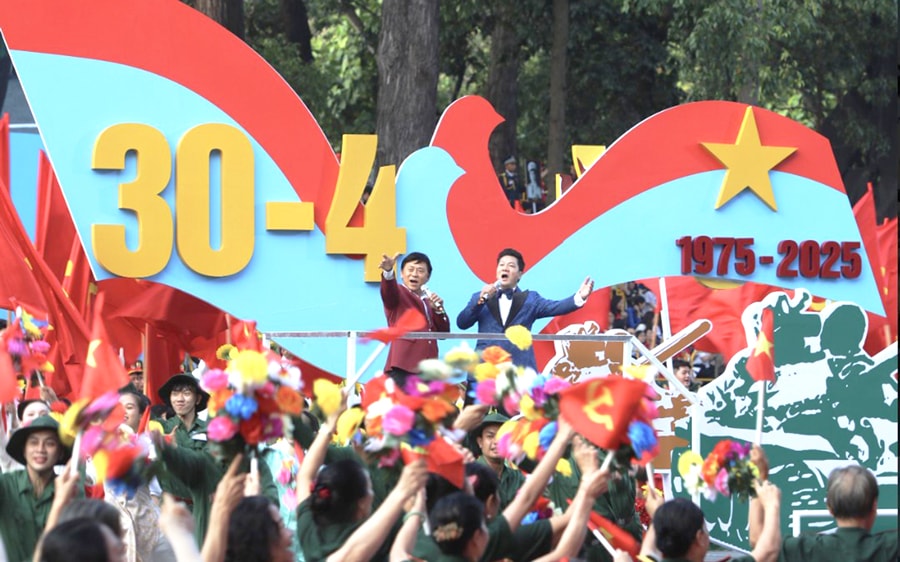
Songs that emerged from the war.
Indeed, if we were to imagine the birth of revolutionary songs during the 1954-1975 period, perhaps we shouldn't think of a recording studio or a sheet music on paper. Instead, think of a corner of the forest, a small hut, a military march... There, music was written amidst the daily movements of the resistance struggle.
“Oh Truong Son! On the road we travel, not a single human footprint is visible / A golden deer tilts its ears in bewilderment / Stopping on the mountain pass to listen to the stream singing / Plucking a wild flower to pin on our hat as we go…” These are very familiar lines from “The Song of Truong Son” (1968) by composer Tran Chung, set to a poem by Gia Dung. What is noteworthy here is how, amidst hardship and danger, the song is so vibrant and optimistic? Similarly, in the song “The Girl Who Opens the Way” (1966) by composer Xuan Giao, from the very first lyrics: “Walking in the night sky, the stars twinkle / Whose singing voice echoes through the mountains and forests? / Is it you, the girl who opens the way? / We don’t see your face, only hear your singing…” it already carries a strong and direct tone with its rapid rhythms, the lyrics sounding like commands yet so cheerful.
A common characteristic of revolutionary songs during this period is their optimistic spirit, mostly featuring lively and bright melodies. In these songs, soldiers choose to face hardship with optimism. And perhaps that is the "key" to understanding the music of the resistance era.
Maintaining that spirit, we can find it in many songs from this period, such as: "My Long Road Across the Country" (1966) by Vu Trong Hoi, "Saigon Girl Carrying Ammunition" (1968) by Lu Nhat Vu, or "Uncle Ho is Marching with Us" (1969) by Huy Thuc... Even songs that lean towards political or lyrical themes are filled with faith in a bright future, such as: "Red Leaves" (1974) by composer Hoang Hiep set to a poem by Nguyen Dinh Thi, for example.
If there is one iconic space representing the period of resistance against the American invasion, it must be the Truong Son mountain range. More than just a strategic route, the Truong Son range is also a symbol, and music has contributed to creating that symbol.
The song "Truong Son East, Truong Son West" (1969) by Hoang Hiep, set to a poem by Pham Tien Duat, resembles a symmetry between East and West, between male and female, and between distance and closeness. The lyrics here become letters without paper, transcending distance through music. From another perspective, "The Sound of the Ta Lu Guitar" (1967) by Huy Thuc opens up a cultural space with the sounds of the mountains and forests, of traditional musical instruments, of melodies imbued with the spirit of the Central Highlands…, creating something special: that war did not erase identity.
The day of great victory arrived, the war ended, the country was unified, and music once again stood at the forefront, not to cheer, but to express joy. Pham Tuyen's "As if Uncle Ho were present on the day of great victory" (1975) is one of the most special melodies: concise, simple, and easy to remember, making it instantly accessible to everyone. It is this very simplicity that allows it to spread so powerfully. Meanwhile, Hoang Ha's "The Nation's Complete Joy" (1975) is like a miniature epic. The melody develops, the climax builds, and emotions are guided from low to high, just like the journey the country has taken from war to peace. These songs not only record historical moments but also shape how we remember them. Thanks to music, joy is not just an event, but becomes a historical moment that can be recreated every time the melody is played.
Significantly, these songs are not detached from reality; the songwriters and singers are directly involved. Therefore, each lyric carries the authenticity of experience, and is not, and is very different from, imagined reality.
When young people continue writing the story
Interestingly, today, in a completely different context, patriotic melodies are gradually making a comeback. No longer about war, no longer about the Trường Sơn mountain range, but the spirit is still inherited and continued. Although they cannot be compared to songs that have stood the test of time, young artists, using the musical language of their era, are continuing the proud tradition of revolutionary music to tell the story of the homeland in their own way.
The DTAP group, comprised of young talents, composed the song "My House Has a Flag Hanging" and released it in 2025, a year of significant events such as the 50th anniversary of the Liberation of Southern Vietnam and the reunification of the country, the 80th anniversary of the successful August Revolution, and the National Day of the Socialist Republic of Vietnam. The flag is the central image of this song. The lyrics, "The old man stands solemnly under the flag / Looking up, remembering his old comrades / Children playing under the flag," connect the past, present, and future. The old man, carrying memories of his comrades, embodies a generation that lived through the war. Conversely, "children playing under the flag" opens up a vibrant and everyday space.
In his song "Continuing the Story of Peace" (2023), composer Nguyen Van Chung did not use the image of a flag or any other symbol from the war era as the central theme of the work, but instead told a more direct story: "Our ancestors fell so that we could have peace in the future." Nguyen Van Chung once shared that he wrote the song with the mindset of someone standing before a monument to heroic martyrs, hoping to connect the past and the present.
The circumstances surrounding the creation of Nguyen Hung's "What Could Be More Beautiful?" (2025) are quite special. During his participation in the film "Red Rain" as an actor, living in a setting that recreated the arduous years of our ancestors' struggle for peace and national reunification inspired the artist to write "What Could Be More Beautiful?" with its simple, profound melody, like the heartfelt words of a young soldier about peace and the dedication of his youth to the Fatherland.
Many patriotic songs praising the homeland and the nation, reflecting the pride in continuing the traditions of their ancestors, have been released by young people in recent years and have been widely accepted by audiences. A common point between the two generations is the expression of patriotism and pride in the tradition of fighting against foreign invaders; they also share the characteristic of telling stories from the perspective of those involved. However, the difference lies in the storytelling style. While songs from the resistance era were often direct and straightforward, today's youth songs tend to be softer and more diverse, blending electronic music with various other genres, in line with modern musical trends.
It is evident that revolutionary music from the 1954-1975 period not only retains its value and presence in today's spiritual life but is also being creatively extended by the current generation of musicians. While the previous generation wrote and sang based on direct experience, blood, tears, and faith, today's generation writes and sings to honor a proud tradition, affirming their responsibility and aspiration to live up to what has been passed down.
The most important thing is not how many songs we remember, but what we retain from those songs. Maintaining optimism amidst difficulties. Maintaining faith in shared values. And maintaining a connection to history.
Musician Nguyen Quang Long
Source: https://hanoimoi.vn/nhung-giai-dieu-vut-bay-cung-dat-nuoc-747924.html




















![[Podcast] Content on drafting and issuing implementing documents for the Capital City Law 2026](https://vphoto.vietnam.vn/thumb/402x226/vietnam/resource/IMAGE/2026/05/25/1779672775296_ban-hanh-mot-so-van-ban-quy-pham-phap-luat-theo-co-che-dac-thu.png)





























































Comment (0)