

Within them lie countless caves, underground rivers, fossils, and rare sediments.
Early in the morning, clouds drifted across the towering limestone mountain ranges. From the summit of U Bo, looking down at the Phong Nha-Ke Bang forest, the ancient trees, covered in mist, seemed to be whispering the secrets of the earth.
Preserving a part of the past
This place is not only famous for its magnificent landscapes but also a rare living "geological museum" in the world. Mr. Le Thuc Dinh, Head of the Science and International Cooperation Department of the Phong Nha - Ke Bang National Park Management Board, said this as he led me along a small, moss-covered slope on limestone mountains formed over 400 million years ago – among the oldest in Asia.
Long-term geological processes have created a massive karst limestone mountain system, with hundreds of caves, underground rivers, and rare sedimentary deposits beneath the surface.
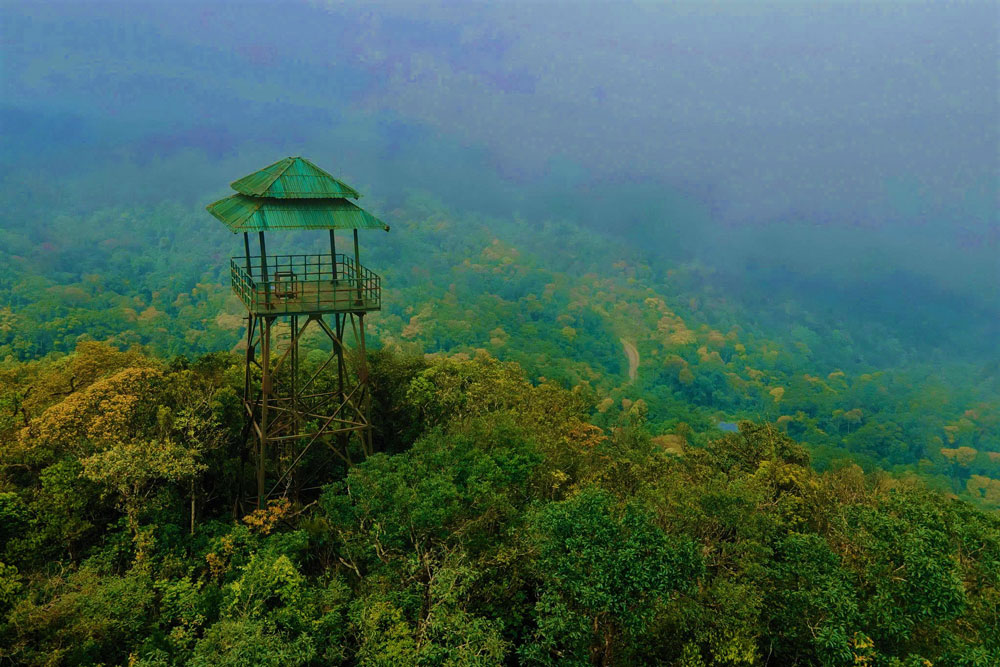
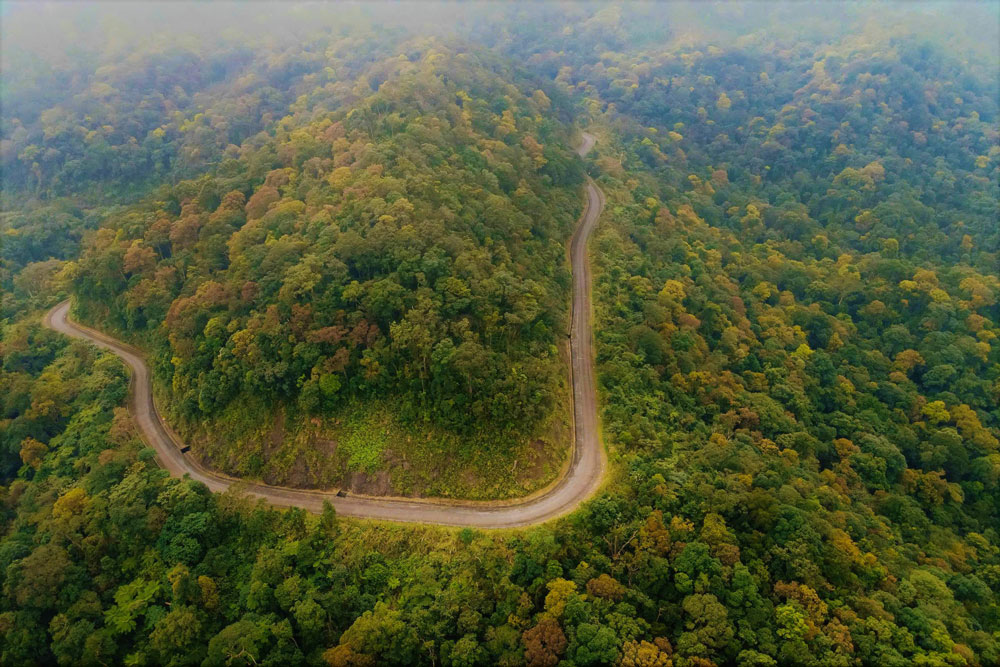
The majestic scenery of Phong Nha - Ke Bang mountain range.
Phong Nha - Ke Bang is not just a scenic wonder as many people know it. For scientists, it is also a living entity, like an "outdoor laboratory" - a place where nature and humans understand and protect each other, opening up new horizons for science and sustainable livelihoods.
On the international conservation map, Phong Nha - Ke Bang stands out with three prestigious criteria recognized by UNESCO: its unique geological and geomorphological system, biodiversity, and magnificent natural landscape. And behind these accolades lies a tireless journey of discovery by scientists, forest rangers, local communities, and the unsung heroes who preserve this heritage.
"Phong Nha - Ke Bang is not only a globally renowned tourist destination, but also a place where many people around the world come to learn how to understand and live in harmony with nature," Mr. Dinh said, his eyes fixed on the exposed geological layers, where ancient sedimentary rocks are stacked like a chronicle of hundreds of millions of years of the Earth's crust.
Within the limestone formations lie thousands of fossil specimens, ancient traces. The sedimentary layers preserve intact paleontological traces, helping scientists trace the origins of life millions of years ago. Thanks to these values, Phong Nha - Ke Bang was recognized twice by UNESCO in 2003 and 2015.
Not only famous for its magnificent cave system, the Phong Nha - Ke Bang primeval forest also harbors a biological treasure: a rare cluster of ancient cypress trees, some over 500 years old – one of the few places in the world where this species still exists. These majestic cypress trees cling to the sheer limestone cliffs, growing at an altitude of nearly 700 meters above sea level.
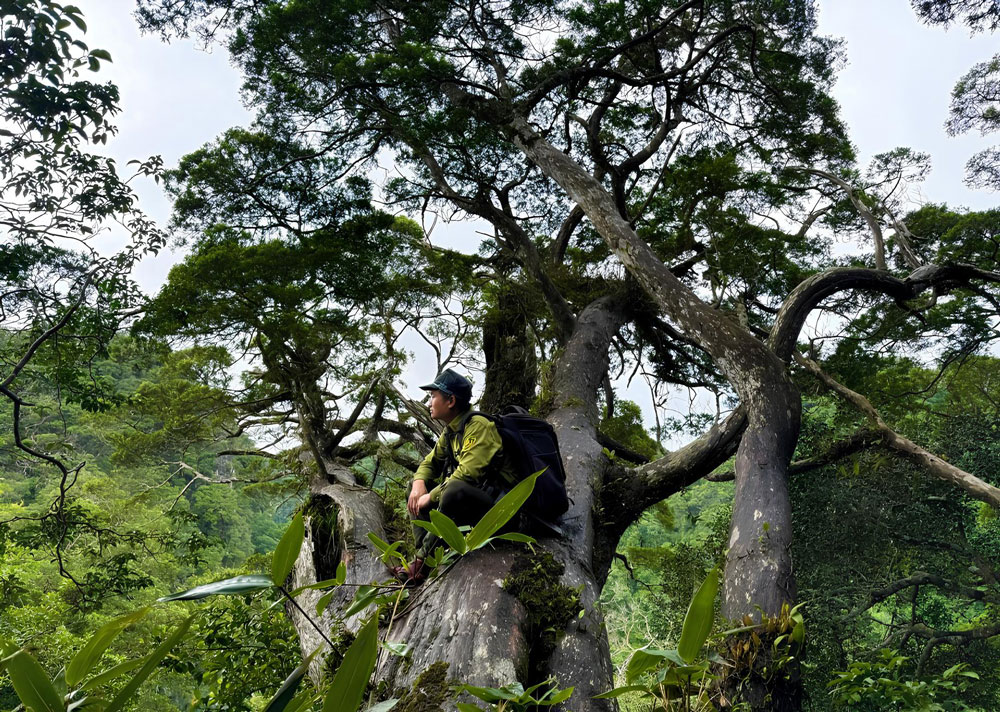
The Phong Nha - Ke Bang National Park boasts a rare cluster of ancient cypress trees, some over 500 years old.
According to Mr. Dinh, the cypress forest covers an area of up to 5,000 hectares, forming a vast primeval forest where thousands of towering trees, over 30 meters tall with trunks more than 2 meters in diameter, resemble a biological wonder discovered just 20 years ago. Interestingly, the cypress on the rocky mountains is a "fussy" species, living alone on rocks at a specific altitude. But strangely, three rare orchid species live alongside them: the green slipper orchid, the spotted slipper orchid, and the twisted slipper orchid. All three species are listed in the International Red Book and are endangered.
Spanning over 123,000 hectares, with the majority being karst topography, Phong Nha - Ke Bang is a valuable field site for geology, paleontology, and climatology. Scientists call it a "gateway to time" leading into the planet's history, where each cave and underground river holds a piece of Earth's past.
Richest and most unique
Nestled within the ancient limestone mountains of Phong Nha - Ke Bang lies another "world": a system of caves and underground rivers stretching over 400 km, creating a mysterious "underground kingdom" where humans have only just begun to touch the tip of the iceberg.
Besides the world-famous "underground labyrinths" like Son Doong Cave, En Cave, Phong Nha Cave, and Thien Duong Cave, in the last five years, scientists in Phong Nha - Ke Bang have discovered dozens of new caves and underground rivers, expanding the cave map by an additional 14 km. The total length of surveyed caves has reached 246 km. Notably, seven new species of flora and fauna have been discovered inside these caves, bringing the total number of new species in the area to 48 - a number that has surprised many international experts.

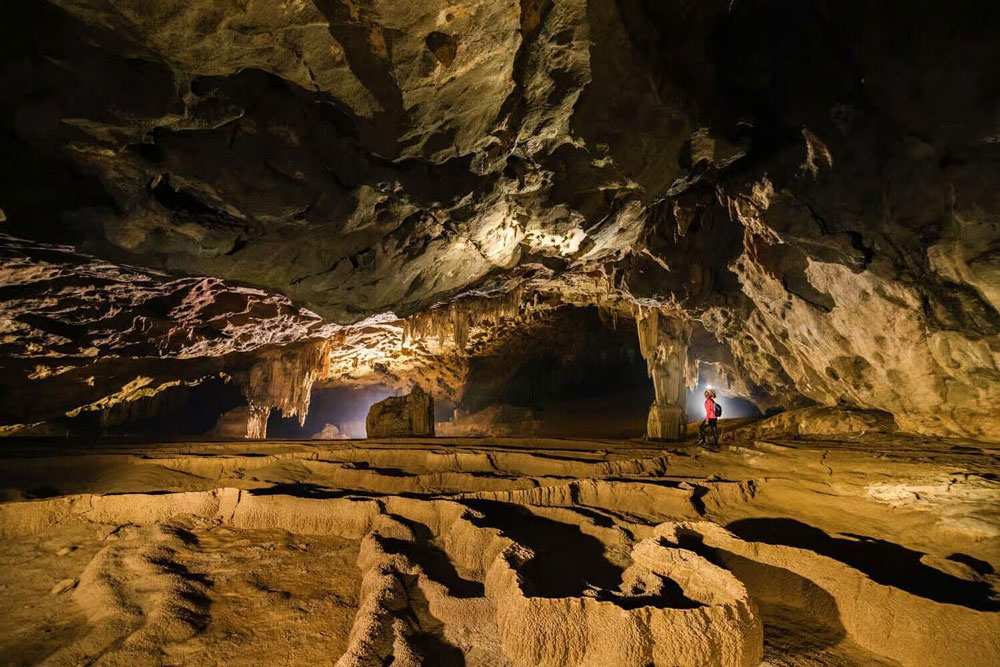
The caves of Phong Nha - Ke Bang hold many secrets waiting to be discovered.
During a recent survey, a team of British Royal Cave Experts – who have been involved with the Phong Nha karst region for over 30 years – continued to discover new cave branches connecting Va Cave, Nuoc Nut Cave, and the Son Doong area. Inside, giant stalactites rise like monuments of time, and crystal-clear underground lakes reflect the winding cave ceilings. The air is bitterly cold, yet life persists. Eyeless fish, scorpions, geckos, bioluminescent shrimp, bats congregate on the cave ceilings, and a host of microorganisms have strangely adapted to the eternal darkness.
Inside Son Doong Cave lies a unique ecosystem – a primeval forest thriving thanks to sunlight filtering through sinkholes. Moss covers the rocks, and birds and lizards live around the skylights.
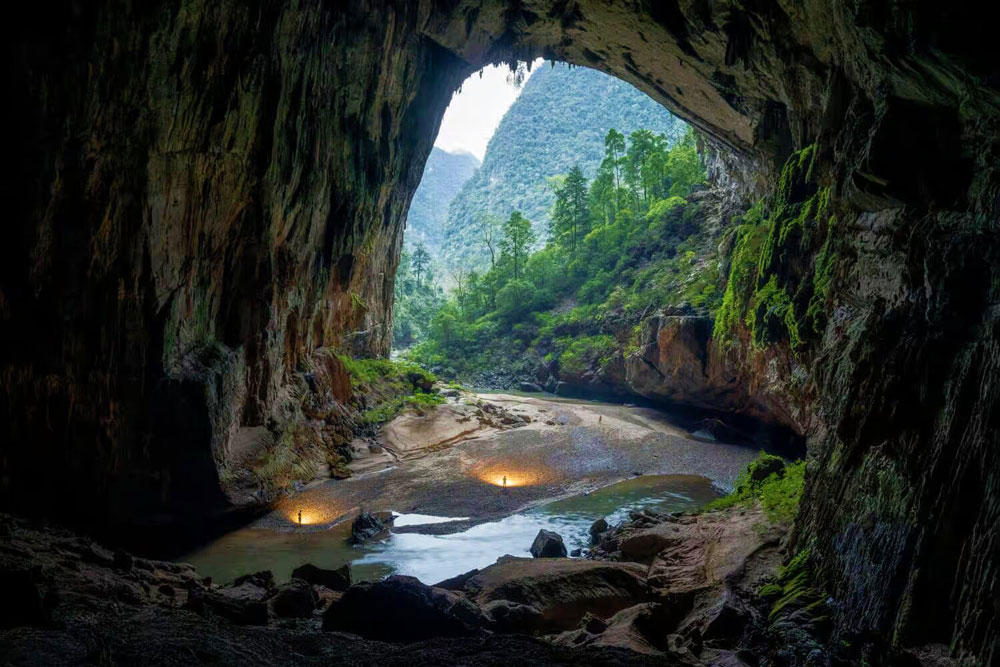
Inside Son Doong Cave – the world's largest cave – lies a unique ecosystem. Photo: OXALIS
Recently, scientists from various Vietnamese research institutes published a report on the biodiversity of this area, discovering 80 species of arthropods, including 10 new species and 13 unidentified species. This number shows that Son Doong is one of the richest and most unique underground habitats in the world.
Along the underground river system beneath the Én, Tú Làn, and Va caves are layers of calcium and magnesium-rich sediments – a breeding ground for many species of insects, mountain spiders, and mollusks. Some species of cave snails exist only in the caves of Phong Nha - Kẻ Bàng and are not found anywhere else in the world.
Nestled in lands dating back hundreds of millions of years, these endemic habitats hold the most vivid memories of evolution – places where science tracks the subtle changes of the planet.
Hold onto your future.
Phong Nha - Ke Bang is not only a geological heritage site but also a "living museum" with its nearly intact primary forest ecosystem, caves, and underground rivers. However, amidst this majestic limestone landscape, signs of both natural and man-made erosion are becoming increasingly apparent. This challenge stems not only from human activity, but also from the significant impact of climate change on the ecosystem.
Recently, the Center for Forest and World Heritage Protection was established to replace the Forest Ranger Station, continuing the mission of protecting Phong Nha - Ke Bang National Park.
"People go into the forest every day. Not everyone goes in to admire the scenery. Some go in to find orchids, timber, or simply to explore the primeval forest. The checkpoints are constantly increasing patrols, but the rugged terrain makes controlling the entire 123,000 hectares of forest a major challenge," shared Mr. Pham Van Tan, Director of the Center for Forest Protection and World Heritage.
Mr. Pham Hong Thai, Director of the Phong Nha - Ke Bang National Park Management Board, said that the unit is entering a comprehensive digitalization phase. An electronic database on geology, biology, caves, and indigenous knowledge is being built to serve research, forest monitoring, and policy planning. This includes remote sensing imagery, artificial intelligence (AI), conservation education in schools, and support for sustainable livelihoods such as growing medicinal plants under the forest canopy, community tourism, and organic farming.
"Phong Nha - Ke Bang is a wonder, but it is also a living organism that needs to be protected every day. Conservation cannot be done alone; the local people must also join hands, accompany, and protect it, because preserving the heritage forest is not just about preserving a title, but about preserving our own future," Mr. Thai confided.
According to the Phong Nha - Ke Bang National Park Management Board, current conservation efforts are not limited to simply preserving the forest but are expanding in a proactive and integrated manner. The Management Board is actively cooperating with domestic and international organizations to build a nomination dossier for the World Biosphere Reserve, aiming for the "Green List" designation. Simultaneously, efforts to mobilize and diversify resources are being intensified to improve management efficiency and enhance heritage conservation capacity.
This unit is also strengthening its connections with UNESCO, international organizations, and members of the global network of national parks to learn from their experiences and work together to protect the region's valuable ecosystems.
More than two decades after being recognized by UNESCO as a World Natural Heritage Site, Phong Nha-Ke Bang National Park in Quang Binh province is not only a source of pride for its magnificent landscapes, but also a vibrant scientific site, uncovering many mysteries of nature and life. It is one of the two oldest karst regions in Asia, a giant "geological museum".
Source: https://nld.com.vn/nhung-kho-bau-o-phong-nha-ke-bang-196250517221156034.htm














































































Comment (0)