

In the hilly area of Khanh Giang (Thien Tin commune, Quang Ngai province), every morning and evening, the sound of a gong from the farm of veteran Huynh Than causes the entire herd of hybrid wild pigs to rush out from the bushes and grassy areas, trotting back to their pens.
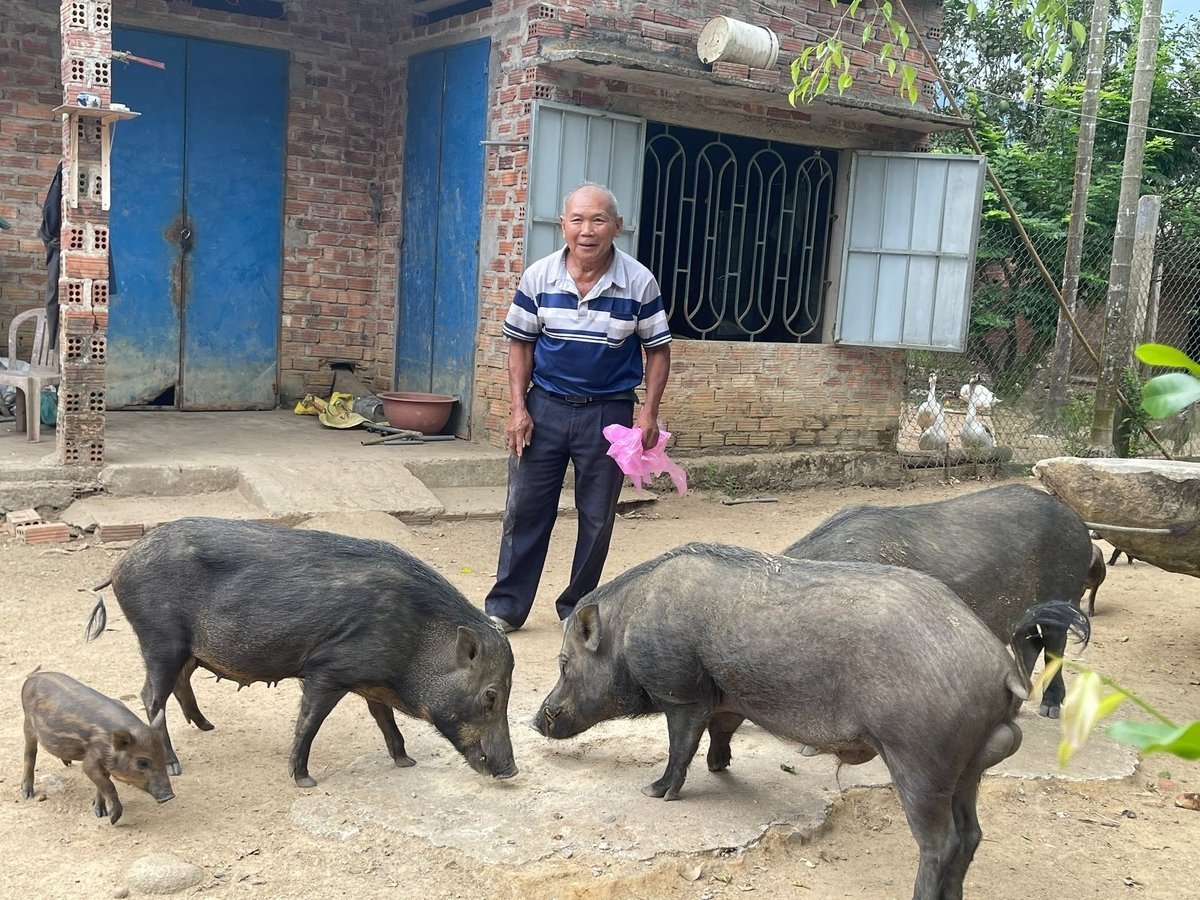
Veteran Huynh Than has achieved success with his free-range pig farming model. Photo: VH
On a spacious plot of land surrounded by lush fruit trees, Mr. Than approached the gong hanging on a tree trunk and struck it forcefully a few times. In just a moment, dozens of pigs of all sizes quickly ran towards him. He poured out onto a plastic sheet a mixture of chopped banana stalks, thinly sliced jackfruit, or dry flour mixed with water to form a thick paste... The pigs, with their long, black fur and healthy bodies, eagerly scrambled to eat.
“Before, I used to use bamboo clappers to call them home. I’d just tap them repeatedly… Later, I switched to using gongs, and they adapted quickly. They knew they were being fed when they heard the call, so they hurried back,” Mr. Than said with a gentle smile.
Recounting his "connection" with hybrid wild boars, he said that this model started after watching an agricultural program on television. Seeing that this breed was easy to raise and suited the climate of the hilly region, he traveled all the way to near Violac Pass to buy a male breeding boar that the local people had trapped, and brought it back to crossbreed with domestic pigs.
"After raising them for a while, I have my own breeding stock. The sows reproduce naturally, so there's no need to import them from elsewhere. That's how I've built up and maintained one litter after another," Mr. Than recounted.
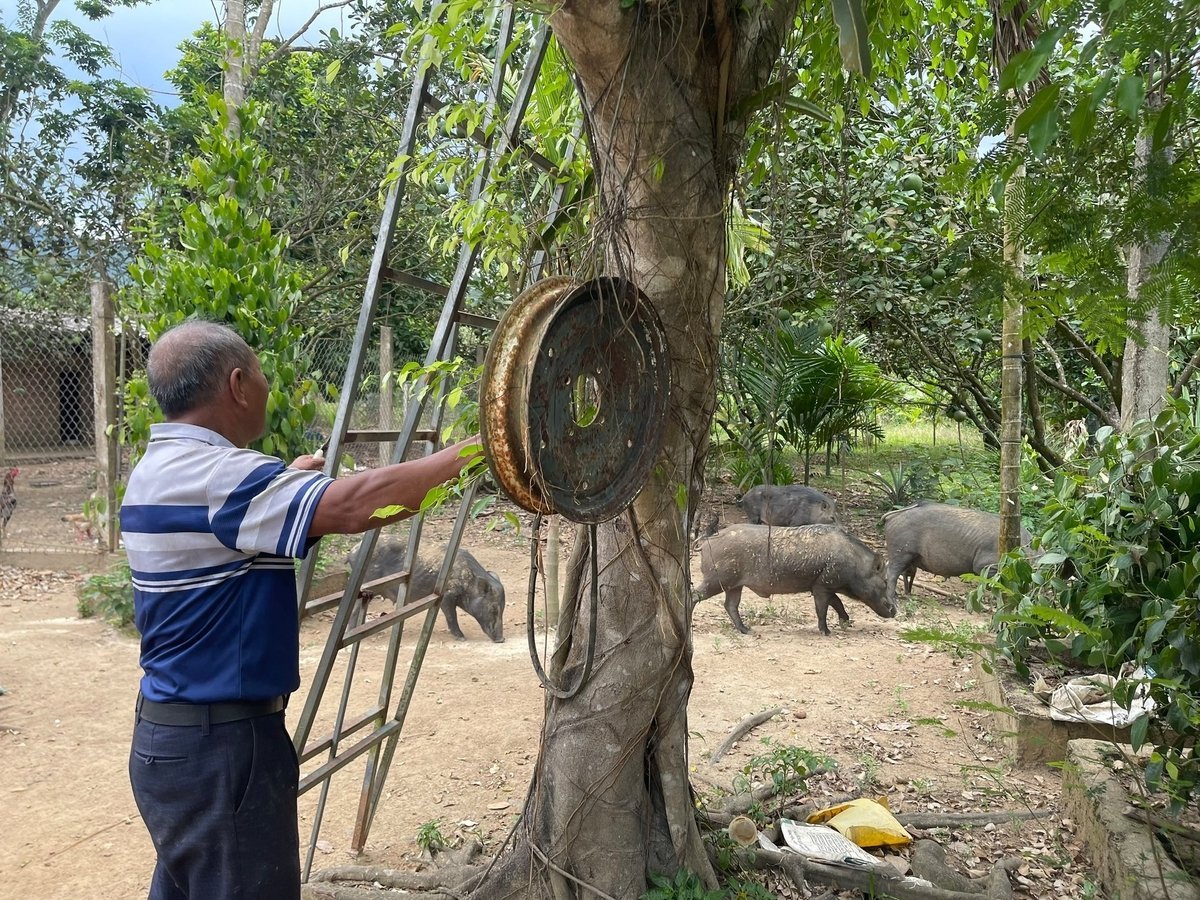
Mr. Huynh Than rings the gong to call the pigs home. Photo: VH
Instead of industrial farming methods, Mr. Huynh Than chose a free-range system, allowing his pigs to graze freely in his garden. Their diet mainly consists of banana tree trunks, fallen ripe jackfruit, leaves, wild vegetables, and agricultural by-products. He feeds them only two meals a day, consisting of diluted wheat flour or rice bran, which provides sufficient nutrients.
"If you raise them in captivity, the meat will be too fatty, and people will complain. If you let them roam freely, the meat will be firm, fragrant, and sweet. You just need to feed them on time; just ring the bell and they'll know to come back," Mr. Than said.
By utilizing readily available food sources around his home, his pigs suffer from fewer diseases, resulting in low costs and high efficiency. On average, he sells 2-3 tons of pork annually, earning a profit of over 40 million VND after deducting expenses. In good years, the yield reaches 4-5 tons, with a selling price of around 150,000 VND/kg.
"The hybrid wild boar is raised naturally, the meat is delicious, and regular customers place orders in advance, so there's no worry about sales," he shared.
Not only does this model provide a stable income, but it also helps him utilize vacant land, keep the environment clean, and reduce agricultural waste. He jokingly said, "The banana and jackfruit trees in the garden are never wasted; everything can become food for the pigs."
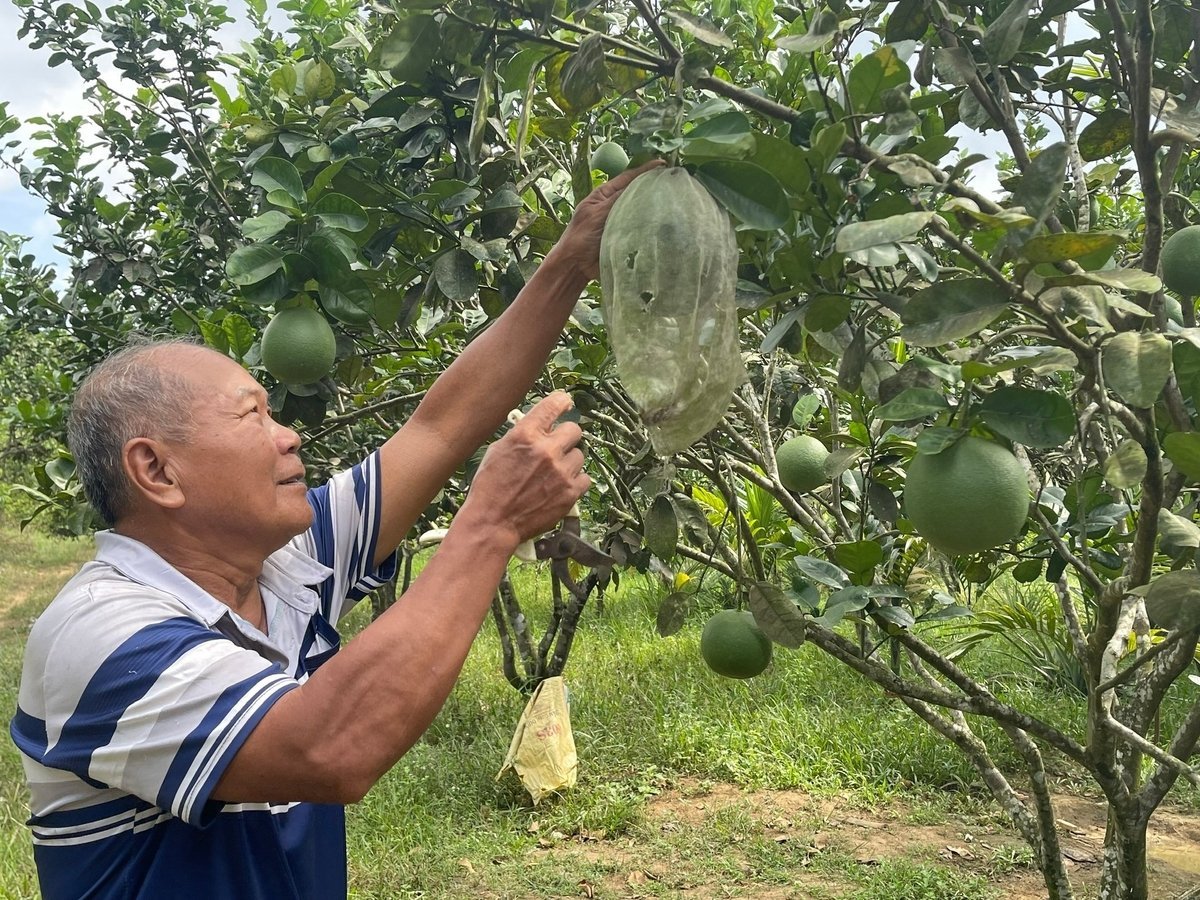
Besides raising hybrid wild pigs, Mr. Than also thrives on growing various types of fruit trees. Photo: VH
Few know that this man with the silver hair and gentle smile was once a courageous reconnaissance soldier during the resistance war. In 1971, when he was not yet 20 years old, Huynh Than enlisted in the army, joining the reconnaissance unit in Nghia Hanh district (formerly). After 1975, he was discharged and returned to his hometown, carrying with him the spirit of a soldier to begin his journey of land reclamation and establishing a livelihood.
Back then, the Khánh Giang hilly area was still wild and full of rocks. With determination and resourcefulness, he boldly cleared dozens of hectares of land to plant sugarcane. Thanks to his hard work and perseverance, within just a few years, he became the "sugar cane king" of the region. When his finances improved, he divided his land among relatives and comrades who were still struggling. From his initial 50 hectares, he kept only 10 hectares for himself.
Then, when the sugarcane market became unstable, he switched to planting acacia trees. When the government launched a campaign to renovate unproductive orchards and develop fruit trees, he was a pioneer in responding. He systematically planned five hectares of hilly land with hundreds of green pomelo, durian, Thai jackfruit, orange, and tangerine trees… The by-products from his farming became an abundant food source for his herd of hybrid wild pigs.
As a war invalid and a member of the Veterans Association, Mr. Huynh Than has been recognized for many years as an outstanding and exemplary farmer in the locality. The commune government highly appreciates him for his ability to apply science and technology to livestock farming and crop cultivation, and his willingness to share his experience with other villagers.
Recalling his life's journey, he just smiled gently: "I'm used to hardship. As long as I have the strength, I'll keep working. I find joy in ringing the bell to call the pigs, tending to the plants, and gardening every day."
In the hills of Thien Tin, the sound of the veteran's gong still rings out regularly every morning and evening - not only to call the hybrid wild pigs back to their pens to eat, but also as a simple melody of diligent working life, of the unwavering spirit of the soldiers of yesteryear.
Source: https://nongnghiepmoitruong.vn/nuoi-heo-rung-lai-บน-dat-doi-cho-hieu-qua-cao-d784062.html
![[Image] Close-up view of the interchange connecting the two expressways and Long Thanh Airport.](https://vphoto.vietnam.vn/thumb/1200x675/vietnam/resource/IMAGE/2026/05/25/1779703378210_ndo_br_z7863716673926-224453a31600126cce10622af6290afd-4549-jpg.webp)
![[Image] Hanoi's urban life under the challenge of a "scorching hot" environment](https://vphoto.vietnam.vn/thumb/1200x675/vietnam/resource/IMAGE/2026/05/25/1779706979265_nang-nong-t5-2026-minh-duy-7-4636-jpg.webp)








































































Comment (0)