From dishes of the rainy season to "medicine pouches" in the forest.
Rock snails, also known as mountain snails or medicinal snails, are endemic species that live only in limestone forests and small streams at moderate altitudes with pristine vegetation. During the dry season, they almost disappear, buried deep in the ground. Only when the first rains of the season fall, increasing the humidity in the forest, do the snails begin to awaken, silently and slowly crawling out of their rocky burrows at night, hiding themselves under layers of damp decaying leaves.
What makes this snail species special is its diet. They feed on forest leaves, including many medicinal plants like mugwort, betel leaves, and ground ginseng. For the Muong and Thai people, rock snails are not only a satisfying meal during the rainy season but also a precious medicinal ingredient from the forest. The snail's intestines, where nutrients accumulate during hibernation, are called the "medicine pouch," carrying the essence of forest plants. Therefore, the locals say: When eating snails, you must eat the intestines; discarding them is a waste of nature's bounty. This is not just culinary knowledge, but also a way of cherishing nature and appreciating what the mountains and forests have bestowed upon us.
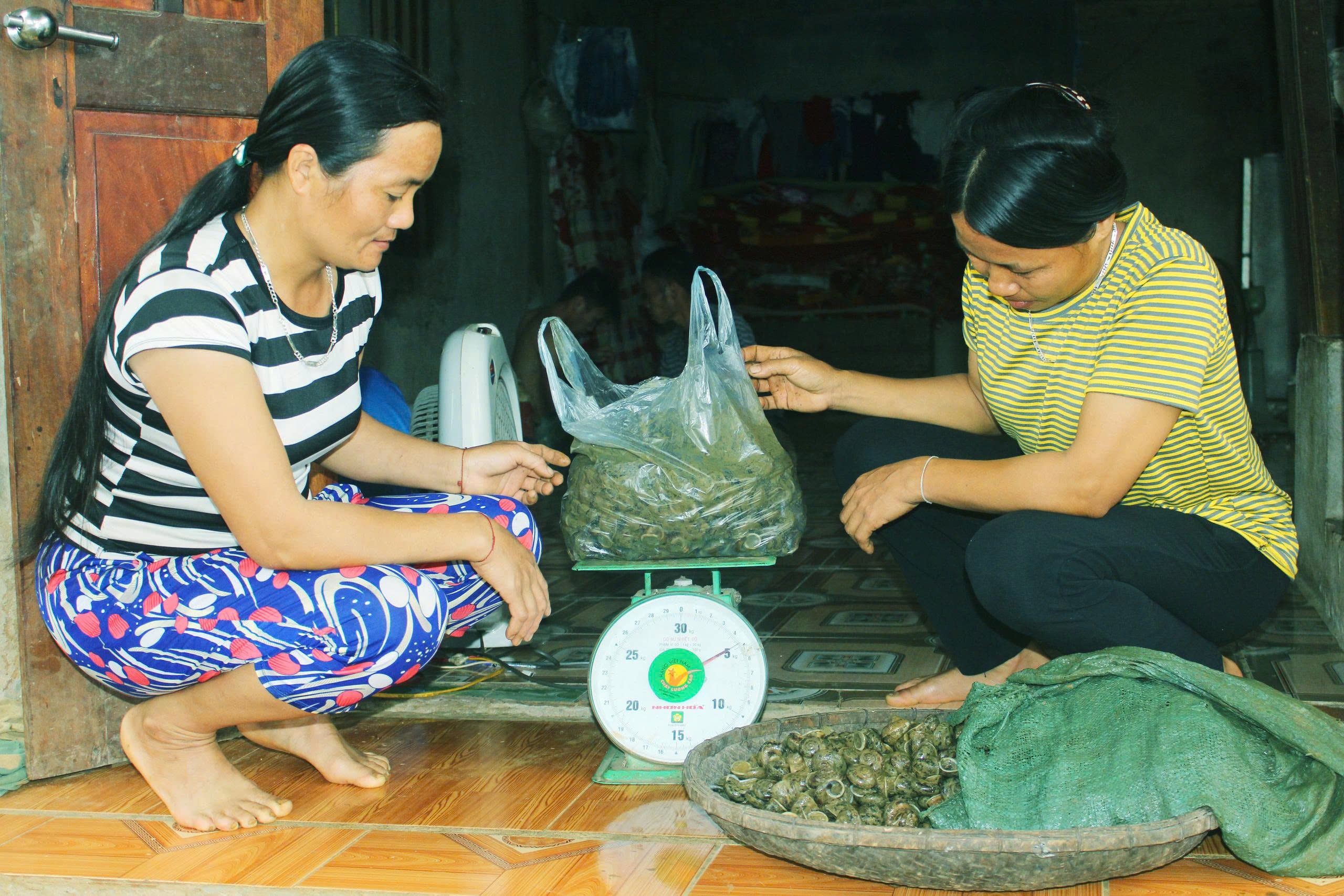
People in Phu Cuong commune weigh out rock snails after a night in the forest.
Rock snails are abundant in areas such as Mai Chau, Tan Lac, Kim Boi, and Lac Son (formerly)... - places that still retain dense forests, clear streams, thick, humid foliage, and a cool climate. Therefore, the number of snails caught each season not only reflects the skill of the forest dwellers but also serves as an indicator of the forest's vitality: a healthy forest produces many snails, while a depleted forest yields scarce resources.
If you've ever visited Lac Village (Mai Chau), stayed in a stilt house, and tasted steamed rock snails with lemongrass, you'll surely never forget this rustic dish. The snails are briefly boiled, then steamed with ginger, lemongrass, lime leaves, and a few slices of chili. In just ten minutes, the aroma fills the kitchen. Diners savor each small snail, dipping it in a lime-chili fish sauce mixed with mắc khén (a type of spice), savoring the crunchy texture, the sweet and savory taste with a hint of medicinal herbs, and a touch of bitterness on the tongue. The taste of the forest, the rocks, and the first rains of the season is unmistakable.
Nowadays, rock snails are not only a common part of everyday meals but also appear on restaurant menus in Hoa Binh City or Kim Boi (formerly), and in community tourism villages like Pom Coong and Chieng Chau (Mai Chau)... A plate of steamed snails with lemongrass costs around 100,000 dong, but visitors from the lowlands praise it as "worth the money, like free-range chicken or local pork." At the stilt house homestay of Ms. Ha Thi Duyen in Chieng Chau hamlet (Mai Chau), foreign tourists find it unusual, people from Hanoi find it delicious, and she simply says: "Our locals miss it. This season, without snails, a meal feels incomplete."
Sacrifice livelihoods or preserve sustainability?
For many people in the highlands, rock snails are a "gift from heaven" during the lean season. Every rainy night, people shine flashlights into the forest, carrying bamboo baskets on their shoulders. Skilled hunters can collect 4-7 kg a night, with prices reaching 80,000-90,000 VND/kg at the beginning of the season. A snail season lasts 3-4 months, and diligent people can earn 5-7 million VND/month - a considerable amount for households in remote areas.
From a humble dish, rock snails have become a specialty commodity, carrying with them the hope of providing villagers with more comforting meals, offering homestays a unique dish to attract tourists, and providing forest dwellers with additional income during the rainy season. However, this also raises a growing concern: as more people enter the forest to hunt snails, will the forest's bounty be sufficient for everyone? With each rainstorm marking a harvest season, can this livelihood derived from nature be sustained in the long run?
“In the old days, after each rain, you could just go to the stream and ‘pick up’ snails, but now you have to go a kilometer deep,” said Mr. Bui Van Chao, who has spent over 20 years searching for snails in the Tan Lac forest area, slowly recounting the story. He wasn’t complaining. He was talking about an obvious reality: the forest no longer has as many snails as before. And if there are any, they are hidden deeper and harder to find.
Rock snails, once a delicacy during the rainy season, have become a commodity. And the forest, once a habitat, has gradually become a "warehouse." Every rain shower triggers a massive gathering of these snails. Traders wait at the edge of the forest, buying them by the kilogram. On social media, groups dedicated to "collecting live mountain snails, unlimited quantities" are constantly popping up. Many people no longer pick only the mature snails but instead gather entire nests—including large, small, and even young snails not yet old enough to reproduce.
Besides the risk of depletion, searching for snails also carries deadly risks. In 2024, a woman in Lo Son commune (formerly Tan Lac district) died after slipping and falling into a crevice while searching for snails at night. Before that, two people from Ninh Binh who went into Cuc Phuong forest to collect snails got lost for three days and three nights... Such incidents are not uncommon, but they are still not enough to stop people from going.

The rock snail has a rounded, flattened, spiral shell that is dark brown or off-white in color.
Currently, rock snails are not listed as a protected species. There are no regulations regarding harvesting seasons, minimum snail sizes, or prohibited hunting areas. Although local authorities have issued warnings, their efforts have mainly been through public awareness campaigns, without specific control measures in place.
"The difficulty lies in the fact that these snails are wild, scattered throughout the forest, and no one has yet managed to breed them, nor has anyone been able to count their numbers," a forest ranger shared. "If we don't control them well, in a few years we might have to... import rock snails to make them a specialty dish."
This is no longer an empty warning. It's the very near future if we continue to believe that nature's bounty is inexhaustible, if every rain shower is a complete drain, leaving no seeds of life for the next season.
Nguyen Yen
Source: https://baophutho.vn/oc-da-loc-rung-thuc-giac-235357.htm






![[Video] Sunset at Lap An Lagoon – Where the sun sets over the fishing nets](https://vphoto.vietnam.vn/thumb/1200x675/vietnam/resource/IMAGE/2026/05/31/1780192137701_beach-landscape-sea-water-nature-grass-745871-pxhere-com.jpeg)













![[Video] Sunset at Lap An Lagoon – Where the sun sets over the fishing nets](https://vphoto.vietnam.vn/thumb/800x450/vietnam/resource/IMAGE/2026/05/31/1780192137701_beach-landscape-sea-water-nature-grass-745871-pxhere-com.jpeg)









































![[Video] Sunset at Lap An Lagoon – Where the sun sets over the fishing nets](https://vphoto.vietnam.vn/thumb/402x226/vietnam/resource/IMAGE/2026/05/31/1780192137701_beach-landscape-sea-water-nature-grass-745871-pxhere-com.jpeg)































Comment (0)