

At the Ministry of Finance 's regular press conference on the afternoon of January 19th, Deputy Director General of the General Department of Taxation Mai Son discussed various issues surrounding the environmental protection tax arrears of petroleum distribution companies.
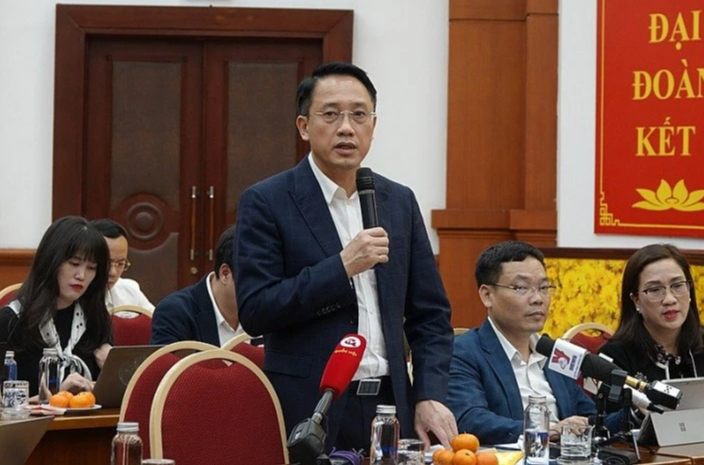
Deputy Director General of the General Department of Taxation Mai Son answered questions at the press conference.
Mr. Mai Son stated that out of a total of 34 petroleum wholesale businesses, nearly 10 have outstanding tax debts. Currently, the General Department of Taxation is closely monitoring the tax debts of businesses in general, and local tax departments have fulfilled their responsibilities in implementing tax management regulations.
The leaders of the General Department of Taxation stated that, in accordance with the Law on Tax Administration, businesses self-declare, self-pay, self-calculate, and are responsible before the law. The tax authorities inspect, monitor, and urge the payment of tax debts to the state budget. Regarding the management of the businesses' cash flow, violations will be dealt with through inspections and audits.
"Over the past period, tax authorities have been urging and enforcing tax debt collection in accordance with the law," Mr. Son affirmed.
Regarding the process, Mr. Son further informed: when units incur debts starting from the 91st day onwards, the tax authorities will enforce account seizure; from the 121st day onwards, they will enforce invoice seizure.
"In addition, other coercive measures may be applied depending on the tax management regulations related to the legal representative, such as travel bans; identification and seizure of assets...", Mr. Mai Son said.
To prevent businesses from defaulting on taxes, in 2024, the tax authorities will focus on building a database related to business financial reports based on financial statements and business operations.
Speaking at the press conference, Deputy Minister of Finance Nguyen Duc Chi emphasized that tax management follows the principle of self-declaration and self-payment by businesses, with tax authorities providing supervision. Regarding cash flow, if businesses are found to be in violation after review, the authorities will handle the matter according to the law.
Earlier in January, the Government Inspectorate issued a notice summarizing the findings of its inspection regarding compliance with policies and laws in the state management of petroleum products.
The inspection results also revealed that, due to the General Department of Taxation and many tax departments failing to fully and correctly implement regulations, and lacking inspection and supervision, many petroleum wholesalers owe thousands of billions of dong in environmental protection tax over many periods and years.
The Government Inspectorate determined that, as of September 30, 2022, 6 out of the 15 petroleum wholesalers inspected owed environmental protection tax totaling more than 3,219 billion VND.
Notably, despite owing the state budget in environmental protection taxes, some major petroleum traders have lent thousands of billions of dong to individuals for personal use.
Specifically, from 2017 to 2022, Thien Minh Duc Group Joint Stock Company lent over 7,485 billion VND to Mr. Chu Dang Khoa, Deputy General Director, and Ms. Chu Thi Thanh, Chairwoman of the Board of Directors of the company. At the time of the inspection, the two individuals still owed the company a total of over 1,396 billion VND.
Similarly, Xuyen Viet Oil Trading, Transportation and Tourism Company Limited has negative equity of over 462 billion VND, owes the State over 1,246 billion VND in environmental protection taxes, and owes the price stabilization fund over 212 billion VND. However, the company is allowing Ms. Mai Thi Hong Hanh, the Chairwoman of the Board of Directors, to owe over 2,978 billion VND…
Source link


![[Image] First UAV flight test in medical transport](/_next/image?url=https%3A%2F%2Fvphoto.vietnam.vn%2Fthumb%2F1200x675%2Fvietnam%2Fresource%2FIMAGE%2F2025%2F12%2F24%2F1766560655977_thunghiembay-3551-jpg.webp&w=3840&q=75)
![[Image] First Congress of the Vietnam Science and Technology Trade Union](/_next/image?url=https%3A%2F%2Fvphoto.vietnam.vn%2Fthumb%2F1200x675%2Fvietnam%2Fresource%2FIMAGE%2F2025%2F12%2F24%2F1766552551054_ndo_tr_img-1801-jpg.webp&w=3840&q=75)



















































































Comment (0)