

PARENTS' THOUGHTS AND QUESTIONS
Although schools conducted surveys and gathered parent feedback before implementing these programs, parents remain uncertain, even confused, about the effectiveness of these subjects in collaboration with external partners – what the Ho Chi Minh City Department of Education and Training calls "school programs."
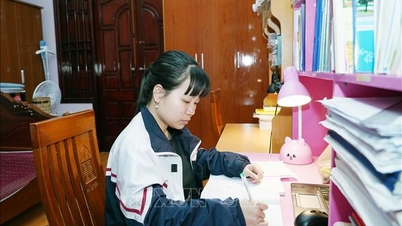
Recently, reporters from Thanh Nien Newspaper have received many letters and inquiries from parents regarding the timetable for elementary school students. "If we don't register for subjects like critical thinking math, math and science in English, or English through software… we don't know what our children will do during class time. It's not like they'll be sitting around doing nothing while their friends are studying. But registering for all the subjects means paying a considerable amount of extra money each month. Elementary school tuition is free, but enrolling in all the voluntary subjects in the school program means a significant monthly fee for students"; "We feel that now, students studying the 2018 General Education Program have to take extra subjects, subjects that the school program requires additional payment for. But if we don't study these subjects, will the goals of the 2018 General Education Program be achieved?"; "To what extent does the 2018 General Education Program help develop the competencies, qualities, thinking skills, and creativity of students and teachers, and what are the challenges?" These are the concerns of many parents of primary school students in Ho Chi Minh City today.
" FILL IN THE BLANKS"?
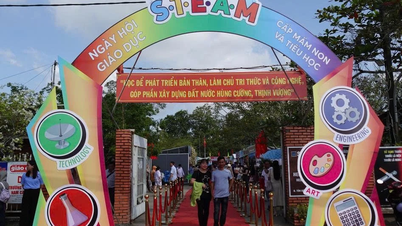
The principal of a public primary school in the heart of Ho Chi Minh City said that the school is fortunate to have complete, modern facilities with sufficient classrooms, functional rooms, playgrounds, computers, Wi-Fi coverage, teaching equipment, as well as a team of young teachers and staff who are knowledgeable in information technology to ensure the smooth implementation of the 2018 General Education Program. The school also has the consensus of parents in implementing educational plans and school programs (international computer science subjects, STEM, life skills, English through science and math, English with native speakers, etc.).
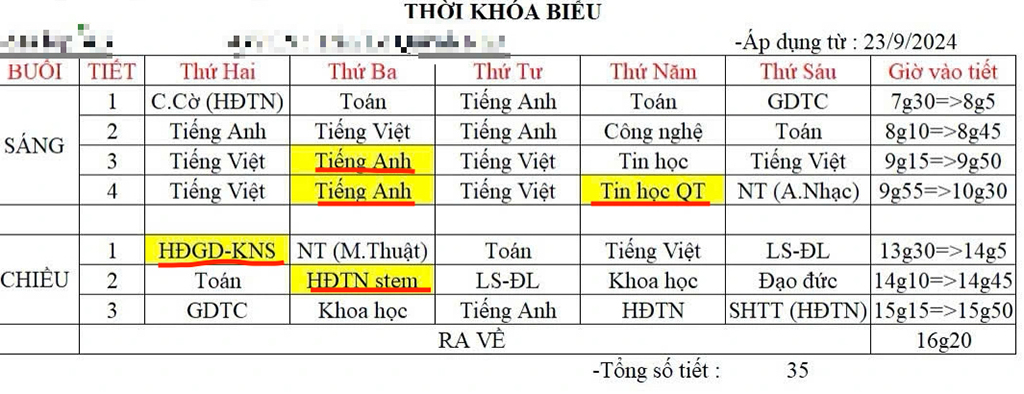
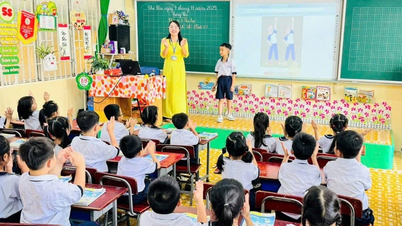
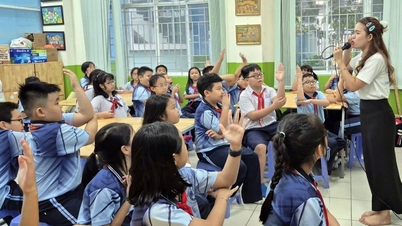
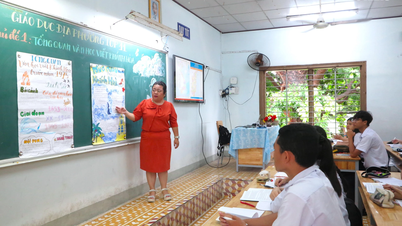
The elementary school timetable consists of two sessions per day, with subjects from the school curriculum interspersed with other subjects.
However, she acknowledged that "in schools where facilities and teaching staff are inadequate, it is very difficult for the 2018 General Education Program to be effective." She explained that if a primary school class has 50-53 students (the regulations for primary schools stipulate 35 students per class), lacks classrooms to ensure 100% of students can attend two sessions per day, and lacks teachers for subjects like English, music , art, and computer science, it is very difficult for homeroom teachers to fulfill all the learning objectives in the textbooks and ensure the comprehensive development of students' abilities, qualities, and talents.
Some readers of Thanh Nien Newspaper have commented that the voluntary subjects in the school curriculum are merely "filling in the gaps," fulfilling the requirement of 7 lessons per day to meet the regulations of the 2018 General Education Program for primary schools. Why aren't those lessons used for students to review math, Vietnamese, or for self-study as in the previous 2006 program? We raised this issue, and the aforementioned principal presented three main points: Firstly, the school curriculum complements the 2018 General Education Program, helping students develop comprehensively, especially in a unique urban area like Ho Chi Minh City, where students need to be nurtured and cultivate knowledge in English, computer science, STEM, etc.
Secondly, according to the overall 2018 General Education Program, students in grades 1 and 2 study 25 lessons per week; grade 3 students study 28 lessons per week; and grades 4 and 5 students study 30 lessons per week. Elementary school students will study 7 lessons per day, in two sessions per day. According to the above regulations, if students only study the compulsory subjects in the curriculum, more than 3 or 4 days per week would be sufficient. So what will students do with the remaining time at home?
Thirdly, parents also asked why review sessions for subjects aren't organized in class during the extra periods. However, elementary school teachers are also assigned a teaching load of 23 periods per week, and if they teach more than that, they are not entitled to overtime pay (to earn overtime pay, they must meet certain specific regulations). So who will pay the teachers?
Instead of collaboration, we need policies that allow teachers to teach independently.
Many people are questioning whether teachers in schools can organize lesson planning and teach the school's curriculum instead of partnering with external organizations. The principal of a school in a central district of Ho Chi Minh City stated: "With our well-trained teaching staff, we are fully capable of teaching STEM, life skills, foreign languages, sports clubs, and arts to students. This approach would also reduce the fees for each subject compared to partnering with external organizations, reassure parents about the lesson plans and curriculum, and provide additional income for our teachers and staff. However, we need mechanisms, policies, and specific guidance from the Department of Education and Training or the District Education and Training Office for this. I believe this is also a concern for many public educational institutions today."
Attention must be paid to the method of doing it.
The principal of another primary school in Thu Duc City (Ho Chi Minh City) believes that Ho Chi Minh City is a dynamic city, a leader in innovation and creativity in education, economics, and other fields, so innovations in school curricula should also be viewed positively and evaluated from multiple perspectives. According to this principal, all school programs aim to support the 2018 General Education Program, helping students develop foreign language skills, critical thinking, and experiences… "In principle, I think it's correct. However, attention must be paid to the approach and methods of implementation by the units. If the units do not communicate to parents so they understand the program, show them its advantages and benefits, as well as its effectiveness, and do not solicit public and transparent feedback during implementation, it is very easy to encounter conflicts and waves of opposition," this principal said.
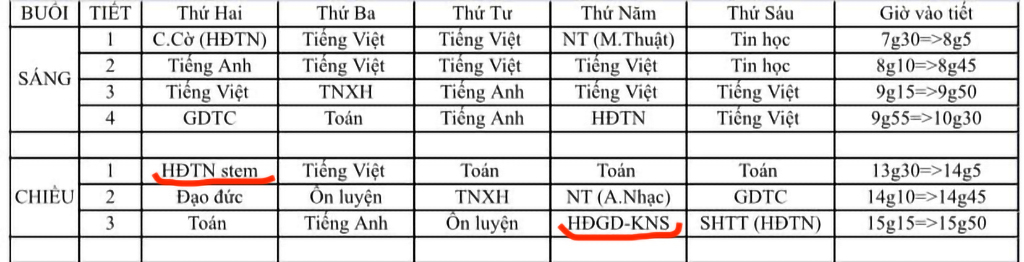
Parents are questioning the elementary school timetable, which has two sessions per day, in which subjects from the school curriculum are interspersed with other subjects.
The principal added: "New things are very prone to controversy. The newer the policies and guidelines, the more cautious administrators must be, listening to various perspectives and adhering closely to educational goals. And we must frankly acknowledge that the goals of primary education now are different from those of 10 or 20 years ago." The reporter then asked, "So, if students from disadvantaged economic backgrounds cannot participate in school programs, does that mean they don't have the opportunity to access the comprehensive goals set by the school program?" This person replied: "Generally, each educational institution always strives to provide students with the best possible access to education in a fair manner. If students are truly disadvantaged, the school allows them to study these subjects for free. Institutions also have flexible solutions; if students don't take a subject, they are provided with reading materials and study materials in the library under the supervision of a librarian. Otherwise, if parents proactively decline to enroll their children in these subjects for other reasons, that is the family's right to choose." (to be continued)
The concept of "main course" and "extracurricular" no longer exists.
Responding to the press, a leader of the Ho Chi Minh City Department of Education and Training emphasized that from the 2024-2025 school year, the regulation of teaching two sessions per day according to the 2018 General Education Program will apply to all primary schools, so the concept of "main course" and "extracurricular" activities within the two-session-per-day timeframe will no longer exist.
This person stated that, according to regulations from the Ministry of Education and Training, when implementing the 2018 General Education Program at the primary school level, 100% of students will attend school for two sessions per day to develop their qualities and abilities in accordance with the program's objectives. Therefore, primary schools must organize teaching and learning for two sessions per day. The concept of "session 1" and "session 2," and the view that morning is for core curriculum and afternoon is for extracurricular activities, as in the 2006 General Education Program, is no longer appropriate.
According to the leaders of the Ho Chi Minh City Department of Education and Training, at the primary school level, the school program is part of each school's two-session-per-day teaching plan. The school program complements and runs parallel to the implementation of the 2018 General Education Program; it cannot be separated if we want to best achieve the goals of the 2018 General Education Program. Primary school students' participation in the school program is a right for each student, helping them develop qualities and abilities, and equipping them with the most necessary skills in information technology, foreign languages, and life skills… to meet the learning needs not only at the primary school level but also at subsequent levels of education.
Source: https://thanhnien.vn/phai-hoc-mon-lien-ket-tu-nguyen-trong-chuong-trinh-giao-duc-moi-185241016193744415.htm


![[Photo] Prime Minister Pham Minh Chinh presides over a meeting on private sector economic development.](/_next/image?url=https%3A%2F%2Fvphoto.vietnam.vn%2Fthumb%2F1200x675%2Fvietnam%2Fresource%2FIMAGE%2F2025%2F12%2F20%2F1766237501876_thiet-ke-chua-co-ten-40-png.webp&w=3840&q=75)

![[Photo] Prime Minister Pham Minh Chinh presides over the conference announcing the establishment of the International Finance Centre in Vietnam.](/_next/image?url=https%3A%2F%2Fvphoto.vietnam.vn%2Fthumb%2F1200x675%2Fvietnam%2Fresource%2FIMAGE%2F2025%2F12%2F21%2F1766309817714_ndo_br_dsc-3400-jpg.webp&w=3840&q=75)






















































Comment (0)