

Empowering teachers with autonomy and creativity.
Ms. Phan Thi Van Huong, a teacher at Hung Dung Secondary School (Truong Vinh Ward, Nghe An Province ), believes that using a common set of textbooks would not create difficulties for teachers' teaching. She argues that using one or more sets of textbooks is not the measure of teaching innovation, but rather the creativity and autonomy of teachers in organizing their lessons.
It is crucial that teachers study the materials, focusing on the knowledge and skills that students need to acquire. Therefore, the curriculum framework, knowledge and skill standards, and learning outcomes are the legal framework, while textbooks are merely the primary resources for organizing teaching and learning.
Ms. Le Thi Xuan Dao, a Literature teacher at Tay Son Secondary School (Hoa Cuong Ward, Da Nang City), shared: “The foundation of teaching remains adhering to the learning objectives of the 2018 General Education Program. By understanding these requirements, teachers can flexibly design appropriate learning activities, ensuring the program's goals are met. It can be said that textbooks are merely supporting tools, while the spirit of educational reform – developing students' competencies and qualities – remains unchanged.”
According to Ms. Dao, having a common set of textbooks makes it easier to use external materials in testing and evaluating students' abilities. After four years of implementing the new curriculum with three different sets of textbooks, teachers have had the opportunity to access, accumulate, and compare many rich sources of materials, thereby easily selecting appropriate materials, ensuring accuracy and diversity in teaching.
In fact, searching for and utilizing external teaching materials has become a familiar skill for teachers throughout the recent reform process. "Most importantly, teachers must clearly understand and adhere to the principles of teaching oriented towards developing students' competencies and qualities. Teachers can still flexibly choose and adjust teaching materials and methods to suit their students," Ms. Dao affirmed.
Mr. Vu Van Tung, a teacher at Dinh Nup Primary and Secondary School (Po To commune, Gia Lai province), believes that the biggest challenge lies not in the "textbook," but in the "teaching" method. With many years of teaching experience, Mr. Tung observes that with only one set of textbooks, teachers must be even more proactive and flexible.
Teaching methods cannot be rigidly structured according to the textbook sequence but can vary activities, connect with real-world situations, and integrate interdisciplinary approaches to make learning easier and more engaging for students. Teaching methods also need to be modernized by incorporating group discussions, project-based learning, experiential learning, learning stations, and dramatizing lesson content.
During class, students are encouraged to participate in content creation, ask questions, and present their learning products in their own way. According to Mr. Tung, teachers should utilize digital technology, open educational resources, online resources, and supporting software to make lessons lively, up-to-date, and relevant to real life. After each lesson, self-assessment and professional exchange with colleagues will help teachers continuously adjust and innovate.
From another perspective, Ms. Van Huong argues that the way questions are formulated and assessments are organized in the 2018 General Education Program is open-ended, posing problems and requiring learners to apply their knowledge to find solutions. Therefore, if a single set of textbooks is used, teachers need to base their teaching methods on the program's learning objectives, determining appropriate approaches not only for Literature but also for other subjects.
“During the teaching process, if teachers are competent and creative, they can refer to other materials and textbooks. Regardless of which textbook is used, I hope that the education sector will continue to promote innovations in current testing and evaluation methods so that teachers and students can feel secure in their teaching and learning,” Ms. Van Huong shared.
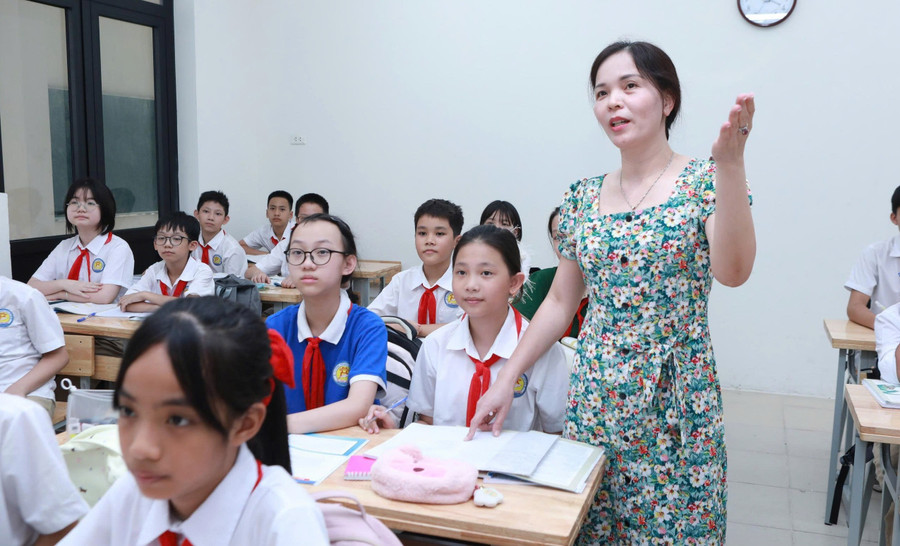
Textbooks are teaching materials.
After 5 years of implementing the 2018 General Education Program and replacing textbooks, Ms. Pham Thi Huong - Principal of Town 2 Primary School (Van An commune, Nghe An province) - believes that if teachers have high competence, using multiple sets of textbooks and reference materials for teaching is excellent.
However, based on many years of teaching and management experience, the actual qualifications of primary school teachers in the school in particular and in the commune in general are not uniform. There are not many primary school teachers who are highly independent, flexible, and boldly creative in their lessons.
Therefore, to improve the effectiveness of teaching when implementing the unified textbook series, Ms. Pham Thi Huong hopes for guidance in each lesson, in addition to the requirements stipulated in the curriculum framework. This way, capable teachers will still be able to proactively develop their abilities and strengths, enhancing the effectiveness of their lessons.
Teachers with lower qualifications will feel more confident in their teaching and won't fear being misdirected. Furthermore, regarding the content of the unified textbook series, for primary school level, it's necessary to address shortcomings in the use of teaching materials, ensuring that the content is friendly, easy to understand, easy to remember, and humane.
Mr. Duong Van Son, Principal of Kim Lien High School (Kim Lien commune, Nghe An province), said that he has many years of direct teaching experience, is currently an administrator, and is a parent with children attending high school.
Speaking from the perspective of an "insider," Mr. Duong Van Son believes that a single set of textbooks should be used to create uniformity and consistency in teaching across schools. Teachers would have access to standardized materials, eliminating the need to constantly compare and contrast knowledge from different textbooks when developing lesson plans for students.
Simultaneously, this standardized material allows teachers to proactively update their knowledge, supplementing it with information from the internet and other sources to enrich lesson content. Students also benefit and feel more confident when participating in important exams such as the entrance exam for grade 10 and the high school graduation exam with common questions across the province or the entire country.
The principal of Kim Lien High School believes that the most important thing is to ensure "standard" assessment of students' abilities. If assessment aims to develop students' abilities, then teachers will also be proactive, creative, and flexible in applying materials to find appropriate teaching methods and content.
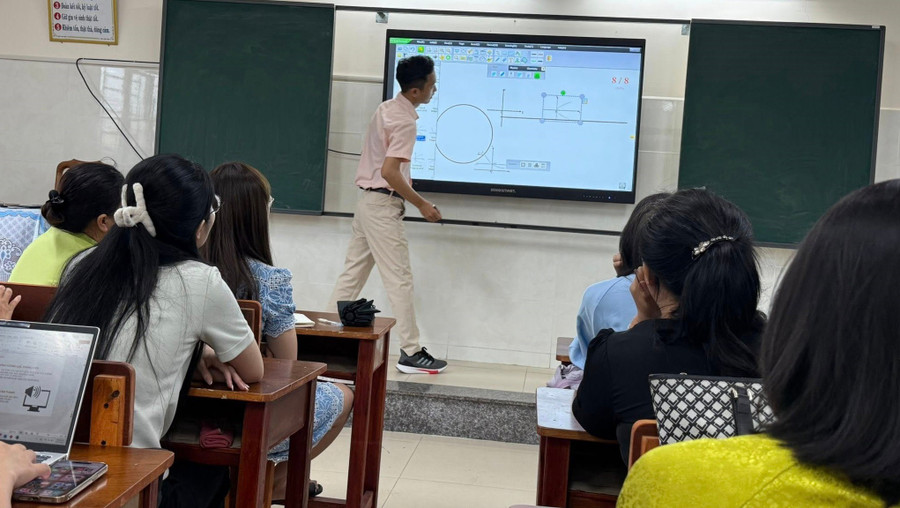
Enhancing teachers' teaching and learning organization skills.
Ms. Nguyen Thi Van Hong, Principal of Chuong Duong Secondary School (Hong Ha, Hanoi), believes that when schools use the same set of textbooks, the important thing is not "what we have in common," but rather what makes them different so that students can still learn with enthusiasm and develop their true abilities.
Textbooks are standard resources, but if teaching is limited to simply relaying the content in the book, the lesson will become rigid and passive. To avoid rigidity, teachers must thoroughly understand the curriculum, clearly grasp the learning objectives and competencies to be developed, and then proactively select content, examples, materials, and approaches that are appropriate for their students.
Changing the order of activities, relating to real-world situations, organizing projects, applying technology, or incorporating local elements are all ways to make lessons more lively, natural, and unique.
Town Primary School No. 2 (Van An Commune, Nghe An Province) sets high standards for teachers in self-study and self-improvement, such as: self-learning English, applying information technology, and digital transformation in teaching. Currently, teachers at the school can flexibly apply AI in their lessons, such as: designing teaching activities, organizing games to promote creativity, and encouraging students to independently explore knowledge…
Tra Nam Ethnic Boarding Primary and Secondary School (Tra Linh commune, Da Nang city) focuses on improving teachers' classroom management skills. Mr. Vo Dang Chin, the school's principal, said: "To ensure effective teaching, teachers need to proactively choose methods and materials that are appropriate to the specific characteristics of students in each region."
For example, when teaching about the natural environment, teachers in Ho Chi Minh City can use examples from ecological zones, parks, zoos, or green cities; while in mountainous regions, teachers should draw material from the local natural conditions to help students easily visualize and understand the lesson.”
Mr. Chín pointed out that, despite training, many teachers are still confused when implementing new subjects such as Experiential Activities, and have not yet clearly envisioned "what they will teach, and how to teach it effectively to convey the content to students."
In practice, classroom observations and assessments show that the application of information technology in teaching in many places is still limited to presentations instead of whiteboard writing, and has not yet created genuine interaction between teachers and students. Therefore, teachers need substantive training, clear evaluation mechanisms, and incentives for professional development.
Mr. Duong Van Son suggested that, along with using a unified set of textbooks, for high school level, there should also be only one exam administered by the Ministry of Education and Training to determine graduation scores and university admissions.
Currently, in addition to preparing for the high school graduation exam, there are also many separate entrance exams for universities. However, the exam structure, scope of knowledge, and answer keys for these separate exams are not compiled or administered by the Ministry of Education and Training. Consolidating these responsibilities under one authority would help students avoid the pressure and expense of participating in too many separate university entrance exams.
Mr. Le Hoai Quan - Principal of To Vinh Dien Secondary School (O Cho Dua, Hanoi): “The essence of modern teaching is to aim at developing the learners' abilities. Therefore, teachers must clearly understand the abilities of students in order to organize personalized educational activities that are suitable for each student.”
Source: https://giaoducthoidai.vn/sach-giao-khoa-thong-nhat-khong-day-hoc-rap-khuon-post754338.html
![[Photo] Secretary of the National Assembly Party Committee, Chairman of the National Assembly presides over the meeting of the Standing Committee and Executive Committee of the National Assembly Party Committee.](https://vphoto.vietnam.vn/thumb/1200x675/vietnam/resource/IMAGE/2026/06/03/1780480353201_ndo_br_bnd-2585-jpg.webp)




![[Photo] General Secretary and President To Lam presides over a meeting with the Central Organizing Committee.](https://vphoto.vietnam.vn/thumb/1200x675/vietnam/resource/IMAGE/2026/06/03/1780482764658_a1-bnd-4741-3342-jpg.webp)










![[Photo] First session of the 14th Congress of the Vietnam Trade Union](https://vphoto.vietnam.vn/thumb/1200x675/vietnam/resource/IMAGE/2026/06/03/1780465947883_ndo_br_img-3852-jpg.webp)





















![[Video] Sunset at Lap An Lagoon – Where the sun sets over the fishing nets](https://vphoto.vietnam.vn/thumb/1200x675/vietnam/resource/IMAGE/2026/05/31/1780192137701_beach-landscape-sea-water-nature-grass-745871-pxhere-com.jpeg)



























Comment (0)