

On September 27th, at the 37th session of the International Coordinating Council of the Man and Biosphere Programme (MAB ICC), the Cat Ba archipelago (Hai Phong, Vietnam) was once again recognized as a World Biosphere Reserve after its second 10-year periodic assessment (2014-2024). This is a significant milestone, demonstrating UNESCO's recognition of the tireless efforts in the management, conservation, and sustainable development of Cat Ba.

The moment the MAB ICC Secretariat announced the results of the recognition of Cat Ba Archipelago as meeting the criteria for Biosphere Reserve. Photo: Provided by the working group.
The UNESCO Advisory Committee highly appreciated the performance of Cat Ba Biosphere Reserve. Management was carried out in a coordinated manner, with broad participation from many stakeholders. The management and operational practices of Cat Ba Biosphere Reserve are considered useful examples for other Biosphere Reserves in the Northwest Pacific region.
Nature conservation is linked to development.
Notably, Cat Ba is the only place in the world home to the Cat Ba langur ( Trachypithecus francoisi polyocephalus ). The conservation project for this rare langur species, coordinated by Cat Ba National Park since 2000, has yielded encouraging results: the number of langurs has increased from approximately 40 individuals to 76 in 2023. This is a prime example of the persistence and effectiveness of long-term conservation efforts.

Representatives from the Vietnam National UNESCO Committee, MAB Vietnam, and the Cat Ba Biosphere Reserve Management Board at the conference. Photo: Provided by the delegation.
Alongside conservation efforts, the Cat Ba Biosphere Reserve has implemented numerous high-quality economic development projects. Ecotourism, biosphere-labeled services, and a volunteer-run sustainable development fund have provided strong impetus for the local community. This model both provides livelihoods and encourages people to participate directly in conservation efforts.
Over the past 10 years, the population of the buffer and transition zones has increased rapidly, from 5,510 people in 2010 to 18,410 people in 2021. Population pressure has led to stricter management and conservation requirements, but also necessitates innovation in development methods, moving towards a green economic model. In particular, in 2023, Ha Long Bay - Cat Ba Archipelago was recognized by UNESCO as a World Natural Heritage Site, expanding from the Ha Long Bay Heritage Site, further enhancing Cat Ba's position on the global heritage map.
A new source of pride and motivation.
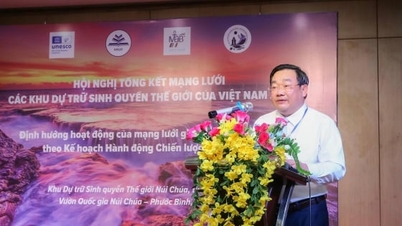
At the conference, Assoc. Prof. Dr. Nguyen Van Hien - Chairman of the Vietnam MAB Committee - stated: “Cat Ba Biosphere Reserve is a vivid testament to the efforts of the local government, management board, and local community in developing socio-economic aspects alongside nature conservation.”
The fact that Cat Ba Biosphere Reserve, one of 11 Biosphere Reserves in Vietnam, has been re-recognized by UNESCO after a rigorous evaluation process will also create momentum and a ripple effect for other Biosphere Reserves in Vietnam in fulfilling their commitments and implementing comprehensive management solutions to best promote the basic functions of a Biosphere Reserve: conservation, development, and community support.”

Assoc. Prof. Dr. Nguyen Van Hien - Chairman of MAB Vietnam - speaking at the Conference. Photo: Provided by the delegation.
He also emphasized that, during the preparation of the dossier, MAB Vietnam closely coordinated with the Management Board, the consulting unit, the leaders of Hai Phong City, the Ministry of Agriculture and Environment, and other relevant parties to ensure that the quality assessment dossier was submitted on time and in accordance with international regulations.
On behalf of the Cat Ba Biosphere Reserve Management Board, Mr. Nguyen Van Thiu - Director of Cat Ba National Park - expressed: “Today's event is a great honor. We would like to express our deepest gratitude to the Vietnam National UNESCO Committee, the Vietnam MAB Committee, the leaders of Hai Phong City, non-governmental organizations, scientists and the community for their companionship and support in enabling Cat Ba to successfully fulfill its functions of conservation, development and community support.”
According to him, in the coming time, Cat Ba Biosphere Reserve hopes to continue receiving attention from all levels, sectors, and international organizations so that it can always be worthy of being a model example of conservation and sustainable development practices.
Connecting the past, present, and future.
With its unique values, Cat Ba is not only a source of pride for Hai Phong and Vietnam but also a shared heritage of humanity. The UNESCO re-recognition of its status shows that Cat Ba has met the stringent criteria of the global biosphere reserve. The adjustment of boundaries, the increase in buffer zone area, and the transition in 2023 demonstrate flexible adaptation, ensuring both strict conservation and the development of livelihoods for the community.

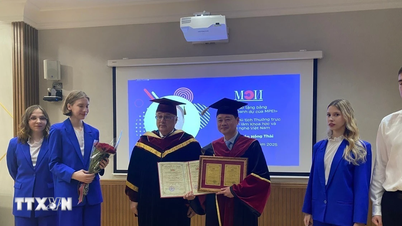
Delegates from the Vietnam National UNESCO Committee and MAB Vietnam met with Ms. Latifa Yakoubi, Chairperson of the MAB Committee of Morocco and Chairperson of the International MAB Council of the ICC, on the occasion of attending the Conference. Photo: Provided by the delegation.
Looking to the future, Cat Ba continues to affirm its position as a "living laboratory" for sustainable development, a hub for initiatives in biodiversity conservation, resource management, and the development of a quality economic model. This is a strong message about Vietnam's commitment to conservation linked to development, while also making a positive contribution to the common goals of UNESCO and the international community.
Cat Ba - a brief overview:
- The Biosphere Reserve comprises 367 small islands belonging to Cat Hai district. The adjusted area in 2023 was 26,419 hectares, an increase of 178 hectares compared to the previous assessment. The core zone decreased by 2,221 hectares, the buffer zone increased by 1,056 hectares, and the transition zone increased by 1,343 hectares.
- This area is typical of a karst landscape eroded by the sea, preserving evidence of sea level rise and fall and the history of ancient Vietnamese habitation.
Source: https://nongnghiepmoitruong.vn/quan-dao-cat-ba-tiep-tuc-giu-vung-danh-hieu-khu-du-tru-sinh-quyen-the-gioi-d775388.html





































































Comment (0)