

Once again, the seasons change, allowing the golden leaves to fall wistfully onto the streets and sidewalks. And the distant clouds, too, have a chance to gently adorn the blue sky after their wandering seasons.
We all know that everything is ever-changing, bringing new joys to life, more beautiful and enchanting destinations, and giving life the motivation to strive for better things. Each of us has a deeply cherished root, but the complexities of life have led us to hastily forget and sometimes unintentionally reject it. Then, we find ourselves bewildered, searching for those warm memories of the past whenever we have the chance to return and look back. Every house, every street corner, every row of trees. The old road to school, where we used to stop at the gate to wait for the train to pass. On one side was the train station, on the other a small flower garden. The streets were simple, the old roads narrow, but somehow my heart still aches whenever I return.
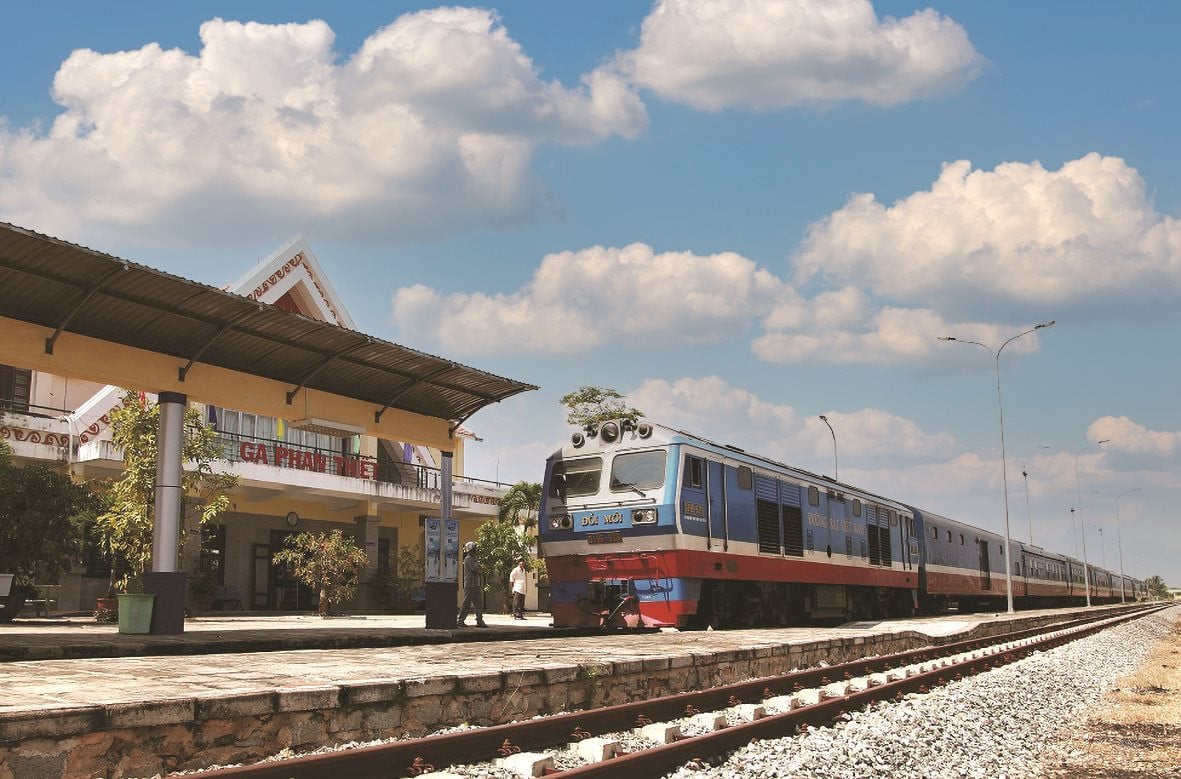
In the relatively crowded, bustling streets of my hometown back then, under the night lights, besides the central market at the Phan Thiet intersection and the Con Cha port, there was only the train station area. Shops and stalls were open almost all night, trains came and went, people boarded and disembarked, and goods of all kinds—local agricultural and seafood products—were everywhere. People were saying goodbye and welcoming each other, their farewells filling the entire station with affection. What parting doesn't bring sorrow, what separation doesn't leave a lasting impression? Those from Phan Thiet who left their hometown now have the opportunity to return to the old paths and roads, their hearts filled with nostalgia for the past, for the innocent days of walking to high school in their white uniforms. Or for the time when they were adults, after the hustle and bustle of life, they enjoyed leisurely moments or thoughtful reflections over a strong cup of coffee with close friends from the arts. And now, every time I pass by here, my heart swells with memories. We had to stop the car and walk along the road, to a spot near the center of the flower garden where a small house used to set up a coffee stall every morning. This allowed visitors to observe the entire train station area, imprinting it in their minds forever. Now, the roads are wide and spacious, the old station is gone. A straight boulevard runs from the Doi Duong beach up to the Truong Chinh bypass and the new train station. Standing here, I felt a sense of wonder, as if I could still see the old station area from days gone by. The steam locomotives pulling the trains, the air horns blaring in the night. The rows of trees on the street corners, the late-night shops. The crowds of passengers coming and going from the station gates, along with many people carrying goods, buying and selling, bringing goods from the countryside to the market or vice versa.
From the main railway line at the train station, there was also a secondary track running to Binh Quang Pagoda, crossing Nguyen Hoang and Thu Khoa Huan streets, parallel to Cao Thang street. There were only two simple guard posts made of long bamboo poles painted red and white, which were lowered and raised each time a train passed to receive goods at the end of the track. Trains at that time ran regularly on the Muong Man - Phan Thiet route day and night. Trains departed on time, regardless of the number of passengers, mainly transporting specialty goods like fish sauce, dried fish, salt, and fish sauce waste. There were only one or two passenger carriages with a few traders traveling daily; the rest were long-distance passengers transferred to Muong Man station to board long-distance trains to Saigon or Nha Trang. The small train tickets were made of thick paper, about two fingers wide, and were punched with holes after passing through the station gate and presented to the ticket inspector. One small memory from our school days is from a Sunday when we had no school. A group of five or seven of us would make a pact to walk along the railway tracks next to the houses, then wait for the train to blow its whistle and hiss before leaping onto the carriage. Since we were young, even if we got caught by the ticket inspectors, nothing would happen to us. At most, we'd receive warnings from the inspectors, who would tell us to sit inside the carriage, not on the steps or at the ends of the carriages, as it was very dangerous. Plus, they'd ask perfunctory questions about where we were going, what we were doing, and if we had tickets, even though we knew perfectly well we never had tickets. The train would leave for Phan Thiet at 5 a.m., return at 10 a.m., then come back down at 5 p.m., and return at 9 p.m. We'd just keep track of the train schedules and wander along the banks of the Muong Man River, surrounded by endless rows of bananas, plums, starfruit, guavas, and peaches growing on the ground. We were free to buy and pick as much as we wanted; the orchard owner didn't want to stop us, only gently warning us not to climb too high or break branches. Asking for a packet of salt and a few chili peppers, we took off our shirts, wrapped up all the fruit, and carried it all to the riverbank. The river was shallow this season, and under the shady trees along the bank, we enjoyed ourselves, playing and shouting along the river. The fruit was perfectly ripe, with a sweet and sour taste. Dipped in the salt and chili mixture, we chewed and wrung out, our tongues and lips tingling. After eating our fill, we all jumped into the river, swimming and searching for freshwater mussels densely packed in the crevices of the rocks along the bank. A little further upstream was the spillway, and even higher up was the Móng Bridge, the railway bridge that crossed the river for trains running to Saigon. While eating, playing, and swimming, we didn't forget to watch out for the setting sun. Turning over the clothes drying on the rocks, as the sun began to set, we hurried to the station to catch the afternoon train. The morning train carriages were still there, as if waiting for us. We rushed aboard, excitedly recounting the childhood games we had just played, and planning for the next summer Sunday. Sitting on the train, looking through the window, we saw our peaceful homeland in our childhood memories, with its rice paddies and lush green orchards on either side.
According to historical records, the Bien Hoa - Thap Cham railway was completed in 1920, and the Phan Thiet station was also finished, with a connection between Phan Thiet and Muong Man stations on this line. In 2006, Binh Thuan province collaborated to open the Saigon - Phan Thiet line to serve tourism . On April 16, 2012, the new Phan Thiet station was officially inaugurated in Xuan Tai village, Phong Nam commune. The old station was demolished and redesigned into one of the most beautiful roads in Phan Thiet city today. Nevertheless, many lingering feelings remain about the old night train station.
Source















































































Comment (0)