

After three days (from April 10 to 12) of urgent and serious work, with a high sense of responsibility, the 11th Conference of the Central Committee of the 13th Party Congress completed all the planned contents and programs and adjourned on the afternoon of April 12. General Secretary To Lam presided over the conference.
The People's Army Newspaper respectfully presents the closing remarks of General Secretary To Lam .
"Dear members of the Politburo , members of the Secretariat, and members of the Central Committee of the Party,
Distinguished comrades attending the conference,
After three days of intensive work, carried out with a high sense of responsibility, the Central Committee members discussed issues democratically, listened to each other, and frankly exchanged views on many new and important matters, reaching a high degree of consensus on key and core issues. The Central Committee unanimously approved the conference resolution. It can be affirmed that the 11th Central Committee Conference of the 13th Party Congress completed all the planned content and agenda. Many Central Committee members requested the Politburo to recognize this as a historic conference, discussing historic decisions in the new revolutionary stage of our country.
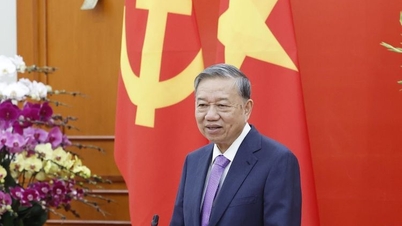
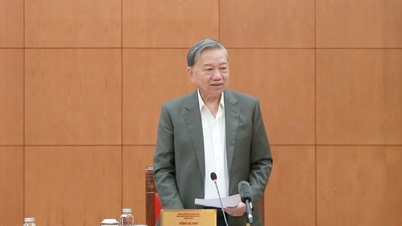
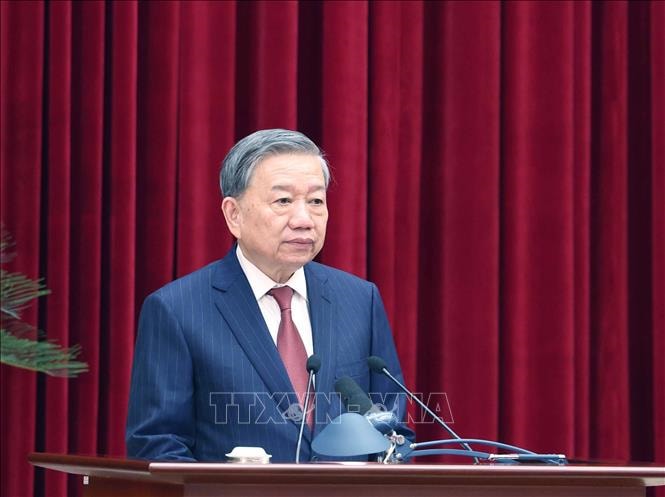 |
General Secretary To Lam delivers the closing remarks at the 11th Conference of the Central Committee of the 13th Party Congress. Photo: VNA |
On behalf of the Politburo and the Secretariat, I acknowledge, highly appreciate, and commend the positive, responsible, proactive, scientific, creative, decisive, effective, and innovative working spirit of the Central Committee; and the thorough, meticulous, focused, and improved preparation and service for the conference by the Subcommittees, the Central Party Office, and related agencies. Following this, I would like to summarize, emphasize, and conclude on a number of issues to ensure unified leadership and guidance in implementation:
Firstly, the Central Committee unanimously agreed on the proposals presented in the submissions, reports, and projects related to the work group on continuing to reorganize the political system's organizational structure, reorganize administrative units, and restructure local governments at two levels. Specifically:
The Central Committee emphasized: Continuing to reorganize the political system's apparatus is an unprecedented strategic decision with the highest goal of ensuring the rapid, stable, and sustainable development of the country, better caring for the people's lives, building a streamlined government apparatus, shifting from passive management to actively serving the people, creating development, and possessing the capacity to effectively implement the Party's policies into practical life in the era of development and prosperity.
This reorganization of local administrative units is based on a scientific, groundbreaking, and innovative approach, closely adhering to practical realities with a long-term vision of at least 100 years, ensuring the formation and expansion of a new economic, social, and cultural development space suitable for national development. The reorganized local governments must be streamlined, efficient, and close to the people, meeting the requirements of modern social governance, achieving rapid and sustainable growth; creating new momentum and strength for national defense, security, and foreign affairs; providing impetus and impetus for economic development, with a focus on promoting the private sector; accelerating the development of science and technology and innovation; and improving the material and spiritual lives of the people.
The restructuring of the Vietnam Fatherland Front and other political and social organizations and mass associations assigned tasks by the Party and State must be truly streamlined, ensuring no duplication or overlap in functions and tasks; avoiding bureaucratization of activities, focusing strongly on residential areas, being close to the people, serving the people in the spirit of "emphasizing and practicing the people as the foundation," truly acting as an "extended arm" of the Party reaching every household and every citizen; and caring for the legitimate rights and interests of members and the people.
Strictly adhere to the principle of unified Party leadership in building organizational structures, personnel work, managing the workforce, and staffing of the political system. Continue to innovate, improve, and implement synchronously and strictly regulations on personnel work at all levels, sectors, and localities according to the principles of openness, transparency, strengthening control over power, and linking power with individual responsibility. Identify, prevent, and resolutely combat and strictly handle acts of corruption, waste, negativity, disunity, seeking positions and power through illicit means, and factionalism in the process of organizational restructuring and handling public assets…
The Central Committee unanimously agreed on the following policies: Regarding the organization of local government at two levels: provincial level (provinces, centrally-administered cities) and commune level (communes, wards, special zones under provinces and cities); the number of provincial-level administrative units after mergers will be 34 provinces and cities (28 provinces and 6 centrally-administered cities) with names and administrative-political centers determined according to the principles stated in the submissions and proposals; the operation of district-level administrative units will cease after the National Assembly decides to amend and supplement some articles of the 2013 Constitution and the 2025 Law on Organization of Local Government (amended); the merger of commune-level administrative units will ensure that the number of commune-level administrative units nationwide is reduced by approximately 60-70%.
The principle of establishing Party organizations at the local level corresponding to the provincial and commune-level administrative systems is approved; the activities of district-level Party committees will be terminated; and the establishment of local Party organizations will be carried out in accordance with the Party Charter and Central Committee regulations.
Under the new administrative organizational model, the provincial level acts as both the implementing level for policies from the central government and the issuing level for policies within the province/city, directly supervising and managing the activities of the commune-level authorities. The commune-level authorities primarily implement policies issued by the central and provincial levels; they are empowered with increased decentralization and authority to issue legal documents to decide on the organization and implementation of laws within their jurisdiction and to make decisions on matters within their authority.
The principle of streamlining and consolidating the Vietnam Fatherland Front, political and social organizations, and mass associations assigned by the Party and State at the central, provincial, and commune levels, as presented in the report and proposal of the Party Committee of the Vietnam Fatherland Front and central mass organizations, was unanimously agreed upon. The principle of ending the activities of the civil servant trade union and the armed forces trade union, and reducing the trade union fee contributions of cadres, civil servants, and workers was also agreed upon. The principle of continuing to streamline the People's Courts and People's Procuracies was also agreed upon; the activities of the High-level and district-level People's Courts and People's Procuracies were terminated; and a three-tiered organizational system of People's Courts and People's Procuracies was established: the Supreme People's Court and People's Procuracy; the People's Courts and People's Procuracies at the provincial, city-level, and regional levels (the military court and procuracy system will retain its current model).
The Central Committee unanimously agreed on the principle of amending and supplementing the Constitution and laws of the State related to regulations on local government to serve the reorganization of the political system's apparatus; regulations on the Vietnam Fatherland Front and political and social organizations; ensuring completion before June 30, 2025; effective from July 1, 2025; stipulating a transitional period to ensure smooth and uninterrupted operation, in accordance with the planned reorganization and merger roadmap; the Central Committee requested the National Assembly, the Government and relevant agencies to closely and effectively coordinate the implementation of tasks related to institutional improvement.
Focus intensely on effectively carrying out these tasks, strongly innovate thinking and methods, and strive to thoroughly remove institutional barriers, difficulties, and obstacles by 2025 to create a legal framework and foundation for development, especially issues related to bidding, budget, public investment, private economy, science and technology, innovation, and digital transformation; create a solid and favorable basis for the revolution in restructuring and streamlining the organizational apparatus of the political system; remove bottlenecks and resources; promote thorough decentralization and delegation of power associated with streamlining the apparatus and ensuring effective and efficient operation; and create new development spaces for the locality and the whole country.
The development and promulgation of laws and policy mechanisms must closely follow the Party's leadership, closely monitor the practical situation and the specific characteristics of the organizational restructuring revolution, avoiding delays and missed opportunities caused by waiting for laws or mechanisms; creating a transparent, safe, and low-cost business environment; thoroughly addressing institutional "bottlenecks" to transform them into resources and competitive advantages, making Vietnam one of the leading countries in administrative reform and innovative entrepreneurship, enabling it to catch up with, keep pace with, and surpass other advanced countries.
Secondly: Regarding the group of issues related to continuing preparations for the 14th National Congress of the Party and the election of deputies to the 16th National Assembly and deputies to People's Councils at all levels for the 2026-2031 term.
Regarding the draft documents for the 14th Party Congress: The Central Committee unanimously assessed that these drafts were concisely edited (reduced by about 30%-35%), yet the content was quite complete and profound, ensuring both comprehensiveness and high actionability, enabling immediate implementation, updating, and supplementation of many major issues, and serving as a model for the development of documents by other Party organizations.
Through exchange and discussion, the Central Committee reached a high level of consensus and recognized the need to immediately implement several major solutions that had been agreed upon in the draft documents, and to concretize them in the 2025-2030 term documents of Party organizations, including: (i) Unanimity on the highest goal of the 14th National Congress is to decide on strategic issues to ensure "stability, development and improvement of people's lives"; all viewpoints, goals, tasks and solutions in the draft documents must be unified, synchronized, consistent and create a combined strength to achieve this goal. (ii) Unanimity on the high requirements of the next period are "high-quality development, rapid development and sustainable development", "proactive, self-reliant and self-sufficient in development".
From there, the Subcommittees are requested to continue reviewing the Central Committee's opinions, fully supplementing the objective difficulties and challenges faced, the long-standing shortcomings and limitations that have not been overcome over many terms, and the tasks and solutions to adapt to the new context, opportunities and challenges with new thinking and revolutionary methods, surpassing themselves to ensure proactive, self-reliant, rapid and sustainable development; at the same time, Party committees in the process of preparing and organizing the congress must focus on thoroughly discussing the tasks and solutions to continue contributing to the completion of the Party's XIV Congress documents and the documents of their own congresses. (iii) Unifying the strong determination to "establish a new growth model" and "build a modern national education system on par with the region and the world" are fundamental solutions to overcome the risk of falling behind. In the new growth model, with science and technology, innovation, and national digital transformation as the main driving forces, the private economy (including both domestic and foreign-invested private sectors) is the most important driving force of the national economy; strengthening the leadership role of the Party and state management over the private economy. At the same time, the Central Committee also unanimously agreed that in the new revolutionary period, it is necessary to focus on defining and strongly implementing the meaning of "Our Party is morality, is civilization," and model projects for "socialist" provinces and "socialist" communes.
Regarding the organization, drafting, and implementation of the Party Charter: The Central Committee discussed, commented on, and basically agreed to approve the draft Guidelines on Personnel Work of the 14th Central Committee; supplementing personnel planning for the 14th Central Committee; amending and supplementing the Central Committee's Regulations on the Implementation of the Party Charter; the Regulations on Party Inspection, Supervision, and Discipline; amending and supplementing Directive No. 35-CT/TW dated June 14, 2024, and Conclusion No. 118-KL/TW dated January 18, 2025, of the Politburo on Party congresses at all levels leading to the 14th National Congress of the Party; and the guidelines for the election of deputies to the 16th National Assembly and deputies to People's Councils at all levels for the 2026-2031 term. The Central Committee requests that the Politburo, Party committees at all levels, Party organizations, and relevant agencies promptly implement the contents that have been agreed upon and approved by the Central Committee.
Immediate tasks: The Central Committee requests that, immediately after the conference, Party committees, Party organizations, agencies, units, localities, and their leaders immediately implement the following 7 tasks:
(1) Actively and proactively do a good job of disseminating, propagating, mobilizing, and guiding ideology in your agency, unit, locality, and organization, as well as participating in guiding public opinion, ensuring high unity, consensus, and uniformity among cadres, party members, civil servants, employees, and all strata of the people regarding the Party's major policies.
(2) Focus on directing and decisively implementing the tasks of arranging and streamlining the organizational structure according to the plans and projects approved by the Central Committee.
(3) Actively carry out tasks related to arranging, assigning, and using cadres, civil servants, and public employees, ensuring the retention of talented people, and implementing good policies and regulations for those affected; fully prepare the legal basis and create the highest possible convenience for arrangement; proactively develop plans for managing, using, and handling assets, offices, and public housing, absolutely preventing loss, waste, and corruption.
(4) Ensure that agencies, units, and organizations operate continuously, smoothly, efficiently, effectively, and efficiently before, during, and after the restructuring, without interruption of work, without leaving any tasks, areas, or fields unoccupied, and without affecting the normal activities of agencies, units, organizations, and the people.
(5) Regarding the organization of congresses at all levels in merged and consolidated localities: We organize congresses at the commune and provincial levels immediately after the administrative unit rearrangement. Therefore, it is necessary to lead and direct very closely to ensure that the congresses are in accordance with regulations and are substantive, not merely 형식적인 (formalistic). The Politburo will issue a new Directive to replace Directive 35 to provide specific guidance on organizing congresses at all levels in the new spirit.
I would like to add two more points: (i) Regarding documents: Provincial-level authorities must promptly supplement and finalize their Congress documents based on the new draft documents from the Central Committee. For provinces undergoing mergers or consolidations, the Standing Committees must discuss and develop the documents for the new Provincial Congress. The documents must be developed in the spirit of the "expanded development space" of the new province. It should not be a mechanical combination of the old provincial documents into the new provincial documents. Merged communes must also follow this principle. (ii) Regarding personnel: Many comrades are concerned about personnel arrangements during mergers and consolidations, and personnel arrangements for the Congress. Central agencies will provide specific guidance on criteria and standards. I propose that the highest standard should be based on job requirements, followed by other criteria. The Standing Committee at the provincial level (in cases of mergers or consolidations) must thoroughly discuss this issue, ensuring high consensus in implementation, especially regarding the appointment of heads of agencies after the merger. For any unresolved issues, the Politburo member or Secretariat member assigned to oversee the area will provide guidance and direction (provinces should also assign provincial Party committee members to guide and direct the commune-level Party congresses).
(6) Ensure the roadmap and progress, process (especially the process of taking opinions from the community according to the grassroots democracy regulations) on amending the legal framework, on the time of ending the operation of the district level, merging communes, arranging and merging provinces as the resolution has been passed.
(7) Organize well the major commemorative activities in 2025, focusing on the 50th anniversary of the Liberation of the South and reunification of the country; the 135th anniversary of the birth of President Ho Chi Minh; the 80th anniversary of the August Revolution and National Day on September 2nd, along with commemorative activities of each locality.
The Central Committee requested the Subcommittees preparing for the 14th National Congress to quickly incorporate additional feedback and refine the draft documents (especially the section on socio-economic development orientation for regions and localities after mergers) to be sent to Party congresses at all levels for discussion and feedback, and to further refine the draft documents and report to the Central Committee at the 12th Central Committee meeting for discussion and feedback from cadres, Party members, and the people.
Immediately following this conference, the Central Steering Committee for the Review of Resolution 18 will meet to concretize the necessary tasks, develop a plan and roadmap for implementing the tasks in the coming period, and assign members of the Politburo and the Secretariat to direct, guide, inspect, and supervise. Also next week, the Politburo and the Secretariat will organize a national conference of cadres to disseminate and unify understanding and methods throughout the entire political system regarding the policies adopted at the 11th Central Committee Conference.
The Politburo will also soon issue resolutions on reforming the work of lawmaking and enforcement to meet the requirements of development in the new era, and a resolution on the development of the private economy to create new momentum, along with Resolution No. 57 on breakthroughs in science and technology development, innovation, and national digital transformation, and Resolution No. 59 on international integration in the new situation, with the determination to achieve the GDP growth target of 8% or more by 2025, creating a foundation for continuous double-digit growth in the following years. The goal is to achieve the target of Vietnam becoming a developed country with modern industry and high middle income by 2030; and a developed country with high income by 2045.
Comrades,
The tasks ahead are immense, the realities of life demand urgent action, the people and Party members are eagerly awaiting, and the tasks ahead are heavy and difficult. I believe this is a great challenge, but also an opportunity for each member of the Central Committee to demonstrate their sense of responsibility to the Party, the country, and the people. The Central Committee believes that, by upholding the tradition of unity, resilience, and indomitability of the nation, under the skillful and wise leadership of the Party, and with the collective efforts and dedication of the entire Party, people, and army, we will certainly overcome all difficulties and challenges, and successfully achieve the goals and targets set forth. We will certainly succeed.
At the closing of the conference, I wish you and your families good health, happiness, and the successful completion of all assigned tasks.
VNA
* Please visit the Politics section to view related news and articles.
Source: https://baodaknong.vn/phat-bieu-be-mac-cua-tong-bi-thu-to-lam-tai-hoi-nghi-lan-thu-11-ban-chap-hanh-trung-uong-dang-khoa-xiii-249188.html

![[Photo] Prime Minister Pham Minh Chinh presides over a meeting on private sector economic development.](/_next/image?url=https%3A%2F%2Fvphoto.vietnam.vn%2Fthumb%2F1200x675%2Fvietnam%2Fresource%2FIMAGE%2F2025%2F12%2F20%2F1766237501876_thiet-ke-chua-co-ten-40-png.webp&w=3840&q=75)


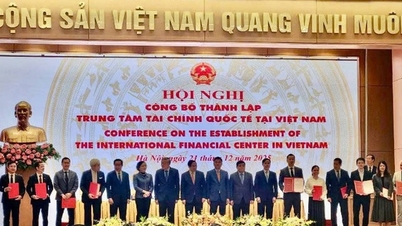
![[Photo] Prime Minister Pham Minh Chinh presides over the conference announcing the establishment of the International Finance Centre in Vietnam.](/_next/image?url=https%3A%2F%2Fvphoto.vietnam.vn%2Fthumb%2F1200x675%2Fvietnam%2Fresource%2FIMAGE%2F2025%2F12%2F21%2F1766309817714_ndo_br_dsc-3400-jpg.webp&w=3840&q=75)

















































Comment (0)