

(CLO) Astronomers have just discovered a gigantic superstructure in the universe, whose size far exceeds any galaxy cluster that has ever been accurately measured before.
Named "Quipu," this structure comprises 68 galaxy clusters, with a total mass of approximately 2.4 × 10^17 solar masses, spanning 1.4 billion light-years – significantly larger than the Great Sloan Wall (1.1 billion light-years), which was once considered one of the largest structures in the universe.
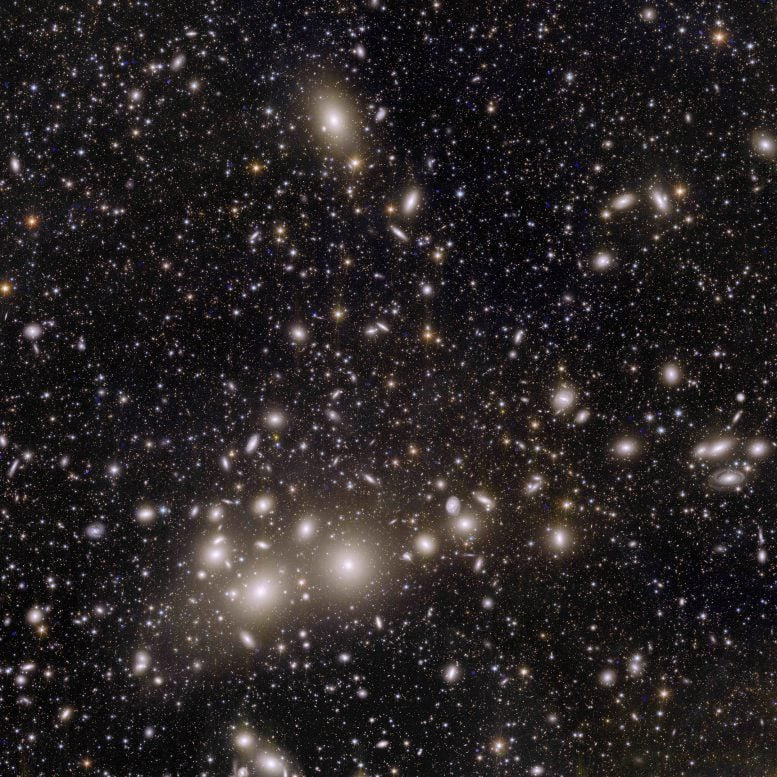
Approximately one thousand galaxies form a single galaxy cluster. Image: ESA
The research team, led by Hans Böhringer from the Max Planck Institute for Extraterrestrial Physics, discovered Quipu based on data from the ROSAT X-ray satellite.
By analyzing the energy radiation emitted from galaxy clusters, they created a three-dimensional map of how matter is distributed in the universe. Observing the region 416 to 826 million light-years from Earth, they discovered a massive structure stretching from north to south, in the shape of a long chain with many smaller branches.
Researchers named it Quipu, inspired by the knot-tying system of the ancient Incas. This name is not only symbolic but also reflects how the galaxy clusters are linked together in a particular pattern.
According to cosmological principles, if the universe were observed on a very large scale, matter should be distributed relatively evenly. However, the existence of Quipu raises questions about the validity of this hypothesis.
Some scientists argue that giant structures like Quipu could shake traditional views of the universe, while others warn that previous studies may have observed too small a part of the universe and drawn misleading conclusions.
The discovery of Quipu is not only significant from a theoretical standpoint but also directly impacts how we calculate crucial parameters of the universe. Giant superclusters like this can bend light, affecting measurements of the universe's expansion rate and the Hubble constant.
This discovery shows that the universe still holds many unexplored mysteries. Astronomers expect that with further surveys, they may find even larger superstructures, helping to confirm or even change current theoretical models of how matter is distributed and the universe is expanding.
Ngoc Anh (according to Earth, SciTechDaily)
Source: https://www.congluan.vn/phat-hien-cau-truc-lon-nhat-trong-vu-tru-post336861.html


































































































Comment (0)