

Venus is known as the hottest planet in the Solar System. It possesses immense atmospheric pressure and surface temperatures hot enough to melt lead. This is why it has long been believed that Venus destroyed any spacecraft that landed on its surface during previous exploration missions. However, new research published in the journal Geoarchaeology by experts suggests that some remnants of spacecraft that once visited Venus may still remain.
Specifically, the team of experts conducted research to assess the preservation of probes on the surface of Venus. After analyzing 15 missions that launched spacecraft to approach Venus between 1965 and 1985, they concluded that at least seven probes still remain on the surface of Venus.
According to Gizmodo, although Venus shares similarities with Earth in size, mass, and composition, it has a thick atmosphere that traps heat in a greenhouse effect. The surface temperature of Venus reaches 467 degrees Celsius. Atmospheric pressure is also approximately 93 times greater than that at sea level on Earth.
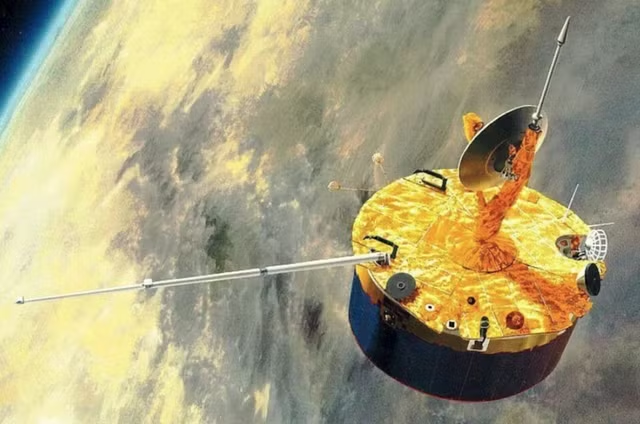
To verify the feasibility of spacecraft existence on the surface of Venus, a team led by Italian expert Luca Forasiepi attempted to study the Venus Daywalker, launched by NASA in 1978. This spacecraft was designed to collect data on Venus's atmosphere while landing on the planet's surface.
Surprisingly, this small probe was able to survive the violent impact upon landing on the surface of Venus and continue transmitting data back to Earth for 67 minutes and 37 seconds before being rendered inoperable by temperature, atmospheric pressure, and running out of energy.
However, laboratory simulations suggest that some parts of the Venus Daywalker may have survived much longer after sending its last signal back to Earth.
The Pioneer spacecraft was primarily constructed of titanium, with beryllium supports and aluminum equipment boxes inside. Tests in a simulated Venusian atmosphere showed that titanium is highly resistant. Therefore, the spacecraft likely retained much of its overall structure.
Aluminum components may also remain relatively intact due to their similar corrosion resistance to titanium. The remaining parts, such as the seals used to maintain internal pressure, may have failed after prolonged exposure to the planetary environment.
Based on these new findings, the research team believes that at least seven probes that once landed on the surface of Venus may still exist on the planet today.
These spacecraft are not only a part of the history of space exploration but also promise to provide information for future missions to other harsh and inaccessible planets.
Source: https://khoahocdoisong.vn/phat-hien-moi-ve-hanh-tinh-nong-nhat-he-mat-troi-post2149100119.html
![[Image] Close-up view of the interchange connecting the two expressways and Long Thanh Airport.](https://vphoto.vietnam.vn/thumb/1200x675/vietnam/resource/IMAGE/2026/05/25/1779703378210_ndo_br_z7863716673926-224453a31600126cce10622af6290afd-4549-jpg.webp)
![[Image] Hanoi's urban life under the challenge of a "scorching hot" environment](https://vphoto.vietnam.vn/thumb/1200x675/vietnam/resource/IMAGE/2026/05/25/1779706979265_nang-nong-t5-2026-minh-duy-7-4636-jpg.webp)



















![[GALLERY] A completely different iPhone for the 20th anniversary edition](https://vphoto.vietnam.vn/thumb/402x226/vietnam/resource/IMAGE/2026/05/25/1779686871893_212-jpg.webp)










































































Comment (0)