

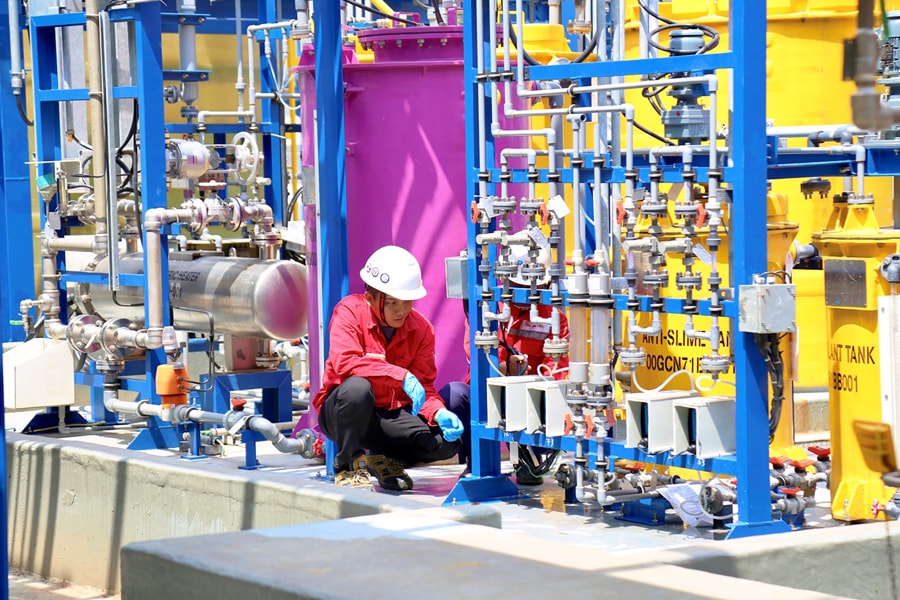
Ensuring a stable and fast power supply.
At COP26, Vietnam, along with nearly 150 other countries, committed to achieving net emissions of zero by 2050 and joined the Global Declaration on the Transition from Coal-fired Power to Clean Energy. To realize this commitment, liquefied natural gas (LNG) power generation is becoming a strategic option, contributing to energy security and emission reduction.
LNG has long been dubbed "green fossil fuel." When liquefied, the volume of natural gas is reduced by up to 600 times, optimizing transportation and storage costs. LNG is colorless, odorless, non-corrosive, and is notably the cleanest fossil fuel currently available.
Compared to traditional fuels, LNG emits 45-50% less CO₂ than coal and 30% less than petroleum. In addition, emissions of nitrogen, sulfur, mercury, and particulate matter (PM2.5) are all very low. This not only improves air quality but also reduces the risk of environmental pollution and protects public health.
In terms of safety, LNG is lighter than water, so in the event of a leak or spill, the gas will quickly evaporate and have less impact on the aquatic environment – a significant advantage over gasoline and diesel fuel.
According to energy experts, LNG power generation is not only a solution for "greening" the power system but also a pillar in ensuring national energy security. Dr. Nguyen Huu Luong from the Vietnam Petroleum Institute stated that LNG is an environmentally friendly and cost-effective solution, applicable in residential, transportation, industrial, construction, and logistics sectors.
Similarly, Associate Professor Dr. Dinh Trong Thinh, senior lecturer at the Academy of Finance ( Ministry of Finance ), emphasized that LNG power generation is an inevitable direction to ensure stable and rapid electricity supply for the economy and support energy transition in Vietnam. This is because gas-fired power plants have the ability to operate in base mode, start up quickly, and are ready to supplement and supply electricity quickly to the national power system when renewable energy sources reduce output, while also emitting less CO2.
From the perspective of residents and businesses directly affected by electricity quality, the need for a stable power grid system has always been the most pressing aspiration.
Mr. Tran Van Tinh, director of a mechanical manufacturing workshop in the Nam Thang Long Industrial Park, expressed his concerns: "With the highly automated machinery and production lines, even a few seconds of power flickering or sudden power outage can ruin an entire batch of goods in my workshop, resulting in losses of hundreds of millions of dong, not to mention the damage to equipment. We strongly support the policy of using clean energy, but above all, the power supply must be continuous and stable. Knowing that the City and the State are investing heavily in gas-fired power plants to ensure a stable supply under all circumstances, we businesses feel very reassured and confident in borrowing capital and expanding production in the coming time."
Step-by-step implementation of the energy transition goal.
With electricity demand continuing to rise, especially as many northern localities enter a period of hot weather, supplementing large-scale, stable power sources is becoming a pressing requirement for the energy sector.
In response to this situation, in the North Central region, the Quynh Lap LNG power plant project is being implemented as one of Nghe An province's key energy projects. The project is considered to play a crucial role in supplementing the power supply for the northern region in the coming years, while also contributing to the development of industrial, logistics, and port infrastructure in the locality.
The consortium implementing the project includes: Vietnam Oil and Gas Power Corporation (PV Power - a member unit of Vietnam National Energy and Industry Group), SK Innovation, and Nghe An Sugar Company Limited (NASU).
Currently, PV Power operates a power plant system with a total capacity of over 5,800MW. In 2025, the company put into commercial operation the Nhon Trach 3 and 4 power plants - Vietnam's first LNG power plants.
According to the plan, the project will be implemented in Tan Mai ward, Nghe An province, with a total investment of over 59 trillion VND and a designed capacity of approximately 1,500 MW. The project includes an LNG storage system of about 250,000 m3, a regasification system, and a dedicated port for LNG import.
Once operational, the plant is expected to supply approximately 9 billion kWh annually to the national power grid, contributing to a more stable power supply for the northern and north-central regions amidst continuously increasing demand.
The project is planned as a synchronized LNG technology chain from receiving, storage, regasification to power generation. Imported LNG will be transported by specialized vessels, received through the seaport system before being regasified and used for power generation. The project is oriented towards applying the new generation Combined Cycle Gas Turbine (CCGT) system.
According to experts, CCGT technology has a higher power generation efficiency than many traditional thermal power plants, while also contributing to reducing CO₂ emissions and other pollutants during operation. This is considered a suitable direction for Vietnam's goal of developing clean energy and its commitment to net-zero emissions by 2050.
Given the projected continued increase in electricity demand in the coming years, the development of LNG power projects is seen as one of the solutions to enhance the stability of the power system and gradually realize Vietnam's energy transition goals.
Source: https://hanoimoi.vn/phat-develop-project-electricity-gas-green-solution-for-the-electric-grid-system-889288.html




















![[Podcast] Content on drafting and issuing implementing documents for the Capital City Law 2026](https://vphoto.vietnam.vn/thumb/402x226/vietnam/resource/IMAGE/2026/05/25/1779672775296_ban-hanh-mot-so-van-ban-quy-pham-phap-luat-theo-co-che-dac-thu.png)

































































Comment (0)