

As of the morning of December 3, Philippine officials had not reported any casualties or serious damage from the earthquake in the Mindanao region, although some residents reported damage to buildings, according to Reuters.
More than 500 aftershocks have been recorded, while the Philippine Institute of Volcanology and Seismology (Phivolcs) is urging people to exercise caution when carrying out daily activities.
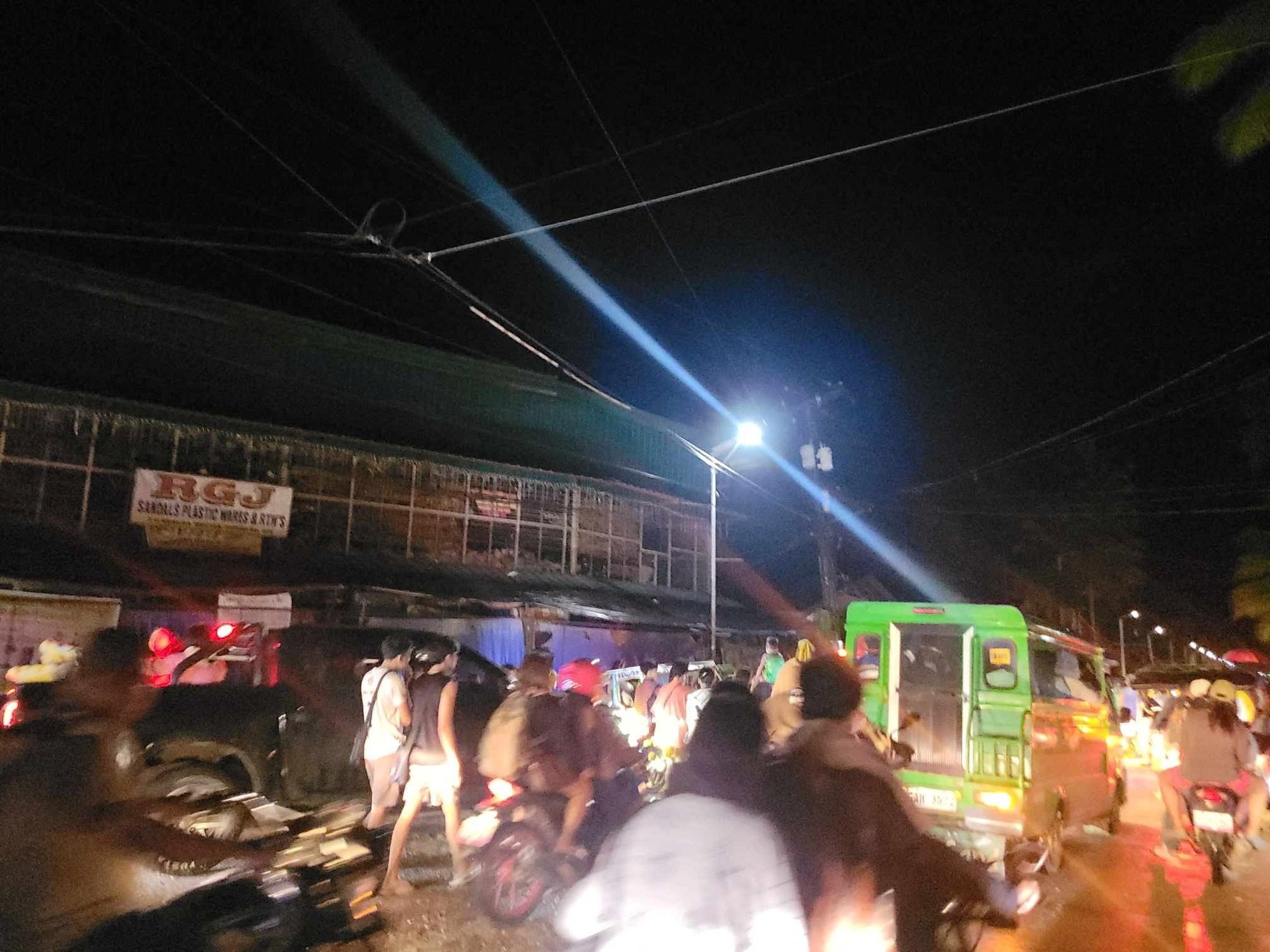
Residents evacuate in Surigao del Sur, Philippines, following the earthquake on December 2.
"The tsunami threat associated with this earthquake has now largely passed over the Philippines," Phivolcs said in a statement, but advised residents in threatened communities to heed local government guidance.
Earlier, the agency had urged residents living near the coast in the provinces of Surigao Del Sur and Davao Oriental to move further inland.
The Philippine Coast Guard has placed all its ships and aircraft on high alert for potential deployment.
Philvolcs reported that the earthquake occurred at 10:37 p.m. on December 2 (local time) in the southeastern sea off the coast of the country, with a magnitude of 7.4 on the Richter scale and an epicenter at a depth of 25 km.
According to the European-Mediterranean Seismological Centre, the strongest aftershock measured 6.5 on the Richter scale.
Philvolcs' monitoring station in Hinatuan-Bislig Bay recorded maximum wave heights of 0.64 meters due to the earthquake. The Japan Meteorological Agency said that Hachijojima Island, about 290 km south of Tokyo, recorded waves as high as 40 cm.
Earthquakes are frequent in the Philippines, a country located on the "Ring of Fire," a term referring to a chain of volcanoes encircling the Pacific Ocean that are sensitive to seismic activity.
Source link


![[Photo] General Secretary and President To Lam presides over the meeting to approve the draft report on the results of the second inspection by the Politburo of the Standing Committee of the Hanoi City Party Committee.](https://vphoto.vietnam.vn/thumb/1200x675/vietnam/resource/IMAGE/2026/05/26/1779789811432_a2-bnd-4430-9620-jpg.webp)


































































Comment (0)