

Walking through the forest, you might come across clusters of bright red rambutan, wild lychees swaying in the sun, and wild fruits silently ripening in the bushes.
Unlike rambutan trees grown in gardens, wild rambutan trees are ancient trees standing majestically in evergreen forests, reaching heights of 25-30 meters, sometimes even more. Each ripening season, clusters of bright red fruit seem to ignite the vast green landscape.
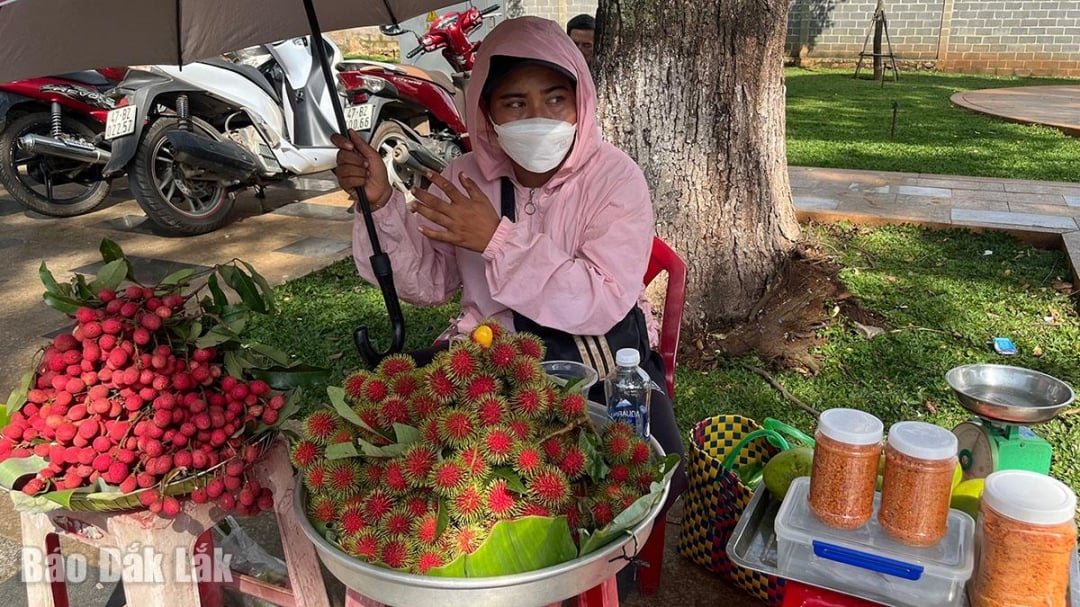 |
| Wild berries are sold in the city streets. |
The people of the Central Highlands say that eating wild rambutan requires courage. Only skilled climbers with strong arms, willing to endure the bites of large black ants, can pick them. Wild rambutans are small, with a red, hairy skin, and inside is an attractive, bright yellow flesh that emits a delicate aroma. Its taste is a mix of sweet and sour, but its fragrance is far superior to that of lychees or longans grown in orchards. For the best taste, dip it in chili salt; this combination neutralizes the sourness, leaving only a sweet, refreshing, and fragrant taste on the tongue. On hot, sunny days, a single wild rambutan is enough to cool you down, quench your thirst, and alleviate the fatigue of a long trek through the forest.
The story goes that when Westerners first set foot in the Central Highlands, they were very curious about this strange, hairy fruit. One Westerner even used a knife to cut off the outer layer of hair before daring to peel and eat it. However, it was the sweet, refreshing taste and the unusual aroma that captivated them. One even brought back rambutan saplings to plant at his home. Perhaps that's why today, in the grounds of the Dak Lak Museum, there stands a majestic, century-old rambutan tree, green all year round. And in many villages, you can still find tall, shady rambutan trees where children excitedly call each other to climb and pick the fruit, soaking it in rock sugar syrup to make a cool, sweet drink throughout the summer. Not only the fruit but also the seeds of the wild rambutan are a valuable medicine. The Ede and M'nong people used to dry the seeds, grind them into a powder to treat diarrhea and dysentery, and even use them to reduce fever and expel worms...
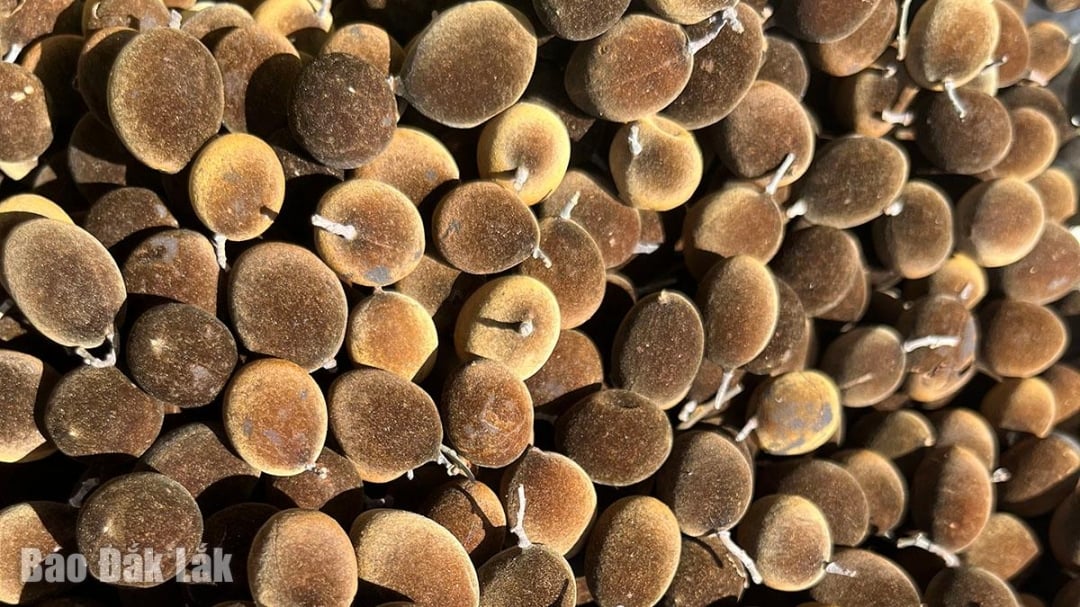 |
| Say fruit, also known as xay fruit or nhung fruit. |
Wild lychees are another gift from the vast forest. Unlike cultivated lychees, wild lychees are much smaller, turning a vibrant red when ripe. The flesh is tangy yet subtly fragrant. Since the flesh cannot be separated from the seed, people often chew on the whole fruit – allowing the sweet and sour flavors to blend, slowly dissolving, letting the forest aroma permeate every tooth and every breath.
This type of wild lychee is only "addicted" to children and young people. They sit by the stream, under the trees, peeling each fruit, dipping it in salt and chili, and... bursting into laughter. Some people take them home to soak in rock sugar, using a recipe passed down by word of mouth: one kilogram of peeled fruit, 60 grams of brown rock sugar, and half a teaspoon of pink salt, soaked for 3 hours and then refrigerated. That cool, fragrant, sweet and sour taste, a glass of it on a hot midday is truly incomparable.
Wild lychee trees are wild plants that require little care. They typically take 3-5 years to bear fruit. Perhaps it is this waiting period that makes the flavor of wild lychee so precious. Although there aren't many scientific studies confirming its specific benefits, people still believe it helps to cool the body, detoxify, and boost immunity – a natural gift that needs no advertising.
Here's another lesser-known fruit: the say fruit, also known as the xay fruit or velvet fruit – its name comes from its smooth, velvety outer skin, which is brown or apricot-yellow when ripe. When gently pressed, the skin cracks crisply, revealing a deep yellow, soft, and spongy flesh that melts in your mouth with a unique sweet and sour taste.
In the Central Highlands, people eat the say fruit as a simple, rustic snack. Children eat it fresh, while adults prepare it in various ways: say fruit simmered in sugar, say fruit coated with salt and chili, creating flavorful dishes that have become specialties of the villages. It's not just about the taste, but also about memories, something that belongs to the green forest.
Without needing any cultivation, nurtured by the sun, wind, rain, and the soul of Mother Earth, wild berries are a precious gift generously bestowed upon humanity by the forest. The wild berry season is also the season of children's joy, of bamboo baskets overflowing with berries, the season when nature is most generous.
More than just a treat, wild berries are a voice of sustainability. Centuries-old trees not only provide shade and protect the soil but also bear fruit, connecting people with the forest. Eating a wild rambutan is touching the history of the deep forest; savoring a wild rambutan is tasting the essence of the red basalt soil...
Forest fruits are not simply food, but an integral part of the Central Highlands – a place where people live in harmony with nature, preserving every tree and every ripe fruit so that future generations can still admire, taste, and call out to each other in the ancient forest: "The fruit season has arrived!"
Source: https://baodaklak.vn/du-lich/202506/qua-cua-rung-754108f/


![[Photo] Commemorating the unwavering friendship between Vietnam and Laos](/_next/image?url=https%3A%2F%2Fvphoto.vietnam.vn%2Fthumb%2F1200x675%2Fvietnam%2Fresource%2FIMAGE%2F2026%2F01%2F27%2F1769518372051_ndo_br_1-jpg.webp&w=3840&q=75)


![[Photo] Announcement Ceremony of the Art Program “Light Concert – Welcoming the New Year 2026”](/_next/image?url=https%3A%2F%2Fvphoto.vietnam.vn%2Fthumb%2F1200x675%2Fvietnam%2Fresource%2FIMAGE%2F2026%2F01%2F27%2F1769514762857_le-cong-bo-ct-hoa-nhac-anh-sang-1772-9042-jpg.webp&w=3840&q=75)


![[Hightling] Conference on the Implementation of Tasks for 2026](/_next/image?url=https%3A%2F%2Fvphoto.vietnam.vn%2Fthumb%2F402x226%2Fvietnam%2Fresource%2FIMAGE%2F2026%2F01%2F27%2F1769477856197_dsc01637.jpeg&w=3840&q=75)


![OCOP during Tet season: [Part 2] Hoa Thanh incense village glows red.](/_next/image?url=https%3A%2F%2Fvphoto.vietnam.vn%2Fthumb%2F402x226%2Fvietnam%2Fresource%2FIMAGE%2F2026%2F01%2F27%2F1769480573807_505139049_683408031333867_2820052735775418136_n-180643_808-092229.jpeg&w=3840&q=75)
![OCOP during Tet season: [Part 1] Ba Den custard apples in their 'golden season'](/_next/image?url=https%3A%2F%2Fvphoto.vietnam.vn%2Fthumb%2F402x226%2Fvietnam%2Fresource%2FIMAGE%2F2026%2F01%2F26%2F1769417540049_03-174213_554-154843.jpeg&w=3840&q=75)





Comment (0)