

Economist Vilhjalmur Hilmarsson at the Viska trade union said that prices in Iceland are now about 3% higher than in Switzerland.
According to Bloomberg , this development highlights the challenges of a small economy that frequently experiences cycles of boom and bust. The post-pandemic tourism boom, along with the relatively high incomes and purchasing power of Icelanders, has somewhat helped to alleviate the pressure from rising prices.

"Tourism contributes significantly to inflation in the service sector. Pressure from tourism has driven up wages. Another important factor is housing, which is also directly affected by tourism. Tourists are competing with locals for accommodation through Airbnb," the expert noted.
Food prices in Iceland are currently 44% higher than in other Nordic countries, which are also among the most expensive in the world. Milk and eggs are 75% more expensive, and meat is 71% more expensive. According to local media, a large glass of beer can cost up to 1,800 kronur (US$14.60), and a latte at a café can cost up to 1,000 kronur.
A recent survey by the national tourism board shows that higher costs are beginning to deter tourists.
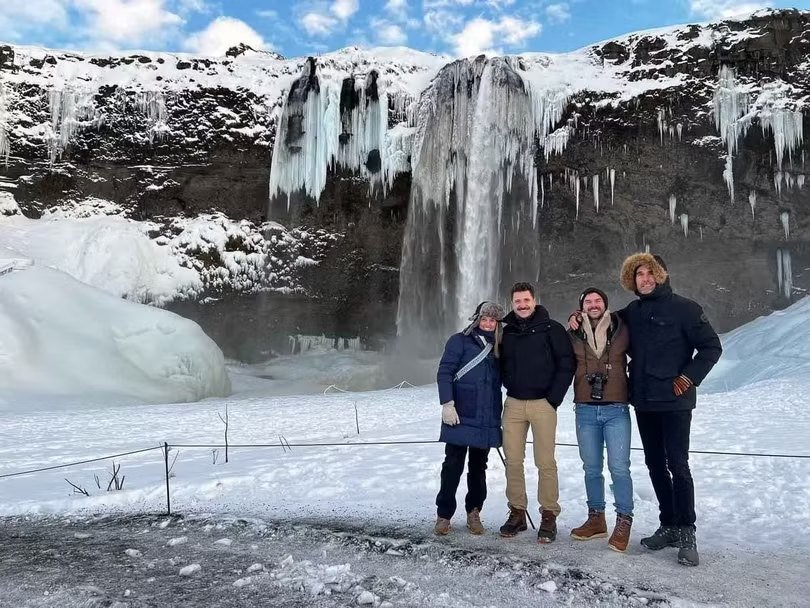
"In the long term, Iceland has failed to build efficient manufacturing sectors. We are too dependent on labor-intensive industries, which will continuously create inflationary pressure. We need to promote more economic pillars," added economist Vilhjalmur Hilmarsson.
According to data from the European Union's statistical office Eurostat, in 2018, the average consumer price in Iceland was 56% higher than in the rest of Europe, making Iceland the most expensive country on the continent. At that time, Iceland's population was only around 355,000 people.
Source: https://baohatinh.vn/quoc-gia-nao-dat-do-nhat-the-gioi-post311558.html


![[Photo] General Secretary and President To Lam presides over a meeting on preparations for the review of one year of operation of the three-tiered government system.](https://vphoto.vietnam.vn/thumb/1200x675/vietnam/resource/IMAGE/2026/06/02/1780391821195_a1-bnd-4595-9717-jpg.webp)









































































Comment (0)